

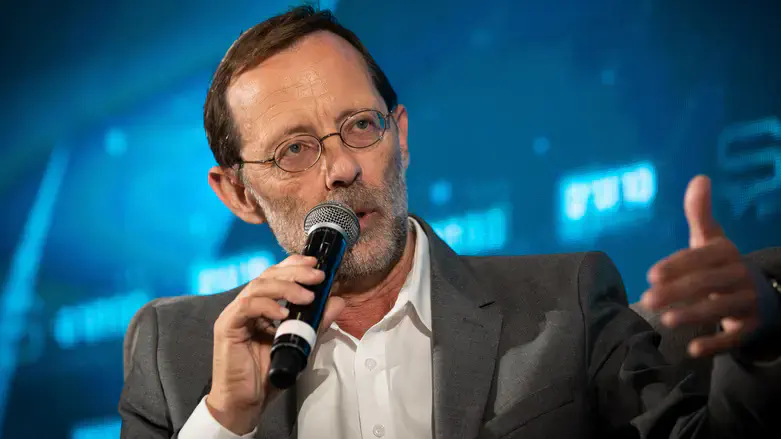
Moshe Feiglin, who holds the second spot on the Religious Zionist Party-Zehut Knesset slate, reportedly expressed willingness to join a government led by Gadi Eisenkot during negotiations with Yaron Zelekha's Economic Party, on the condition that he be appointed Defense Minister.
According to a report by Kan 11 News, Feiglin made the remarks in August during negotiations over a possible merger between his Zehut party and Zelekha's party. The talks ultimately ended without an agreement.
The report stated that participants in the discussions asked Feiglin to clarify which political partnerships he would be willing to consider.
According to sources present at the meeting, Feiglin replied: "I wouldn't rule out Eisenkot as Prime Minister either, say, in exchange for the Defense Ministry."
Zelekha was reportedly pleased with Feiglin's response, as he wanted to preserve the possibility of joining governments with different political compositions. However, the negotiations broke down shortly afterward for unrelated reasons.
Feiglin subsequently signed an agreement to form a technical alliance with the Religious Zionist Party, led by Bezalel Smotrich. Under the agreement, Feiglin was placed second on the joint Knesset list while retaining the option of operating as an independent faction in the next Knesset.
However, the written agreement between Feiglin and Smotrich includes a provision requiring both parties to support Benjamin Netanyahu for Prime Minister.
In its response to the report, Zehut confirmed that the possibility of a government involving Eisenkot had been raised during the negotiations with Zelekha, but maintained that the discussion concerned hypothetical scenarios rather than a political commitment.
"During the negotiations with Zelekha, various hypothetical possibilities were examined to establish the boundaries of each side's positions and assess the feasibility of running together," the party stated.
Zehut explained that one scenario involved forming a broad government that included Likud, in which Feiglin would serve as Defense Minister and be able to advance his policies.
According to the party, Feiglin made clear that under those circumstances, he would not oppose a rotation agreement under which Eisenkot would serve as Prime Minister for part of the government's term.
Zehut compared the arrangement to a scenario that it claimed Netanyahu himself had recently accepted.
"The entire negotiation process was terminated by Zelekha after he claimed that Feiglin was 'too right-wing,'" Zehut stated.
The party claimed that Zelekha's objections included Feiglin's positions regarding unrest within the Arab sector and security threats in hospitals.
Zehut also accused Zelekha of secretly recording his negotiating partner and subsequently releasing selective information intended to damage Feiglin politically.
"The fact that Zelekha chose to secretly record a negotiating partner and is now spreading half-truths and manipulations in a transparent attempt to harm him is disappointing, to say the least," the party said.
Zelekha's Economic Party declined to discuss the negotiations, stating: "We will not comment on the talks with Feiglin."