
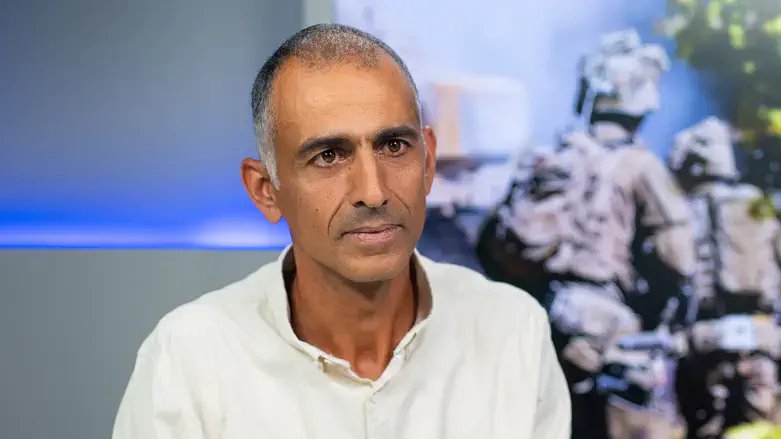
Col. (res.) Hezi Nehama, former commander of the Alexandroni Brigade and Menashe Regional Brigade and former deputy commander of the Givati Brigade, warns of the possibility of a large-scale terrorist attack originating in Judea and Samaria and calls for a fundamental change in Israel's policy toward the Palestinian Authority.
In an interview with Arutz Sheva, the first in a series examining ways to confront security threats in Judea and Samaria, Nehama explains that although the likelihood of an attack on the scale of October 7 is relatively low, there is a real possibility of hundreds of Palestinian Arabs raiding a community, farm, or hilltop.
According to Nehama, the IDF and Shin Bet's intelligence capabilities in Judea and Samaria, together with the military and civilian presence on the ground, reduce the likelihood of a mass invasion similar to the one launched from the Gaza Strip. However, he emphasizes that this does not rule out scenarios involving severe localized attacks.
Addressing the media's focus on the possibility of an invasion from Judea and Samaria toward Kfar Saba and other cities in central Israel, Nehama says that the media naturally concentrates on this scenario because it is the one it finds most troubling and alarming. However, he stresses that the proper approach must not distinguish between the blood of Jewish residents of Judea and Samaria and that of residents of central Israel.
In confronting these scenarios, Nehama says Israel must clearly define the identity of its enemy.
"We, as a country, must understand that the Palestinian Authority is an enemy. The fact that we have cooperated with them for the past 20 or 30 years is the result of misguided considerations and the fact that we have not yet dealt with the issue because of our priorities and our focus on Gaza, Lebanon, Syria, and Iran. But the next government will have to define the nature of our relationship with the Palestinian Authority and bring about its dissolution, along with everything connected to the Oslo Accords."
As a possible alternative, Nehama proposes examining Dr. Mordechai Kedar's emirates plan, which is based on local self-government by clans without armed military forces.
"We will have to move to a different plan. As an interim step, we will have to consider Moti Kedar's proposal, which speaks of emirates - areas in which the clans living there are granted self-government, but without the whole issue of an army, weapons, armored vehicles, and so on.
"We must not allow them to possess such equipment. They could turn against us, and we must already be working both to cancel the agreements with them and to collect all those weapons."
Asked whether canceling the Oslo Accords and dismantling the Palestinian Authority would provoke a harsh international response, Nehama rejected the very notion that fear of the world's reaction should dictate Israel's security policy.
"Those are October 6 questions: What will the world say if we do this or that in Gaza? What will it do if we move Hezbollah's tent? And so on. That is what guided us for 30 or 40 years, and that is what brought us to the catastrophe of October 7."
Nevertheless, Nehama clarified that any change should be implemented gradually and in coordination with the United States, while taking diplomatic constraints into account.
"We will have to move forward step by step in the face of those constraints, and the Prime Minister knows how to navigate them. Right now, in Judea and Samaria, the military and the Jewish communities are going above and beyond, but we are still living under the assumption that the Palestinian Authority and the Palestinian police will not launch an attack against us."
He continued, "I believe that, in coordination with the United States, under the right conditions, and in response to their future violations, we will have to know when to take the next step and ensure that we do not face a significant threat.
"Will we be able to collect every Kalashnikov? Probably not. Can we carry out major weapons collection operations? Can we establish that the Palestinian police will be permitted to carry nothing more than handguns? Yes. There are many steps that can and must be taken to ensure that no threat emerges from Judea and Samaria."
For skeptics who find it difficult to imagine such measures, Nehama suggests looking at what the IDF has accomplished over the past year and a half in northern Samaria.
"If we had told a British or American official that we were going to destroy the Jenin refugee camp, he would not have believed his ears. Yet today, that refugee camp no longer exists. All the refugees who were there have moved elsewhere. The military divided the camp into numerous sectors and established military positions inside it because that camp was a source of terrorism.
"In my view, that is how we should act anywhere that even begins to raise its head. If two terrorist attacks originate from villages near Jerusalem, those villages should end up looking like the Jenin refugee camp, like Lebanon, and like Gaza. That is the language they understand, and that is what they should receive."
We also asked Nehama whether the hundreds of Jewish communities scattered throughout Judea and Samaria make a military campaign in these areas more complicated than one in the Gaza Strip, particularly when the IDF would be confronting a Palestinian force armed with tens of thousands of rifles.
Nehama believes the reality is different.
"There are many armed civilians in the Jewish communities, many reservists and active-duty soldiers, civilian security response teams, and community security coordinators. The military has reinforced the communities and raised the level of security.
"We must understand that when it comes to maintaining control of territory, a farm performs missions that an entire military company cannot accomplish."
While discussing the Arabs of Judea and Samaria, Col. Nehama also urges Israel to keep an eye on Israeli Arabs, who, according to various reports, possess more than one million illegal firearms.
He says the security establishment must consider how to respond if they were to block roads or take over a community, whether simultaneously with an operation by Palestinians from Judea and Samaria or independently of one.
"After taking the positive steps in Judea and Samaria, the next government will also have to deal with removing the threats - declaring the Palestinian Authority and its army irrelevant, collecting the weapons, and doing the same with Israeli Arabs.
"Collecting the weapons is a critical step in this campaign."