

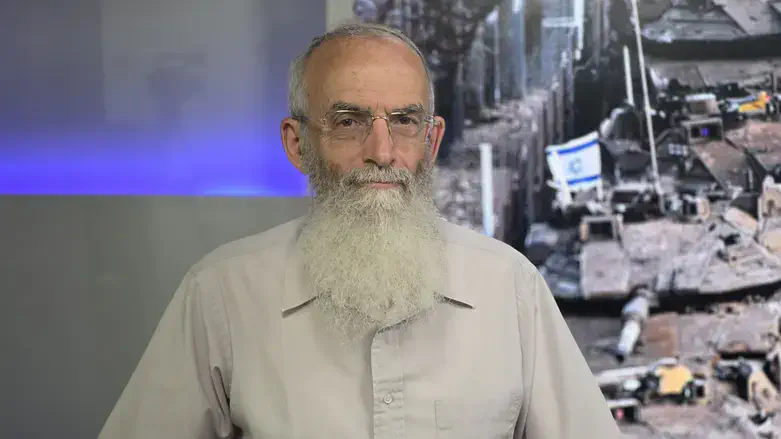
Rabbi David Stav, chairman of the Tzohar Rabbinical Organization, addressed the upcoming elections in a new episode of the Mabat Gadol podcast on Tzohar's Mashav channel.
"We have an opportunity to appoint a king. Appointing a king in our time is done by electing the leader, choosing the party, and that is a wonderful privilege," he said.
Regarding the role of rabbis, Stav said: "They are permitted to express their opinions, and it is appropriate that they do so. But they must also remember their limitations. There is no such thing here as a Torah ruling telling you whom to vote for, or that if you don't vote for a particular party, you are violating a prohibition. That's not how it works."
Rabbi Stav recalled his days at the Mercaz Harav Yeshiva.
"Rabbi Tzvi Yehuda was very supportive of the National Religious Party (Mafdal), and even gave a sermon: The Torah begins with the letter bet - 'Bereishit bara Elokim' [In the beginning, God created] - and you should vote bet [the party's ballot letter].
"I was part of a group of students who wanted to vote for Tehiya. We felt uncomfortable asking Rabbi Tzvi Yehuda whether we were allowed to vote contrary to his opinion, so we sent Moti Tau, Rabbi Tau's son, to ask his father.
"The answer was: 'Of course you're allowed to. It's not a halachic ruling. If you trust Rabbi Tzvi Yehuda's understanding of matters concerning the Jewish people as a whole, support what he's doing. If not, don't.'"
"A rabbi has no special Torah authority in this matter," Stav added. "His greatness in Torah gives him no advantage in telling you whom to vote for. You are allowed to rely on him, but not because that is the halacha. There is no clause in the Shulchan Aruch that says to vote for Party A or Party B."
Interviewer Kobi Nachshoni challenged him: "In these elections, people are voting on Shabbat, the next war, and Haredi conscription. Why can't a rabbi say to vote for Smotrich or Lieberman?"
Rabbi Stav replied: "He can say that, in his opinion, this is the most important thing for the Jewish people, but not that it is the Torah's position.
"According to halacha, it is appropriate to appoint God-fearing people to positions of significance, and yet a large proportion of the leading Torah sages supported a government headed by someone who does not observe the Torah. They weighed considerations affecting the entire Jewish people, each according to his worldview. That has nothing to do with Torah authority."
Regarding Rabbi Yitzhak Yosef's Saturday night sermons, Stav said: "Using a halachic platform to talk politics is problematic, in the sense that you are taking the Torah's name in vain.
"There is no commandment in halacha to vote for Shas, Smotrich, or Bennett. You have the right to say that Shas is the best thing for the Jewish people, and someone else has the right to say it's Eisenkot. But to say that the Torah dictates whom people should vote for? That's nonsense."
Addressing rabbis who have entered politics themselves, Stav said: "In politics, a rabbi is required to compromise and confront reality with all its complexities, and then what often happens is that he gets his hands dirty.
"Politics requires a great deal of sophistication and cunning, qualities that we don't exactly want our rabbis to be blessed with. It seems to me that most rabbis who entered politics with every fiber of their being did not emerge from it clean."