
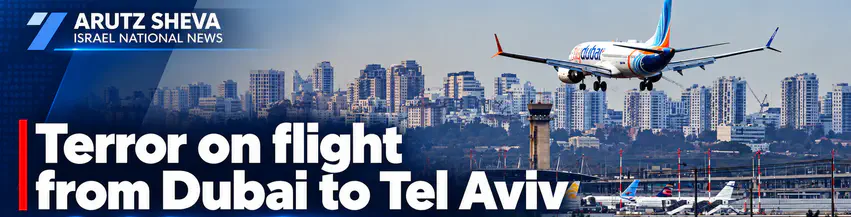


The drama that unfolded Wednesday morning aboard a Flydubai flight from Dubai to Tel Aviv demonstrated within minutes one of the most sensitive scenarios the Israeli Air Force is required to confront: a civilian passenger aircraft on its way to Israel when a concern suddenly arises that something unusual is happening on board.
Flight FZ1073 was en route from Dubai to Ben Gurion Airport when it transmitted emergency signals, including a code indicating "unlawful interference" with the aircraft. The plane changed course and ultimately landed safely in Tabuk, Saudi Arabia. Israeli fighter jets were also scrambled following the alert. Flydubai confirmed that the aircraft landed safely and that all passengers were safe.
As the hours passed, however, a more complex picture emerged. Israeli sources said the incident occurred in the cockpit, and Israel is examining the possibility that it was an attempted terrorist attack.
According to reports published throughout the day, one of the pilots attacked the other pilot, and at some point a distress signal was transmitted. However, the circumstances and motive behind the incident remain under investigation, and initial reports throughout the day presented differing accounts as to whether it was an attempted hijacking, a terrorist incident or an unusual confrontation in the cockpit.
For the Israeli Air Force, that distinction does not yet exist during the first few minutes. A civilian aircraft displaying unusual signs while heading toward Israel is first and foremost an incident that must be understood quickly - before it reaches Israeli airspace and before it becomes clear whether the cause is a malfunction, human error or a deliberate threat.
For this purpose, the Israeli Air Force has a dedicated protocol that is routinely practiced and is designed to deal with unusual incidents involving civilian aircraft heading toward Israel. One of its purposes is to prevent the possibility of an aerial terrorist attack - a scenario in which the civilian aircraft itself could be turned into a weapon for carrying out an attack.
The response is not activated only when an explicit report of a hijacking is received. From the Air Force's perspective, even signs that may initially appear less dramatic can begin the same process: an aircraft deviating from its planned flight path, a plane failing to respond to radio calls, the transmission of a distress signal or other behavior inconsistent with what is expected.
A technical malfunction can also trigger the protocol, as can a medical emergency involving a passenger that requires an emergency landing. The reason is simple: During the initial moments, forces on the ground do not necessarily know what is behind the irregularity. They must quickly determine what is happening aboard the aircraft while simultaneously preparing for the more serious possibility.
The system relies on a continuous aerial situational picture and forces kept on alert that can rapidly transition from routine operations to operational activity. All relevant units monitor the airspace, look for irregularities and attempt to quickly close the gap between the first indication that something is wrong and an understanding of the incident.
When the protocol is activated, measures designed to protect Israeli airspace begin. Depending on the circumstances and the situation assessment, this can include closing the airspace and scrambling fighter jets to identify and escort the civilian aircraft.
Scrambling fighter jets is therefore only one component of a broader response. At the same time, a situation assessment continues in an effort to determine who is in control of the aircraft, what caused the unusual behavior and whether it poses a danger. As additional information becomes available, a clearer picture is developed on which decisions can be based.
This is precisely the type of incident the Air Force routinely practices for. The emphasis during drills is on closing operational loops within short periods of time and making decisions under conditions of uncertainty. Forces must rapidly move from detecting an irregularity or suspicious sign to understanding the situation and activating the appropriate response.
The Flydubai incident also demonstrated why activation of the mechanism cannot itself be considered proof that a terrorist attack is underway. During the morning, before the details became clear, Israeli security sources assessed that there was no verified information indicating a hijacking and that a violent incident aboard the aircraft was being investigated. Later, the possibility that it had been a deliberate act gained strength in Israel, but the circumstances continued to be investigated.
This is also why the Air Force treats every irregularity as a potential threat until the concern has been ruled out. Over the years, the protocol has also been activated because of technical malfunctions, communications problems, deviations from flight paths and human errors by flight crews. From an operational standpoint, there is no possibility of assuming in advance that an aircraft failing to respond or deviating from its route is doing so for an innocent reason.
On Wednesday morning, that concern took on particularly tangible form. A civilian aircraft en route to Ben Gurion Airport transmitted a signal raising concerns of unlawful interference, changed course and prompted the scrambling of fighter jets. Ultimately, it landed safely in Saudi Arabia and its passengers were safe.
Behind those dramatic minutes lies the defensive approach that the Air Force repeatedly seeks to practice: not waiting until the full picture becomes clear, but identifying the irregularity, rapidly building a situational picture and being prepared to transition from routine civilian aviation to an operational response.
Sometimes, the incident will ultimately prove to have been caused by a malfunction or human error; in another case, the threat could be far more serious. Until the answer is clear, from the Air Force's perspective, the incident remains open.