

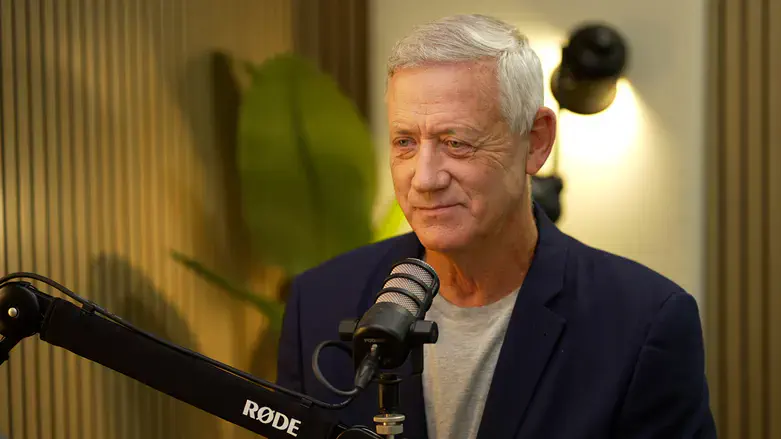
Less than a month before the election, Blue and White chairman Benny Gantz is campaigning under difficult circumstances, with polls placing his party below the electoral threshold and growing questions about whether he should withdraw. Gantz, however, says what he sees on the ground is very different from what the polls suggest.
“I’m out in the field a lot, and sometimes I genuinely struggle to explain the gap between what I’m seeing on the ground and what I’m seeing in the polls," Gantz tells Arutz Sheva - Israel National News in an exclusive interview. “People want to vote for us, but they are afraid of the electoral threshold. I tell people: don’t be afraid. We’re going to pass it."
Gantz believes that once Blue and White is shown crossing the threshold, its support could rise rapidly. “If we cross, and I believe we will, you’ll see exponential growth," he says, pointing to a previous election in which Blue and White won eight seats despite facing similar calls to withdraw.
But his campaign is about more than keeping his party in the Knesset. Gantz argues that Israel needs to break out of the traditional political blocs and establish a broad Zionist government built around the center.
“The blocs are locking up Israel," he says. “We need a Zionist government that crosses the blocs, takes four or five key issues and moves them forward. Otherwise, we’ll remain trapped in small-scale politics. The people are being torn apart, society is being torn apart, and Israel cannot truly advance."
Gantz says he supports political change but rejects the idea that simply switching the coalition and opposition would be enough. “If the opposition moves into the coalition and the coalition moves into the opposition, nothing has really changed," he says. “It’s simply the same struggle."
He also calls for an end to the political focus on “only Bibi" versus “not Bibi," saying voters should instead consider what Israel needs. “Look at what the country needs, look at what you need, look at what your children need," he says.
Gantz is openly critical of Prime Minister Benjamin Netanyahu, saying he believes Netanyahu should leave office and linking the social divisions that preceded October 7 to his political leadership. “The social situation in Israel, and the weakness we reached because of it, was the product of a political reality he created," Gantz says. “We paid the price for that on October 7."
At the same time, Gantz says the election should not be reduced to a referendum on Netanyahu. He recalls the bitter divisions visible in Israeli society before October 7 and contrasts them with the unity that followed the Hamas attack. “Two weeks later, people were coming together to provide meals for soldiers," he says. “We don’t have the luxury of continuing this way. There is right and there is left, but Israel comes first."
He says the next government should therefore be “built from the center outward," while drawing a clear line against National Security Minister Itamar Ben-Gvir. “In my view, Ben-Gvir is sawing through the branch of Zionism as we know it, the branch on which the State of Israel was established and on which it continues to exist," Gantz says.
Gantz also defends his decision to join the government after October 7, saying the national emergency left him with little hesitation. “The decision was very, very easy, in the sense that the need was so overwhelming that there was no dilemma," he recalls. “I told people that even if this were the last thing we ever did in politics, we should do it because that was what was needed."
Describing his meeting with Netanyahu during the first days of the war, Gantz says, “I understood that there was no choice. Israel needed an emergency government. It wasn’t political partnership that brought me there. It was a partnership of fate."
Gantz says he does regret leaving the government, primarily because he believes it gave greater space to extremist voices, but rejects the suggestion that his political calculations determined either his entry or exit.
On the war itself, Gantz says Israel must recognize both the failure of October 7 and the achievements that followed. He praises IDF commanders, including Chief of Staff Herzi Halevi, while arguing that the fighting in Khan Younis and Rafah should have moved faster, that the hostages should have received greater priority, and that Israel should have shifted its attention to the northern front sooner.
Looking beyond the war, Gantz says Israel cannot allow hostile forces to rebuild military capabilities near its borders. “We cannot afford to allow the possibility of an invasion near our borders," he says, arguing that Israel must maintain forward security zones and prevent threats from being rebuilt in Gaza, Lebanon, Judea and Samaria, and the Golan Heights.
On the issue of haredi military service, Gantz advocates requiring those who are not studying Torah full-time to serve, while creating service and volunteer frameworks that allow haredim to maintain their identity. “I don’t want to change the haredim," he says. “People will come as haredim, serve as haredim, and leave as haredim. Israeli society cannot afford to give up on the haredim, and Israeli society does not need to give up on the haredim."
Gantz acknowledges the fundamental difficulty facing his campaign: he is calling for a broad political center while his own party is struggling simply to enter the Knesset. But he insists that his political project extends beyond the immediate election. “I’m not sure we’ll finish this event in one round. I just know that Israel has no future besides this."
Asked what keeps him in politics despite the polls, Gantz returns to his family. He says his children were among the reasons he entered politics, because they wanted to know what would happen to Israel.
“What happens here depends on this unity," he says. “With this unity, you can do everything. Without it, you can do nothing."