

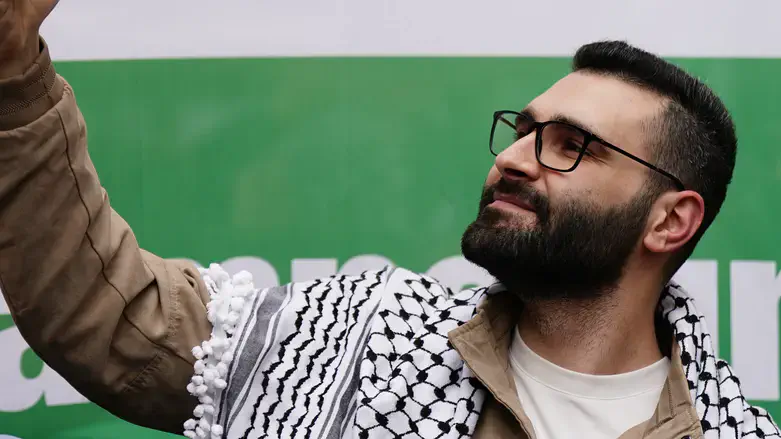
Palestinian Arab photographer Motaz Azaiza says he possesses footage from October 7 that he did not publish, including recordings showing Gaza residents beating and assaulting hostages in the Gaza Strip.
According to Azaiza, the decision to keep the material off the internet was deliberate: He feared that the footage would help Israel identify those involved and take action against them.
In an interview with journalist Ahmed al-Bikawi’s Taqarrab podcast, Azaiza recalled what he witnessed that day. He said he saw a vehicle belonging to the Izz ad-Din al-Qassam Brigades in which hostages who had been brought from Israel into Gaza were being held.
“People came out, looked at them, beat them and assaulted them, and I followed them and filmed," he recounted. Despite documenting what was happening, Azaiza decided not to upload the footage. He explained that he believed Israeli security officials could use it to identify the people who appeared in it.
“I knew Israel would use these videos to identify every person who was there and eliminate them," he said. “I did not want to be responsible, even indirectly, for the deaths of those people in exchange for a few likes and views online."
Azaiza was included in Time magazine’s list of the 100 most influential people in 2024. In the same interview, he also elaborated on the conditions under which media personnel operate in the Gaza Strip. He described a system in which criticism of Hamas can result in pressure, including physical harm, and retaliation against the journalist who publishes it.
One of his revelations concerns a WhatsApp group called “Smart." According to Azaiza, its members include journalists from Gaza, and it is managed by a media figure affiliated with Hamas. He said the group was also used to organize attacks against media personnel who dared to publish criticism of the organization.
“Photographers in Gaza have become accustomed to lowering their cameras the moment someone says something bad about Hamas," he claimed.
Azaiza’s account of “Smart" was also the focus of a New York Post article, which placed his remarks within a broader picture of how the media has operated in the Gaza Strip over the years.
According to the newspaper, since Hamas took control of Gaza in 2007, local journalists have been forced to work under restrictions imposed by the organization, with violations potentially exposing them to harm. The Post claimed that some of this reality and awareness of its existence, disappeared somewhere between the collection of material in Gaza and its publication by Western media outlets.
One example cited by the newspaper was a meeting held by the Hamas Interior Ministry in 2013 for journalists and online activists. According to the article, participants were told during the meeting that the role of the media was “no less important than that of the resistance on the ground."
During the war following October 7, the Post claims, there were cases in which journalists were subjected to various forms of pressure. The newspaper describes at least three cases in which Gazan reporters said they were beaten or threatened by Hamas members after reporting on residents who blamed the organization for the destruction in the Gaza Strip. According to their accounts, they were ordered to stop reporting such critical voices.
According to the New York Post, the implications extend beyond the borders of the Gaza Strip. International media outlets have for years relied on local journalists and other personnel to obtain footage and provide coordination and translation. However, when the information reached newsrooms abroad, the pressures that influenced what could be filmed and published were not necessarily apparent to readers and viewers.
The New York Post concludes that Azaiza’s revelation once again raises questions about how information from Gaza has been gathered and transmitted over the years and about its veracity. Among other things, the newspaper raises the question of how many American and international media outlets use members of SMART as local “fixers" who assist foreign journalists in arranging meetings and translating from Arabic into English.