

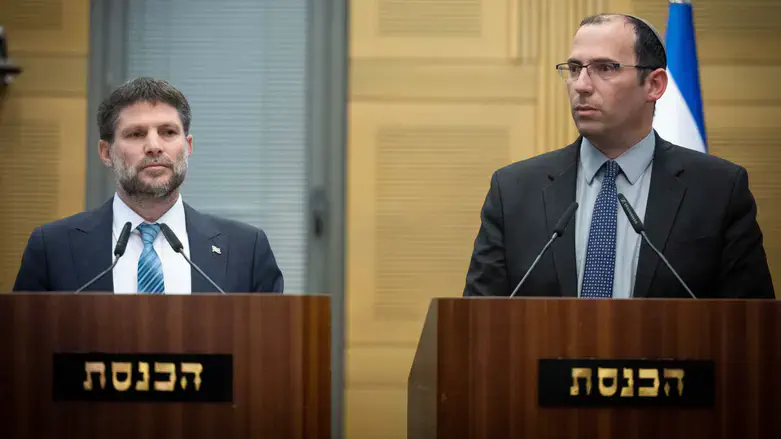
The Religious Zionism party, headed by Minister Bezalel Smotrich, unveiled on Tuesday a comprehensive plan for changes to the judicial system and for regulating relations between the Knesset, the government, and the judiciary.
The party announced that implementation of the plan will be a prerequisite for joining the coalition in the next Knesset term.
The plan is being spearheaded by Knesset Constitution, Law and Justice Committee Chairman MK Simcha Rothman. According to the party, its goal is to maintain an independent and professional judicial system alongside a government and Knesset capable of exercising their powers, while establishing rules governing relations between the branches of government, increasing oversight and transparency, and protecting individual rights.
One of the plan’s central components is completing the division of the Attorney General’s role, so that alongside a legal adviser who would serve in a position of trust under the government, an independent prosecutor general would be responsible for criminal proceedings. The plan also proposes turning the legal advisers in government ministries into positions of trust appointed by the ministers and regulating responsibility for investigating prosecutors.
Regarding the Supreme Court, the plan proposes holding public hearings for judicial candidates and selecting the Supreme Court President and Deputy President through a secret ballot of all judges in Israel.
It also proposes determining judicial panels through a computerized random-selection mechanism. The party notes that ten Supreme Court justices are expected to be appointed during the coming Knesset term.
The plan also includes regulating constitutional judicial review and an override clause, restoring restrictions on standing, and establishing procedural rules for High Court of Justice proceedings. Regarding appointments, the party seeks to abolish appointment committees, expand the authority of the government and ministers to appoint senior officials, and open senior positions in the State Attorney’s Office to external tenders.
Another chapter deals with individual rights and proposes limiting the duration of investigations and criminal prosecutions, eliminating the state’s ability to appeal an acquittal in criminal proceedings, and abolishing the offense of breach of trust. It also proposes expanding the broadcasting and recording of court proceedings and strengthening oversight mechanisms for the judicial and prosecution systems.
The electoral system and regulation of Knesset activity are also included in the plan. Proposals include lowering the electoral threshold, introducing an expanded surplus-vote agreement, adopting a semi-open ballot that would allow voters to influence the ranking of candidates on a party’s slate, changing the mechanism governing parliamentary immunity, and postponing criminal proceedings for certain offenses against prime ministers and ministers until after they leave office.
Smotrich said that the appointments expected during the next Knesset term to the Supreme Court and to the positions of Attorney General and State Attorney “will shape the State of Israel for years to come."
“Therefore, when the next government is formed, we will demand the implementation of the plan that will change the rules of the game: The government will be able to govern, the Knesset will be able to legislate, and the judicial system will operate solely within the bounds of its authority," he said.
Rothman described the initiative as “a foundational plan to put Israeli democracy back on track."
“This will not happen if all decisions are made by a deep state of bureaucrats and judges whom no one elected and no one will elect," Rothman said. “Only our plan will ensure that sovereignty is returned to the people and will fix the judicial system so that the citizens of Israel receive justice."