

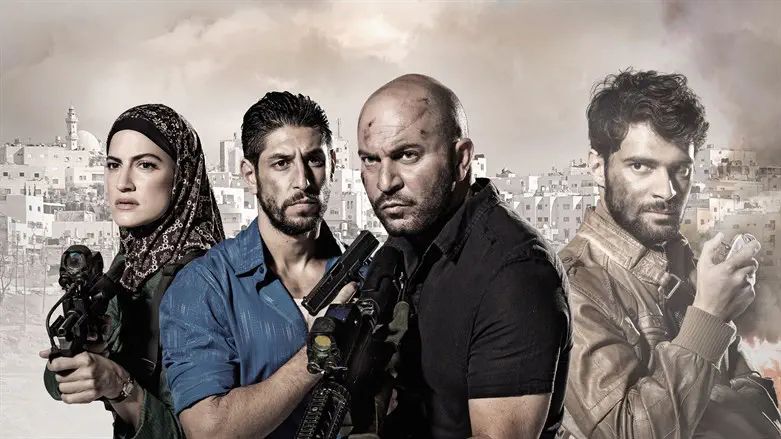
The fifth season of the Israeli television series "Fauda" is generating powerful reactions from viewers around the world after dedicating several episodes to the October 7 massacre.
Episodes seven and eight focus specifically on the Hamas-led attack and have prompted viewers in countries including Italy, India, England, the United States and Brazil to describe the episodes as deeply disturbing and unusually realistic.
Within 24 hours of its release on Netflix, "Fauda" Season 5 had climbed to seventh place among the platform's 10 most-watched shows in 43 countries.
Brazilian cartoonist Luciano Pires wrote that the new season was particularly difficult to watch because its depiction of October 7 differs from a conventional fictional drama.
“I watched the fifth season of ‘Fauda.’ It has always been an unsettling series. But the fifth season is particularly shocking and painful. Episodes 7 and 8 recreate the October 7 massacre, making them far more difficult to watch than a fictional drama. After all, we have all seen dozens of real videos from the attack, many of them filmed by the terrorists themselves, and they were horrifying enough. But this time, the fictional work takes us directly into the horror."
Pires focused on the personal connection that members of the Israeli cast and production team have to the events portrayed in the season.
“I was genuinely horrified, not only by watching the massacre through the eyes of the victims, but also by thinking about the Israeli actors, many of whom are Jewish. The image accompanying this post shows actor Yaakov Zada Daniel, who plays the operative Eli, as he enters his home in a kibbutz attacked by Hamas terrorists. It is a breathtaking moment. He was not acting out a scene about a distant tragedy; he was recreating on camera an event that struck his country, his family, his friends, and the series’ own production team. Idan Amedi, an actor in the series, was seriously wounded during the fighting in Gaza. Matan Meir, a member of the production team, was killed in the war."
“Perhaps that is why these episodes have a different quality. They do not feel like an attempt to imagine the horror. They take us directly into it."
The episodes have also sparked intense responses from viewers in Italy. One viewer wrote, as quoted by JPost, “I could barely keep my eyes open." Another said the series might help people understand the atrocities committed by Hamas on October 7, while expressing doubt that it would change everyone's views. The viewer emphasized that her friend was neither Jewish nor Israeli.
An influencer from India described being unable to sleep after watching the episodes.
“Sleepless nights. Can someone please erase my memory of this episode?? I can’t stop thinking and worrying. Episode eight of ‘Fauda’ really disturbed me. I don’t understand how there are still Hamas supporters among us. God, please help me get over this series."
Another viewer replied that, despite being a major fan of "Fauda" and Israel, he did not have the courage to watch the fifth season.
Viewers elsewhere offered similarly emotional reactions. One, stressing that he was neither Israeli nor Jewish, wrote, as quoted in Ynet, “I cried my soul out. I usually don’t cry at shows or movies."
Another non-Israeli viewer wrote, “Honestly, I couldn’t speak for the entire two episodes and for a while afterward. Everything felt far too real. No Hollywood production comes close to this."
A non-Jewish American viewer praised the season, writing that it had done “an excellent job" despite the difficulty of watching it.
“As difficult as it is to watch, it is incredibly important for people to see what Israel went through and is still going through," she wrote.
A viewer from England wrote, “Episodes 7 and 8 broke me. I cried a lot. The season is definitely different from the previous ones, but I still enjoyed it."
Another viewer said, “This is the first time I’ve had an anxiety attack while watching a television series," adding, “I can’t imagine what it is like for people who actually went through this."
The international response has surprised the show's creators. Lior Raz, co-creator and star of "Fauda," told Ynet that the scale of the reaction exceeded expectations.
“The success on this level surprises us," Raz said. “We did not expect the intensity of the response around the world, or what we are seeing on social media, and certainly not what is happening with Fauda in Arab countries."
He said the response to the episodes dealing with October 7 was particularly meaningful.
“The reactions to the episodes about October 7 are especially moving. Our intention, as always, was to create a high-quality television series, a season that would take Fauda another step forward, and at the same time tell the world what the State of Israel went through and experienced in the October 7 massacre."
“We are very proud that Fauda is reaching homes all over the world. This is much more than ratings."
Avi Issacharoff, Raz's co-creator, said the production sought to convey to international audiences an experience that was deeply familiar to Israelis.
“Our hope was to bring the entire world a story that burned inside us and inside every Israeli who experienced October 7," he said. “People always say, ‘An outsider won’t understand.’ We hope that this time, outsiders will understand a little better."