

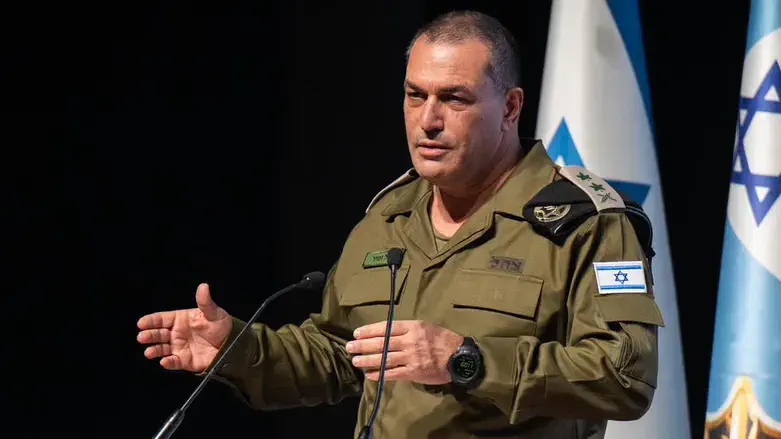
First report: The parents of soldiers in the Hesder platoon of the Givati Brigade’s Rotem Battalion are appealing to IDF Chief of Staff Lt. Gen. Eyal Zamir and demanding his intervention in an affair that ended with soldiers being sent to military jail.
In a letter titled “Crisis of Confidence and Command Failure in the Rotem Battalion: A Call for an Emergency Meeting," they also demand an urgent meeting with him and declare, “As things stand right now, there is no trust in the Rotem Battalion."
The parents begin by describing their sons’ service and seek to reject the way they say the soldiers have been portrayed in the media. According to them, these are outstanding soldiers who finished first in the training-units test among all IDF brigades, fought in Lebanon and Gaza, and during their first baptism of fire, eight soldiers were wounded, three of them critically.
However, according to the parents, the central issue is not the dispute over the female paramedic entering the armored personnel carrier, but rather a deeper crisis of confidence between the soldiers and their commanders.
“Anyone who has served in a combat role knows that trust is a critical link: the soldier places his trust in his commanders - and they in him. Breaking that trust undermines the military’s most basic ability to issue an order and have it carried out," they wrote.
They claim the crisis began even before the paramedic incident, during a training exercise held on Shabbat, August 8, which they described as an incident in which the soldiers were forced to violate Shabbat while being told that the exercise had been approved by the brigade rabbinate.
This week, the IDF confirmed in a response to Arutz Sheva - Israel National News that there had been no operational reason to conduct the exercise during Shabbat and that the brigade rabbi had not been informed about it.
The parents argue that the earlier incident directly affected the way the soldiers subsequently received the instruction to enter the armored personnel carrier with the female paramedic. “When the same pattern repeated itself, and the soldiers were called upon to deviate from the Joint Service Order on the claim that everything had been approved by the rabbinate, it is hardly surprising that they found it difficult to trust what they were being told," they wrote.
In the letter, the parents also sharply criticize the punishments imposed on the soldiers, describing the punishment policy as “scandalous." According to them, instead of the system taking responsibility for the command failure and working to restore trust, it chose “collective punishment to the fullest extent of the law - prison sentences and prolonged denial of leave."
The parents further claimed that some soldiers were punished merely for expressing an opinion, even though they had not been present at the incident, and that the legality of the move is questionable. They said the affair could have ramifications far beyond the platoon itself, at a time when thousands of yeshiva students and Torah-observant Jews are examining whether they can serve in the IDF while remaining faithful to their beliefs.
“The incident in which we currently find ourselves has the potential to cause enormous damage to the IDF - the army of us all," they warned. They added, “There cannot be a situation in which soldiers are imprisoned because of their justified struggle against the trampling of the Joint Service Order and the betrayal of their trust on matters that touch the very core of their beliefs."
At the end of the letter, the parents place responsibility directly on the Chief of Staff’s office. “After the soldiers’ immediate commanders failed throughout this entire process and no longer enjoy our trust, we turn to you, Commander, and place the burden of that trust in your hands, along with the privilege of bearing it," they wrote.
“We have complete confidence that you will hear our voice, intervene in this matter, and deliver justice where our sons have been wronged," the parents added, making clear that they expect the soldiers to be released immediately.
They concluded their letter by calling on Zamir to meet with them and examine how, in their words, it is possible “to restore trust and prevent the continuation of the severe damage being caused to the IDF as a whole."