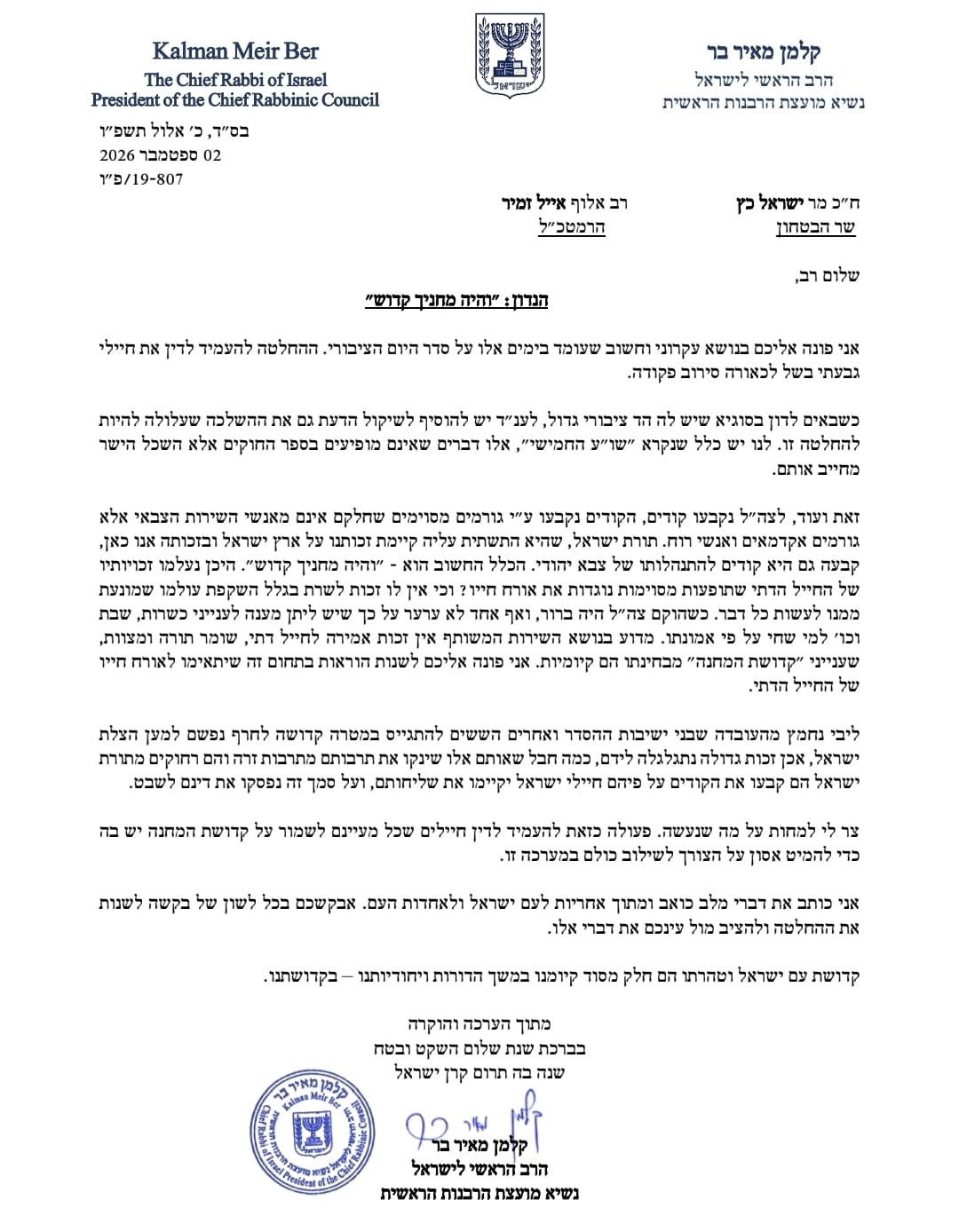
Israel’s Chief Rabbi, Rabbi Kalman Meir Ber, appealed to IDF Chief of Staff Eyal Zamir and Defense Minister Israel Katz, demanding that they reverse the decision to put Givati Brigade soldiers on disciplinary trial following an incident in which soldiers from the Rotem Battalion refused to enter a Namer armored personnel carrier in which a female paramedic was present.
In a strongly worded letter, Rabbi Ber argued that the handling of the incident does not sufficiently take into account the lifestyle of religious soldiers and the principle of “the sanctity of the camp."
Rabbi Ber asked the Chief of Staff and Defense Minister to examine the incident not only through the lens of military orders and regulations, but also with consideration for common sense and the broader implications of the decision. “We have a principle known as the ‘fifth section of the Shulchan Aruch’ - matters that do not appear in the law books but are dictated by common sense," he wrote.
A significant portion of his letter addresses the rules governing service in the IDF. The Chief Rabbi argued that some of the military’s codes were formulated by academics and intellectuals, while noting that the Torah, in his view, also contains principles governing the conduct of a Jewish army, foremost among them, “Your camp shall be holy."
He said that just as the IDF has accommodated observant soldiers on matters of kashrut and Shabbat since its earliest days, their needs should also be taken into consideration regarding mixed-gender military service. “Why, when it comes to mixed-gender service, does a religious, Torah-observant soldier have no right to a say, when matters of the ‘sanctity of the camp’ are fundamental to his very way of life?" he asked. He called for the relevant regulations to be changed so that they accommodate the lifestyle of religious soldiers.
Rabbi Ber also addressed hesder yeshiva students and other religious soldiers who enlist for combat service, writing that his “heart aches" over the situation that has developed. He sharply criticized those who, he said, established the military’s codes based on a culture far removed from the Torah of Israel, arguing that it was on the basis of those rules that the soldiers had been “judged harshly."
According to Rabbi Ber, putting soldiers on disciplinary trial under these circumstances could also affect efforts to integrate additional sectors of the population into military service. “Such an action - putting soldiers on trial when their sole concern is preserving the sanctity of the camp - could bring disaster upon the need to integrate everyone into this national effort," he wrote.
The Chief Rabbi concluded his letter with a direct appeal to the Chief of Staff and Defense Minister to reverse the decision.
“I write these words with a heavy heart and out of a sense of responsibility for the people of Israel and the unity of the nation. I implore you to change the decision and to keep these words of mine before you," he wrote.