

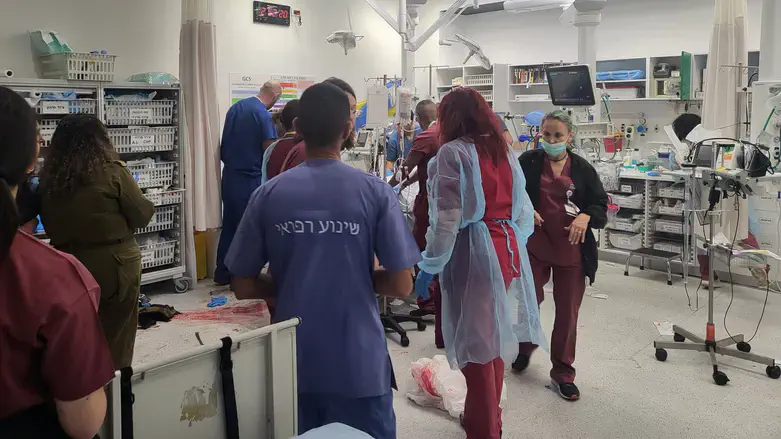
A new study published in the journal Disaster Medicine and Public Health Preparedness has examined how emergency department staff at Asuta Ashdod Hospital responded during the October 7th massacre, finding that years of preparation and training played a critical role in enabling the medical teams to respond immediately to the mass-casualty event.
The study concluded that the lessons learned at the hospital could provide a professional framework for hospitals around the world preparing for wartime conditions and other extreme emergencies. Researchers conducted extensive in-depth interviews with medical and administrative staff who worked in the emergency department during the attack. The resulting data were analyzed by research teams in Israel and Sweden.
According to the study, years of drills and emergency training had created a high level of preparedness that allowed staff to respond almost instinctively once emergency protocols were activated. As a result, medical teams were able to focus their resources and attention on treating the wounded and dealing with unexpected challenges rather than having to learn procedures during the crisis itself.
The researchers also highlighted several factors that helped the department maintain continuous medical care during rocket attacks. These included clearly defined roles, strong teamwork, flexibility among staff, the presence of managers on the ground and the department’s protected structure. Treatment was able to continue without patients having to be transferred or medical care interrupted during rocket barrages.
At the same time, the study identified areas where Israel’s broader emergency medical system could be strengthened. The recommendations include improving information-sharing systems, strengthening coordination between the various health organizations involved in emergency response and developing better mechanisms for managing sudden surges of patients during wartime.
The research was led by Prof. Adam Rose of the Hebrew University’s School of Public Health, together with Maximilian P. Nerlander, a doctoral student at the Center for Disaster Medicine and Trauma at Linköping University in Sweden and a visiting researcher at the Hebrew University, and Dr. Debra West, the former director of Asuta Ashdod’s emergency department.
Asuta Ashdod CEO Dr. Galit Kaufman said the study recognizes the hundreds of hospital employees who worked during one of the most difficult days in Israel’s history.
"This research is first and foremost an acknowledgment of the hundreds of team members who acted with professionalism, dedication, and courage on one of the hardest days that the State of Israel has experienced," Kaufman said. "We are proud that the experience accumulated at the hospital is being examined by leading researchers from Israel and around the world, and is now becoming professional knowledge that can help other hospitals prepare better for emergencies. In addition to recognizing strengths, we believe that the ability to learn, improve, and draw lessons is also an inseparable part of our professional excellence."
Dr. Chagit Sarvegil-Mammon, medical director and deputy CEO of Asuta Ashdod, recalled the uncertainty that gripped the hospital as the scale of the attack became clear. "On the most painful day that the State of Israel has known, when we were still in enormous uncertainty and trying to process the scale of the event, we drew strength from our ability to treat the wounded who continued to arrive. In those moments, years of training and preparation became reality teams knew exactly what to do and acted together with exceptional professionalism."