

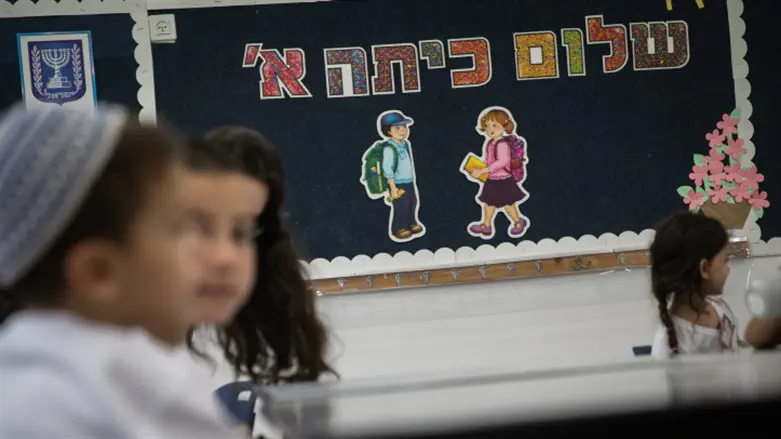
About 2.6 million students returned to kindergartens and schools across Israel on Tuesday morning, marking the opening of the 2027 school year following the summer break.
The new school year begins without the threat of teacher strikes, with the education system hoping for a stable, continuous and calm year. For approximately 180,000 children, however, the day marks a particularly significant milestone as they enter first grade for the first time and begin their 12-year journey through the education system. At the other end of the spectrum, some 143,000 12th-graders are beginning their final year of school.
A total of 27,757 educational institutions are operating nationwide, including 21,800 kindergartens and 5,957 schools. Some 418,385 students, representing approximately 16% of all students, are eligible for special education services-a 9% increase from last year.
The first week of school will focus in part on strengthening students’ sense of belonging, social connections and trust between students and educational staff. Alongside the return to routine, schools will emphasize emotional and social dialogue, identifying students’ needs and strengthening individual and group resilience. Preventing violence, social rejection and bullying will also be a priority, both in schools and in digital spaces.
The annual theme for the education system, from kindergarten through 12th grade, will be “Future, Heritage and Initiative." The program will combine identity and heritage with leadership, initiative, personal responsibility and social involvement. The “Heritage Paths" subject area will also be expanded this year for the Druze sector in elementary schools and for seventh-grade students in state and state-religious education.
Beginning this year, junior high school students will be prohibited from using mobile phones on school grounds, including during breaks between classes.
Alongside the social and educational focus, the new school year will introduce several changes to the curriculum. One of the main innovations is the introduction of financial education. The program will initially be taught to ninth-graders, with plans to expand it to 10th grade in the future. It is designed to give students practical tools for independent financial management, strengthen critical thinking about financial issues and prepare them for the economic world and labor market.
Artificial intelligence is also expected to play a larger role in classrooms. As part of the expansion of the “Israel Reality" reform, the 720 program will be expanded to adapt teaching and assessment methods to the AI era. It will operate in English studies across all junior high schools and will be expanded to approximately 140 schools in science, technology, engineering and mathematics.
More than 12,000 English, science and technology teachers are expected to receive training in artificial intelligence. Students in grades 8 and 9 will also participate in a 20-hour program covering the use of AI tools, critical thinking, identifying misinformation and ethical questions surrounding the technology.
The changes will also reach matriculation examinations. AI tools will be incorporated into matriculation assignments in more than 10 science and technology tracks. In addition, 27 schools nationwide will launch a dedicated artificial intelligence sciences track, with graduates eligible to receive a technological certification diploma.
The start of the school year carries particular significance in communities surrounding the Gaza border. In the Tekomah Regional Council area, 22,233 students in Sderot and the regional councils of Eshkol, Hof Ashkelon, Sdot Negev and Sha’ar HaNegev will begin the new school year.
The figure represents an approximately 9% increase compared with the number of students on the eve of the October 7th massacre, amounting to 1,802 additional students. The increase comes as residents continue returning to communities in the region following the prolonged evacuation period.
During the summer, residents returned to Kissufim, Chulit and Kfar Aza, while youth from Kibbutz Nir Am also returned to study in Eshkol. The reopening of educational institutions, together with the growth in student numbers, marks another step in the renewed return of Gaza border communities to their homes.
During 2026, NIS 364 million will be invested in strengthening education in the Tekumah Regional Council area through eight major projects. Of that amount, NIS 184 million will be allocated to the “Tekumah education basket," NIS 103 million to additional educational buildings and NIS 54 million to informal education programs.