

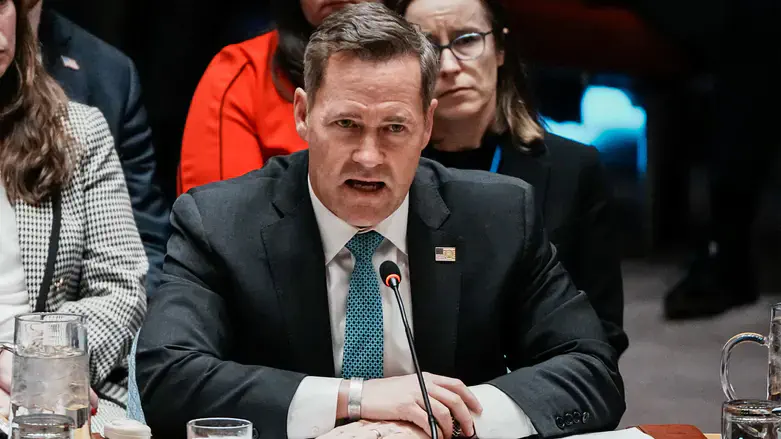
The United Nations Security Council held an open briefing on Wednesday on “the situation in the Middle East, including the Palestinian question," hearing from Board of Peace High Representative for Gaza Nickolay Mladenov, Acting Special Coordinator for the Middle East Peace Process Ramiz Alakbarov, and Association of International Development Agencies Executive Director Athena Rayburn.
Mladenov told the Council that the agreement by Hamas and other armed factions in Gaza to relinquish their weapons and governing authority represents an unprecedented development.
“Indeed, it is a historic breakthrough. For the first time, Hamas and the armed factions in Gaza have agreed to hand over their weapons and to transfer full governing authority, civilian and security, to a transitional administration recognized by the United Nations," Mladenov said.
“We now have the opportunity to dramatically improve life in a sustainable way for Palestinians in Gaza; to provide durable security for Israelis; and to move from a conflict that has destabilized the region to an environment that offers peace, prosperity and economic opportunity for the entire Middle East," he added.
According to Mladenov, the Roadmap does not replace or contradict the Comprehensive Plan or Security Council Resolution 2803 (2025).
“There is no grey zone and no category left out," he said.
Mladenov said the Roadmap contains three elements that have not existed at any point in the past 20 years. The first, he said, is Hamas’ acceptance of the requirement for its complete demilitarization and transfer of governance in Gaza.
The second is agreement on the principle of “One Authority, One Law, One Weapon," while the third is that “Progress is performance-based, not calendar-based," meaning that each phase will begin only after the previous phase has been certified as completed.
“What has been agreed on paper will matter only if it is translated into verified action," Mladenov stressed.
Addressing skepticism over the Roadmap, Mladenov said, “I have yet to hear an alternative plan. Yet, I see only two choices."
He described those alternatives as an Israeli reoccupation of Gaza, involving the governance of two million people at a significant human, economic and reputational cost, or a return to the conditions that preceded the October 7, 2023 attack, with Hamas neither disarmed nor removed from governance and instead contained through periodic military force.
“What remains is a choice. A Gaza disarmed, rebuilt and reconnected to the world. Or a Gaza rearmed, divided and in rubble, with a radicalized generation raised inside it and the next war already on the horizon," he said.
“The responsible choice is clear."
Rayburn sharply criticized the situation in Gaza and the work of the Board of Peace, saying that increased aid had not resolved the conditions facing Gaza residents.
“Yes, the latest IPC figures show we have clawed our way back from an engineered famine in Gaza, but it is a disturbing marker of 'progress' to celebrate that a child that may no longer be at imminent risk of starving to death may still be killed at any moment from shelling, air strikes or gunfire, or may survive only to carry the consequences of hunger, devastation and deprivation for the rest of their life," she said.
Rayburn said what is needed is sustained humanitarian access, basic services and recovery, together with “the creation of conditions in which people in Gaza can begin to live rather than just survive the next 24 hours."
“By these basic measures, the Board of Peace is failing," she said.
Rayburn urged members of the Security Council to conduct a mission to Gaza.
“Let the reality on the ground, the facts, our colleagues and Palestinians speak to you themselves. We are here, and we are ready to receive you," she said.
US Ambassador Michael G. Waltz criticized Rayburn’s remarks, arguing that her briefing failed to address Hamas’ role in Gaza’s humanitarian crisis and its treatment of Palestinian Arabs who oppose its rule.
“Not a word from Ms. Rayburn, the civil society briefing, on the knee-capping of Palestinians who recently dared to step out and protest Hamas's rule," Waltz said.
Waltz told the Council that Gaza continues to face serious humanitarian needs, while arguing that recent improvements in aid access and nutrition demonstrate the effects of increased supplies reaching civilians.
Citing the United Nations Children’s Fund (UNICEF), Waltz said Hamas has hoarded aid and used humanitarian assistance as a means of control.
He also contrasted the humanitarian situation among civilians with the conditions of Hamas leaders and fighters.
“You know who is not starving in Gaza?" he said. “Hamas fighters aren't starving. You don't see their leadership starving. You don't see their wives who are carrying Birkin bags on camera; they're not starving."
The US defended Security Council Resolution 2803 (2025) and President Donald Trump’s comprehensive Gaza plan, saying they provide an alternative to continued Hamas rule or a prolonged Israeli occupation.
Waltz noted that Hamas has twice committed to disarm and said that reconstruction and an eventual Israeli withdrawal depend on the terrorist organization relinquishing its military capabilities.
“Gaza cannot sustainably rebuild while Hamas retains the ability to plunge it back into war," he said.
Alakbarov, meanwhile, told the Council that the ceasefire remains fragile as discussions continue on implementing Resolution 2803 and the Comprehensive Plan to End the Gaza Conflict.
“As talks continue on the implementation of Resolution 2803 (2025) and the Comprehensive Plan to End the Gaza Conflict, the ceasefire remains fragile," he said.
Alakbarov said Israeli strikes in Gaza are continuing and that the situation in Judea and Samaria “continues to rapidly deteriorate."
Full implementation of the 15-point Roadmap, he said, would advance transitional arrangements that include the disarmament of Hamas and all other armed groups, the withdrawal of the Israel Defense Forces from Gaza, deployment of the International Stabilization Force and the transfer of transitional governing responsibilities to the National Committee for the Administration of Gaza.
“I urge all parties to build on this momentum, fulfil their commitments and advance the Roadmap in accordance with international law," Alakbarov said.
Turning to humanitarian conditions in Gaza, he said, “They are losing hope."
According to Alakbarov, Israeli air strikes resumed on August 12 following a week-long lull, while shelling, drone attacks and ground operations continued. He cited the Gaza Ministry of Health as saying that more than 100 Palestinians were killed and over 400 injured during the reporting period.
He also said that around two-thirds of Gaza remains inaccessible or subject to severe access restrictions and that the 2026 Flash Appeal for humanitarian aid is 40% funded.
“More than 10 months into the ceasefire, this situation is unacceptable," Alakbarov said, adding that “human dignity must be at the centre of all efforts."
On Judea and Samaria, Alakbarov said large-scale attacks by Israelis against Palestinians continue “with virtually no accountability for these crimes."
He also criticized Israel over the E1 housing plan east of Jerusalem and the entry by Israeli authorities into the UNRWA compound in Jerusalem's Kafr Aqab neighborhood.
“I reiterate my call on Israel to act in accordance with its obligations under international law. All efforts to seize, control or expropriate UNRWA facilities must cease," he said.
French Ambassador Jérôme Bonnafont also addressed the Council, condemning recent remarks attributed to Israeli National Security Minister Itamar Ben Gvir, as well as community expansion and violence by Israelis against Palestinian Arabs.
“The restoration of decent living conditions cannot be subordinated to the finalization of the disarmament process," Bonnafont said.
“It is important that Hamas disarm," he added. “It is important for the Israeli army to withdraw."
France also condemned restrictions on humanitarian aid and daily violations of the ceasefire.