

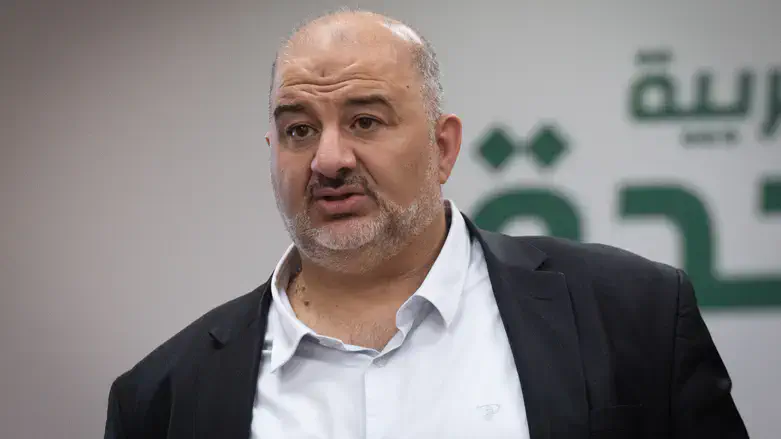
A political storm erupted Wednesday following remarks by United Arab List (UAL) chairman Mansour Abbas, published in Arabic on his social media account.
Abbas sought to clarify his positions on core issues concerning the State of Israel after facing criticism in the Arab sector following an interview in which he said that he would not today repeat his previous claim that “Zionist gangs captured Palestine."
In his post, Abbas said he recognizes what he described as the “Palestinian Nakba." “The claim that I deny the Nakba, displacement, and the Palestinian narrative is yet another fabrication," he wrote. “When people on the right confront me with my past statements that indicate the credibility of my belonging, my identity and my narrative, I say that today, and especially since in recent years we presented our approach of partnership and influence, I am framing my statements, my ideas and my political approach differently. This does not mean that I deny the Nakba, displacement, or the Palestinian narrative."
Abbas continued by questioning whether a different political approach could better address the conflict’s history while focusing on the future. “Is it not possible that a different wording and a different political approach would precisely reflect the truth of the Nakba, learn from historical experience in a more accurate and wise way, and present a practical vision for the future?" he wrote. He also asked whether there was an opportunity to gain political influence that could address “the injustices and the wounds we inherited from our ongoing Nakba," prevent further displacement and move beyond the historical narrative toward “the narrative of the future that we hope for."
Abbas later addressed the nature of the State of Israel specifically. “The Jewishness of the state is an existing reality imposed upon us and not something we chose. This is the choice of the Jewish majority and not our demand," he wrote. Abbas emphasized that Arab parties were effectively forced to accept this reality in practice, since otherwise they could be disqualified from running for the Knesset and local authorities.
“By contrast, our demand, our approach and our order of priorities are to focus on strengthening our status and securing our national and civic rights, and to carry out our political role within the government, and not to withdraw to representation in parliament only from the opposition," Abbas continued. “We must act to achieve our interests and to repel harm from our society and our people. Our position regarding the right of the Palestinian people to self-determination and recognition of a Palestinian state alongside the State of Israel is well known and familiar."
Religious Zionism chairman and Finance Minister Bezalel Smotrich accused Abbas of using his remarks to conceal what he described as his true intentions. “For years I have been warning against the ‘takiya’ method of Mansour Abbas," Smotrich said, referring to a concept he described as concealment. “It is a foundational element in the Brotherhood movement’s method: they conceal the true goal, accumulate power, and use it for the true purpose, jihad and the elimination of ‘infidels,’ with an emphasis on Jews and the State of Israel."
“Mansour Abbas is a dangerous enemy, a wolf in sheep’s clothing," Smotrich continued. “The fact that Eisenkot and the left are still working to form a government with him is a dangerous lapse in judgment." He said he was proud of opposing the formation of a government dependent on Abbas and vowed to prevent Israel from becoming dependent on what he called its enemies.
The Otzma Yehudit party announced that, following Abbas’s remarks, it would seek to disqualify him from running for the Knesset in the upcoming elections.
“Bennett and Eisenkot’s senior partner in the government admits that he does not recognize the State of Israel as a Jewish state," National Security Minister Itamar Ben-Gvir said. “I would tell you that his statements are delusion, but I am not surprised. He is from the Muslim Brotherhood. The delusion is that Eisenkot and Bennett dream every night about how they will form a government with him."
Ben-Gvir added that Bennett and Eisenkot would allow Abbas to take control of the National Security Ministry and would permit what he described as a rollback of enforcement policies in the Negev and against muezzin loudspeakers. He further accused them of allowing “the Galilee and the Negev to turn into Hamasstan."