
Parshat Ki Tavo opens with one of the Torah’s most beautiful expressions of gratitude.
After settling in Eretz Yisrael, a farmer takes the first fruits of his harvest, places them in a basket and brings them to the Beit Hamikdash, the Holy Temple. Standing before the Kohen, he declares: “I have come to the Land that the Lord swore to our forefathers to give us" (Deuteronomy 26:3).
We might have expected him simply to thank G-d for the harvest.
But that is not what the Torah tells him to do.
Instead, the farmer recounts Jewish history. He recalls our patriarch Yaakov, the descent to Egypt, the enslavement and suffering of the Jewish people, their cries to G-d, the Exodus and, finally, their arrival in the Land.
Only then does he say: “And now, behold, I have brought the first of the fruit of the land which You, Lord, have given me" (26:10).
Why is all that history necessary?
The man has grown wheat, grapes or figs. Why can he not simply thank G-d for his good fortune and leave it at that?
The Torah is teaching us a crucial lesson: gratitude without memory is incomplete.
The farmer standing in Jerusalem is being asked to understand not only what he has, but what it means.
His ancestors had once been slaves in a foreign country. They owned neither fields nor vineyards. They wandered through the wilderness without a land to call their own.
And now he stands in Jerusalem holding produce grown from the soil of Eretz Yisrael.
Suddenly, the fruit means something very different.
It is not merely the product of a successful harvest. It is the culmination of a story that began generations earlier.
This may also explain the striking opening words of the declaration: “I have come to the Land."
The farmer himself may have been born there. His parents may have been born there as well. Yet he speaks as though he personally has just arrived.
Every generation is required to see itself as part of the return.
That is no small demand, because human beings have an extraordinary ability to grow accustomed to blessings. What one generation yearns for can become something the next hardly notices.
The mitzvah of Bikkurim, of bringing the first fruits, was meant to prevent precisely that.
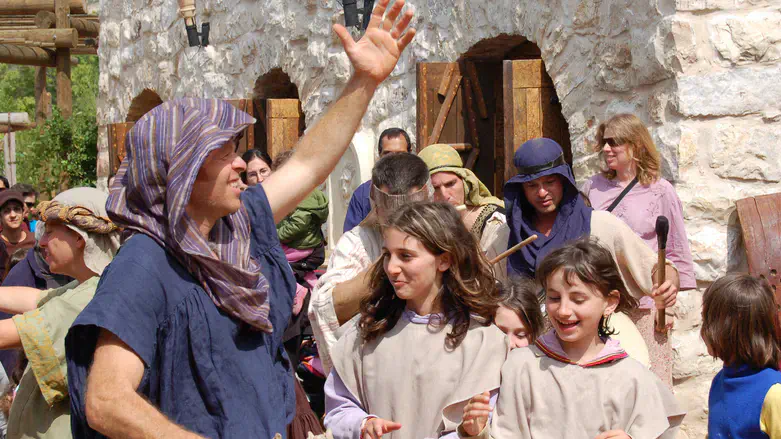
The Mishnah (Bikkurim, Chap. 3) describes how those bringing the first fruits traveled together toward Jerusalem in festive processions. An ox decorated with gold and olive branches went before them, while a flute was played along the way. As they approached the city, dignitaries came out to greet them.
This was far more than an agricultural ceremony. It was a public lesson in Jewish memory.
And that lesson has particular relevance today.
If we want the next generation to appreciate Eretz Yisrael, we have a responsibility to make sure they know its history.
Young Jews need to understand that the bond between the People of Israel and the Land of Israel did not begin in 1948. It runs through Tanach, through centuries of Jewish prayer and practice, through exile and persecution, and through the unbroken longing to return to Zion.
If we fail to teach that history, we should not be surprised when young people encounter falsehoods on social media and have no basis on which to recognize them as such.
A slogan repeated thousands of times on TikTok or Instagram can sound convincing to someone who has never been taught the facts.
We therefore cannot expect the next generation to understand why the Land of Israel belongs to the People of Israel if we have not given them the knowledge to understand that connection for themselves.
For centuries, Jews prayed toward Jerusalem while living under foreign rulers. They invoked Zion at weddings, at the Seder table and at the conclusion of Yom Kippur. Countless generations lived and died without ever setting foot in the Land they prayed to see.
We live in a generation that has been granted what they could only dream about.
Bikkurim reminds us that such blessings cannot and must not be taken for granted. They must be placed in their proper historical context and passed on.
That is why the farmer does not simply bring his fruit to Jerusalem. He tells a story.
And if we want our children and grandchildren to understand what Eretz Yisrael means, we must make sure they know that story too.