

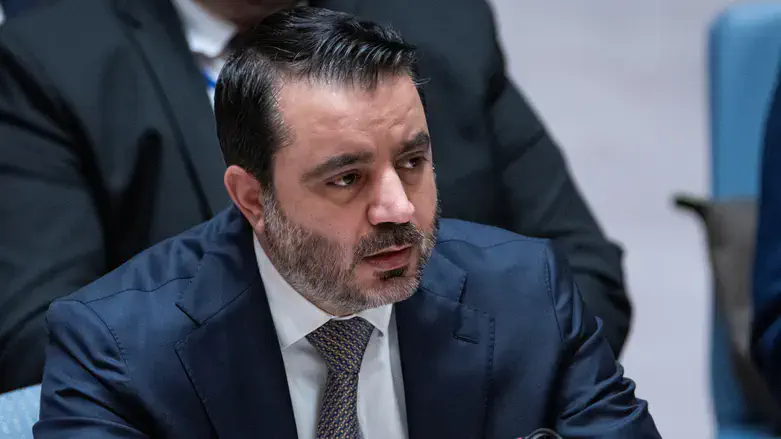
Syrian Foreign Minister Asaad Al-Shaibani told Axios on Wednesday that Damascus had assured Israel that it had no plans to establish a Turkish military base or a permanent Turkish military presence at the Abu al-Duhur airbase, but Israel carried out a strike on the site regardless.
"[T]here was no intention to establish a Turkish base there, nor to establish a permanent Turkish military presence or deploy Turkish forces at the site," Al-Shaibani said in one of eight written responses provided to Axios.
According to Axios, Israel dropped at least eight bombs on runways and hangars in the early Tuesday morning attack at the airbase in northern Syria, roughly 45 miles from the Turkish border. The attack damaged recently reconstructed runways but caused no casualties.
US and Israeli officials said Israel informed the Trump administration that the operation was intended to stop a potential Turkish military buildup at the facility. Prime Minister Benjamin Netanyahu said in a video posted Wednesday that Israel had warned Syria against allowing Turkey to establish a presence there.
"Our message was very clear: Don't. I guess they didn't quite understand the message," he said.
Al-Shaibani rejected that justification, saying the activity at Abu al-Duhur was focused solely on restoring facilities damaged during the war.
He said the work "was limited to rehabilitating the airfield and its facilities that were damaged during the war," for the use of the Syrian Air Force.
"There was no Turkish military build-up at the base in any sense that would justify such an interpretation," he wrote. "The base was, in fact, largely empty. It had not yet been fully rehabilitated or become fully operational, and the work there was still at the rehabilitation stage.
"Therefore, linking the strike to a Turkish military presence at the base is not supported by the situation on the ground as it stood at the time," he added.
The Syrian Foreign Minister acknowledged that Turkish military personnel had visited the facility several days before the attack, but said their presence was part of "ongoing military cooperation in the areas of training and the exchange of expertise."
"Syria is currently working to rebuild its military and civilian institutions and develop their capabilities. It therefore benefits from cooperation and training programs with a number of countries, not Turkey alone. Similar cooperation has taken place and continues with Saudi Arabia, Jordan, Qatar and Russia," he wrote.
"Syria is a sovereign state, and it has the right to establish relations of cooperation and alliance with any country, including Turkey", he added.
Al-Shaibani said Syrian and Israeli officials had communicated in the days preceding the attack. Damascus explained the work taking place at the base and emphasized that it remained under Syrian authority.
Syria "made clear the base is Syrian and will remain under Syrian sovereignty and control," he said, adding that no permanent Turkish deployment was planned.
"The nature of the activity at the base was known, and there was no basis for interpreting the rehabilitation work as the establishment of a Turkish military site on Syrian territory," he wrote.
His account follows a Reuters report stating that Mossad chief Roman Gofman spoke by phone with Al-Shaibani on August 14, with the two discussing Turkey's military presence in Syria.
Al-Shaibani also said Damascus maintained communication with the Trump administration both before and after the Israeli strike.
"The primary objective was to convey our position and concerns and to work to prevent escalation," he said.
"We made clear to the US that we do not trust Israel's intentions towards Syria, and that we believe current Israeli policy, including its military escalation and actions on the ground, does not contribute to stability in Syria or the region," Al-Shaibani said.
Despite the latest escalation, Al-Shaibani said Damascus remains interested in reaching an agreement with Israel to reduce tensions along their border.
"But de-escalation cannot be the responsibility of one side alone. Israel must also reassess its policy towards Syria and recognise that continued military operations and attacks will not deliver long-term security, but will instead increase instability," he wrote to Axios.
"In principle, Syria does not close the door on negotiations. On the contrary, we believe that political and security solutions offer the most sustainable path towards stability."
Al-Shaibani said negotiations could resume if there is "genuine political will", potentially producing understandings "that ensure the security of both sides, respect Syria's sovereignty, and contribute to greater stability in the region rather than perpetuating the cycle of escalation."