
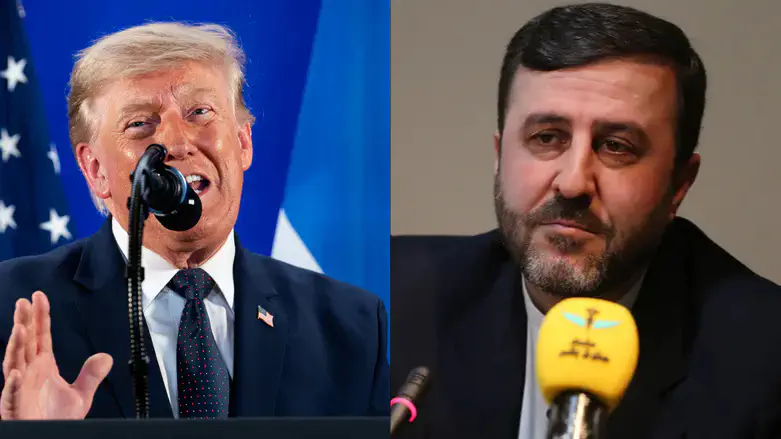
Iran retains exclusive power to regulate traffic through the Strait of Hormuz and will sustain its maritime blockade until Washington acknowledges its "strategic defeat," Iranian Deputy Foreign Minister Kazem Gharibabadi stated Friday.
The declaration came after US President Donald Trump indicated intentions to claim the critical shipping lane as American territory following what he termed a decisive military victory over Tehran.
Responding directly to Trump on social media, Gharibabadi remarked, “Once and for all, accept the reality: up to this point, you have suffered strategic and heavy defeats; the Strait of Hormuz has been Iranian, is Iranian, and will remain Iranian."
He further wrote, “This strait will only be closed and opened under Iran's command, and as long as you do not accept the reality of defeat and cease your fanciful delusions, Iran will continue to enforce the blockade."
Concurrently, Iranian Foreign Minister Abbas Araghchi clarified that no decision has been reached regarding a resumption of direct negotiations with Washington, according to the semi-official ISNA news agency.
While confirming that diplomatic channels through regional intermediaries Qatar and Pakistan remain active, Araghchi emphasized that message exchanges do "not mean negotiations".
He further noted that the Islamabad memorandum of understanding pertained strictly to an "end to the war" rather than a temporary ceasefire, meaning no 60-day truce extension was required.
Araghchi added that previous diplomatic mechanisms were no longer effective, with Iran working toward an interim framework that might eventually pave the way for a formal arrangement.
These statements followed comments made by President Trump during a rally on Long Island, where he announced plans to absorb the strategic body of water into US jurisdiction.
“After we finish defeating Iran, which is being very badly defeated, pretty soon, I will be declaring the Hormuz Strait a territory of the United States," the President said at the rally.
He elaborated on the scope of the campaign, stating, “What we are doing [in Iran] is a great service for the world, not only for ourselves, for the world."
Trump continued, “Nobody has any idea how successful we are [in Iran]. You know who knows how well we are doing? Iran."
“They had 212 very nice airplanes, some bought from the United States, brilliantly, through Obama. And every one of their airplanes is shot down, it’s gone," he added.
Addressing the leadership landscape within Iran, Trump asserted that Iran has “no leadership. Their leadership is gone. Their second tier is gone. The third tier is half gone. That’s one of my problems, that there is nobody to negotiate with. It's a problem. It's the only country in the world where nobody wants to be president."
On Thursday, US Vice President JD Vance spoke to Fox News and defined America's primary goals in the ongoing standoff as guaranteeing global energy market stability and stopping Tehran from securing nuclear capabilities.
Outlining Washington's two main mandates, Vance stated, “It's ensuring that the Gulf countries continue to send oil and gas to the world economy so that we have energy price stability. That's obviously important for the American people. I know that oil is down today and it's way down from the highs in the early days of the conflict. That's goal number one, keep oil and gas cheap for Americans all over our country."
“And then obviously goal number two is [to] ensure that Iran never gets a nuclear weapon. I feel confident we're accomplishing both of those goals, but it's inherently an unpredictable thing because the Iranians themselves are unpredictable and they sometimes don't honor the commitments they've made to us," Vance concluded.
Later on Thursday, US Treasury Secretary Scott Bessent declared that Washington is preparing to execute economic actions against Tehran on a scale never previously attempted.
"Watch this space for more announcements coming next week because we are going to apply measures like have never been seen in the history of economic isolation on a country," Bessent told Newsmax in an interview.
"It will be a combination of economic isolation like the world has never seen before, and the continued blockade in the Strait of Hormuz that will keep anything from going in or out of the Iranian ports," he added.
(Arutz Sheva-Israel National News' North American desk is keeping you updated until the start of Shabbat in New York. The time posted automatically on all Israel National News articles, however, is Israeli time.)