
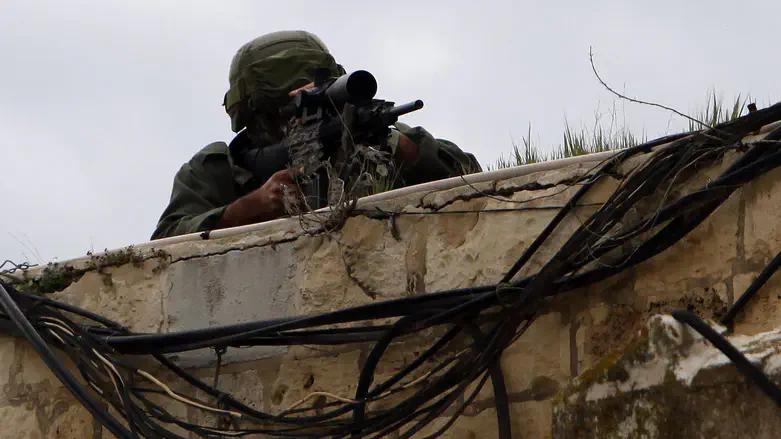
There are few things more natural than fear on the battlefield.
A soldier facing an enemy knows what is at stake. The next few minutes may determine whether he lives or dies, and it would be unnatural for him not to feel fear.
And yet, in this week’s Parsha of Shoftim, the Torah commands precisely the opposite.
“When you go out to war against your enemy, and you see horse and chariot, a people more numerous than you, you shall not be afraid of them, for the Lord your G-d is with you, Who brought you up from the land of Egypt" (Deuteronomy 20:1).
The Torah does not minimize the danger. It acknowledges that Israel may face a more powerful force yet still insists: Do not be afraid.
Before we address that command, Rashi (Rabbi Shlomo Yitzchaki, 1040-1105) draws our attention to an earlier phrase in the verse: “against your enemy." At first glance, the words seem unnecessary. After all, against whom else would a nation go to war?
Rashi explains: “Let them be in your eyes as enemies; do not have pity upon them, for they will not have pity upon you."
Compassion must not blind us to those who seek our destruction. If someone is determined to kill us, we cannot afford to pretend otherwise simply because the truth is unpleasant.
But if Rashi warns against underestimating the enemy, the Ramban (Rabbi Moshe ben Nachman, 1194-1270) warns against overestimating ourselves.
Commenting on the same verse, he explains that Jewish soldiers must not trust in their own military prowess, imagining that they will prevail through their own strength. Rather, they must turn their hearts toward G-d and place their trust in Him.
The Ramban is not minimizing the importance of military strength. His warning is against mistaking that strength for the ultimate source of victory.
Just a few verses later, the Torah makes this explicit. Before battle, a specially designated Kohen tells the people: “For the Lord your G-d is the One who goes with you, to fight for you against your enemies, to save you" (Deuteronomy 20:4).
Rashi notes that whereas Israel’s enemies “come relying on the strength of flesh and blood," the Jewish people “come relying on the strength of the Omnipresent." The Philistines placed their confidence in Goliath, Rashi points out, but when he fell, they fled.
In other words, we are required to prepare, to fight and to use every means at our disposal, while remembering that ultimately it is Hashem Who fights for Israel and grants salvation.
This also helps explain the command not to fear. If everything depends solely on our own strength, a larger or better-armed enemy can inspire terror. But if human effort is necessary while the outcome ultimately rests with G-d, fear need not determine how we act.
The Rambam (Rabbi Moshe ben Maimon, 1138-1204) develops this idea in his Mishneh Torah (Hilchot Melachim 7:15). Once a soldier enters battle, he writes, he must place his trust in G-d and “not be afraid or frightened." He must put aside thoughts of his wife and children and concentrate on the battle before him.
The point is not that a Jewish soldier stops feeling fear. It is that fear cannot be allowed to take over.
For most of the past two thousand years, Jews were largely powerless to defend themselves and often had to depend on others for protection.
The return to Eretz Yisrael changed that. After centuries of powerlessness, the Jewish people once again took responsibility for their own defense. A Jewish army now guards the Jewish state and protects Jewish life in the Jewish homeland.
Taken together, Rashi, Ramban and Rambam offer a powerful lesson: we must see our enemies clearly, never mistake our strength for the ultimate source of victory, and refuse to let fear govern our decisions.
Our generation has been given something Jews prayed for over the course of centuries: the ability to defend ourselves in our own land. After exile, persecution, pogroms and the Holocaust, we have at last returned home.
The weapons and enemies may have changed, but the command has not:
“You shall not be afraid of them."