

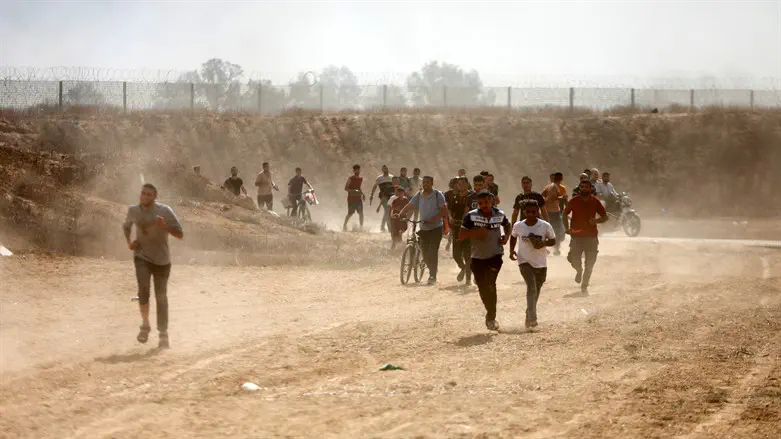
Following the October 7 massacre, Israel’s defense establishment launched a mission to track down and eliminate those involved in planning, facilitating and carrying out the attacks, including operatives involved in holding and abusing hostages.
To carry out the mission, the IDF and Shin Bet established a joint unit known as NILI, the Hebrew acronym for Netzach Yisrael Lo Yishaker (The Eternal One of Israel does not lie) named after the Jewish underground intelligence network that operated in the Land of Israel during World War I.
Channel 12 provided a first look at the unit’s strike cell and spoke with operators who continue working around the clock to identify and eliminate Hamas terrorists connected to the October 7 atrocities.
During the war, Israeli security forces have eliminated much of Hamas’ senior command and planning echelon, including Mohammed Deif, Yahya Sinwar, Mohammed Sinwar and Saleh al-Arouri. More recently, forces also reached Izz al-Din al-Haddad.
A military officer involved in the operation explained that NILI’s mission extends from the terrorists who carried out the attacks to those who participated in holding the hostages.
“This can be the driver who drove a tractor, and it can be the Hamas officer who led a raid," he said.
The unit’s target list has expanded throughout the war. According to the head of the targets division, the focus eventually broadened to include Hamas members who held, abused or encountered hostages during their captivity.
Among those targeted were the terrorist who called his father after October 7 and boasted that he had killed 10 Jews, as well as terrorists involved in decapitor of several hostages. The hunt for the terrorist responsible for the murder of IDF soldier and scout Noa Marciano continued for a year and a half before he was ultimately eliminated.
“This was a Sisyphean task, work that also included failures and missed opportunities. But you do not forget it. You do not forget your responsibility to kill this evil."
NILI maintains a target bank containing thousands of names. One soldier described the painstaking daily process inside the unit’s operations room.
“We have an Excel file; we consolidate all the terrorists’ names there, and every day we ‘delete a line,’" the soldier said. “I’ve already deleted dozens of lines. I delete a line and immediately think about the next one, even before I process what I feel about it."
The unit combines multiple intelligence capabilities to locate its targets, including footage recovered from terrorists’ GoPro cameras, artificial intelligence systems and information provided by field agents.
Since the ceasefire agreement with Hamas took effect last October, the pace of operations has increased. With Hamas no longer holding Israeli hostages, the Air Force and ground forces have greater freedom of action, while testimony from released hostages and interrogations of detainees captured during military operations have provided intelligence that has helped security forces rapidly identify and strike additional targets.