
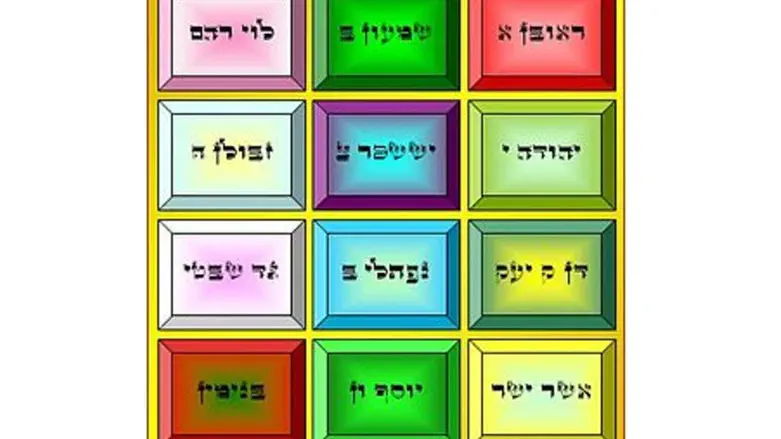
Our haftarah opens with a glittering metaphorical description of the glory of the Messianic age:
Oppressed and storm swept, never comforted; behold: I am paving your ground with garnet, lapis lazuli your foundations. I am fitting your windows with gems, your gates with glowing granite, marking your borders with stones men covet. (Isaiah 54:11-12)
The many gemstones referenced here have more than the simple connotations of wealth and luxury. When we read this description our memories are directed to the jewel-bedecked Choshen, the breastplate which lay on the heart of the Kohen Gadol, the high priest. The identities of the gems mentioned by the Torah in both that context and this one together hold a secret about the convergence of the physical and the spiritual in our lives.
The Choshen worn by the Kohen Gadol in the Mishkan displayed twelve gemstones, and each was meant to represent one of the twelve tribes of Israel. Each stone, like each of the tribes and each individual human being, had its own color, character, and temperament, highlighting how God embraces and celebrates our unique differences.
Some of us shine like rubies; others are tough like diamonds. But all Jews stood equally beloved before God as the High Priest carried us, in all our variety, upon and within his heart.
The two final gemstones enumerated by the Torah as being embedded in the Choshen represented the tribes of Yosef and Binyamin. The Hebrew words for these gems are שֹׁהַם and יָשְׁפֵה, traditionally identified as onyx and jasper (Shemot 28:20). These two stones, placed side by side in the Choshen, are referenced again in a Talmudic discussion of our haftarah, specifically of the phrase: “I am fitting your windows with gems" (v. 12). When looking at this phrase in Hebrew, וְשַׂמְתִּי כַּדְכֹד שִׁמְשֹׁתַיִךְ, it seems clear that the word כַּדְכֹד, which we have provisionally translated “gems," actually refers to a specific type of stone. But to which one is unclear.
The Gemara (Bava Batra 75a) claims that the uncertainty about the כַּדְכֹד has roots in a debate between the Talmudic sages as well as the ministering angels Michael and Gabriel. There in the heavens, the angels quarrel over the true identity of the כַּדְכֹד: One claims that it is another name for שֹׁהַם [onyx], while the other identifies it as יָשְׁפֵה [jasper]. Finally, God is asked to settle this geological debate, and He rules: “It is similar to both this and that." In other words, the כַּדְכֹד is a melding of both the שֹׁהַם and the יָשְׁפֵה stones, a mixture of jasper and onyx together.
What is so significant about the identification of the כַּדְכֹד, to the point where it is necessary to call upon God Himself to settle the debate? In his commentary to the Talmudic story, R. Shmuel Eidels (Maharsha) draws our attention back to the fact that these stones represent Yosef and Binyamin in the breastplate. The synthesis of these two stones, the Maharsha argues, symbolizes a deeper blending of the natures of these tribes: the partnership between the physical and the spiritual.
In rabbinic literature, the two characters Yosef and Binyamin are said to reflect these two sides of the redemptive process. Yosef is tasked with the physical salvation of the Jewish people, since in the biblical story he tends to the physical and financial needs of his brothers in Egypt. Later, the Sages refer to the idea of a “Mashiach ben Yosef," a messiah from the tribe of Yosef who, like his forebear, ensures that the physical and material infrastructure of the Jewish people is developed and redeemed.
Binyamin, on the other hand, carries the role of spiritually uplifting Jewish society. The tribal inheritance of Binyamin includes the land on which the Beit Hamikdash was built, containing the Holy of Holies. Through his connection to that hallowed ground, the site of God’s residence in this world, Binyanim and his representative stone stand for spiritual rejuvenation.
By identifying the כַּדְכֹד as onyx and jasper together, God challenges us to work for the admixture of those two stones and the qualities they represent. For true redemption necessitates the combining of the physical and the spiritual facets of existence. Sanctity can only have meaning for our lives when it is given a home in the real world; and the mundane becomes significant when it is imbued with a higher, more sacred reality.
We live in a miraculous generation, one in which we are privileged to constantly witness and participate in the melding of the sacred and the everyday in all aspects of Jewish life. The combination of physical and spiritual advancement in the modern Jewish state propels us towards the redemption represented in our haftarah by כַּדְכֹד.
We live at a time when we can see Jewish soldiers standing on the front lines of battle to protect our nation from harm. They are bringing tzitzit, tefillin, and sefarim along with them to their bases, tanks, and armored personnel carriers. They are sending countless sheilot, halakhic questions, to their rabbinic authorities to ensure they conduct themselves in a manner consistent with the dictates of the Torah. Throughout the duration of this war, we have seen numerous grassroots initiatives emerge throughout Israel and the Diaspora in both the physical and spiritual realms, from food collection to clothing distribution, to tzitzit tying, to the recitation of Tehillim.
In all these phenomena, we see the synthesis of our physical and spiritual needs come to life, paving the way towards the redemption we so eagerly await. May the onyx and the jasper continue to join together into a beautiful duet of the sacred and everyday that enters every corner of our existence. And may God save us, physically and spiritually, from all those who wish to do us harm.