
Supreme Court justices on Monday heard petitions filed by human rights organizations on behalf of "Palestinian refugees" challenging the UNRWA laws passed by the Knesset.
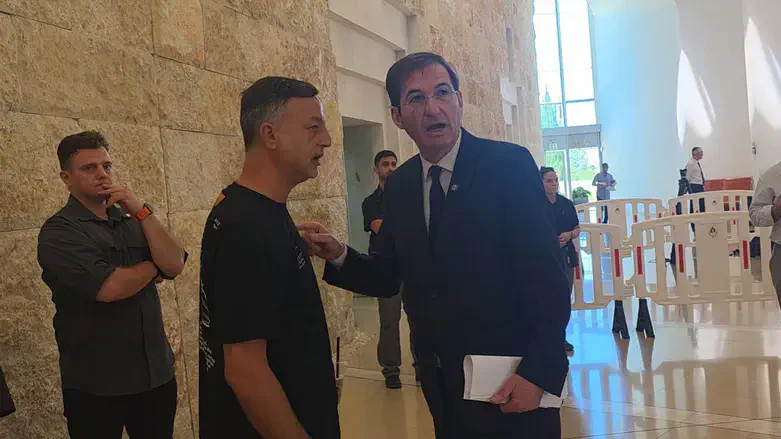
Among those attending the hearing were National Security Minister Itamar Ben Gvir and MKs Tally Gotliv, Yulia Malinovsky, and Boaz Bismuth. Outside the courtroom, Bismuth and Gotliv sharply criticized the very fact that the hearing was taking place.
MK Boaz Bismuth, who co-sponsored the UNRWA legislation together with Kobi Samerano, father of deceased hostage Yonatan Samerano, said in an interview with Arutz Sheva - Israel National News that the hearing was "a disgrace."
He noted that Yonatan Samerano was murdered on October 7 and that his body was dragged into Gaza by a UNRWA employee. He also stressed that the legislation was enacted in response to the involvement of UNRWA employees in the October 7 massacre.
"I struggle to understand under what authority the Supreme Court is reviewing a law that enjoyed such broad consensus in the Knesset," Bismuth said. "If there is one consensus in Israel, it is the fight against terrorism. Has the Supreme Court become Hamas' defense attorney?"
MK Tally Gotliv slammed the hearing, telling Arutz Sheva, "I can't believe I'm coming to a Supreme Court for Terrorists - a Supreme Court for Terrorists, a Supreme Court for Supporters of Terrorism - not a Supreme Court of Justice."
According to Gotliv, the petitions are based on "130 pages of lies and defamation" intended to overturn laws passed by the Knesset.
"The Knesset and the government have already made their decision. This hearing should never have taken place - not even for a single minute," she said, adding that merely holding the hearing lends legitimacy to petitions that are also being used against Israel in the international arena.
At the same time, Gotliv said she does not believe the court will ultimately strike down the UNRWA laws, but "while the petitioners are given their day in court, bereaved families whose loved ones were harmed by UNRWA employees are forced to ask permission just to join the proceedings. It's impossible to describe how absurd this is," she said.
Ben Gvir slammed, "Yesterday they intervened over the crocodiles around the security prison, today they want to intervene in the UNRWA laws, and before that it was judicial reform," he said. "I'll say it clearly: In the next election, either there will be judicial reform, or there will be no government."
During the hearing, Justice Ofer Grosskopf challenged the petitioners' arguments and questioned the evidentiary basis presented to the court, stressing that in order for the Supreme Court to intervene in Knesset legislation, the petitioners must demonstrate a violation of rights protected by Israel's Basic Laws.
"The Basic Laws protect human rights. You need to begin by explaining how the Knesset exceeded its authority. We need to see a violation of the Basic Laws, but I would appreciate it if you could zoom in - what exactly is the violation? Why not file an administrative petition instead?" he asked.
Attorney Suhad Bishara, director of the legal department at Adalah, responded that the petition concerns a population living under especially difficult conditions in Jerusalem, Judea and Samaria, and the Gaza Strip, arguing that for decades it had relied on a social safety net.
Justice Grosskopf replied that the claims were not supported by up-to-date evidence, saying, "If you are arguing there is actual harm to the population, you need to provide evidence. You can't simply say you've seen it yourself. The affidavits you submitted in the petition predate the legislation. There is nothing in the affidavits that establishes actual harm. There is no evidence, so what exactly are we supposed to be discussing?"