
Giulio Meotti is an Italian journalist with Il Foglio and fellow at the Mideast Forum who writes a twice-weekly column for Arutz Sheva. He is the author, in English, of the book "A New Shoah", that researched the personal stories of Israel's terror victims, published by Encounter and of "J'Accuse: the Vatican Against Israel" published by Mantua Books, in addition to his books in Italian.
“I tried to run away, but he was on top of me and kept hitting me," Salman Rushdie told the federal court in Buffalo. “I felt the pain and I screamed: ‘What happened to my eye?’ It was a huge lake of blood."
He lost the eye, and it took seven months of physiotherapy before Rushdie could use one hand again. He can no longer drive, and the wounds have made writing difficult for him.
Federal Prosecutor Timothy C. Lynch invited Rushdie to remove the glasses he has worn since the day of the attack.
One lens is clear, the other dark, covering the stabbed eye. “As you can see, there is nothing left now," Rushdie said, pointing to it.
On Valentine’s Day thirty-seven years ago, Ayatollah Khomeini, Supreme Leader and founder of the Islamic Republic of Iran, sentenced a writer to death for having written a novel. Tehran ordered Rushdie’s killing after the publication of his book, The Satanic Verses.
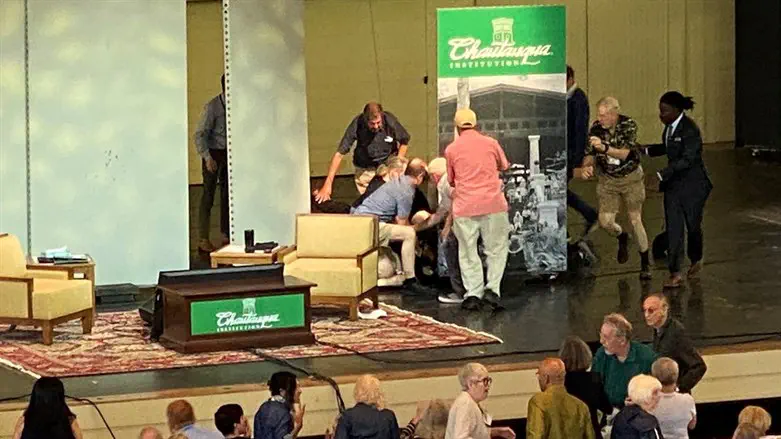
After years of British clandestinity, Salman Rushdie resumed a more or less normal life, making public appearances and abandoning his armed escort. That normality was shattered on 12 August 2022, when a Lebanese-American, Hadi Matar, rushed onto a stage in the state of New York, where Rushdie was giving a speech, and stabbed him fifteen times. The attack left the writer blind in one eye, with damaged nerves and scars all over his body.
Rushdie, 79, had already testified last year about the attack during Matar’s state trial in Mayville, where the terrorist was sentenced to 25 years in prison for attempted murder.
He was then convicted for terrorism: “Matar did not merely attempt to kill Rushdie; he acted under the direction of Hezbollah and on behalf of the Iranian fatwa."
There are Matar’s trips to southern Lebanon, where Hezbollah runs training camps.
At the time of his arrest, Matar was carrying a false New Jersey driver’s license in the name of “Imad Mugniyah," the Hezbollah terrorism planner eliminated in Syria by Israel. In the months before the attack, Matar had assembled propaganda videos with titles such as “Fatwa against Rushdie 1.6."
“If Muslims had killed Rushdie," Matar had written, “there would have been no cartoons of the Prophet."
According to federal prosecutors, Matar had also planned the attack with a person in Iran. In May 2022, Matar wrote to him saying he knew “where to find Rushdie," but that “the problem is how to do it."
According to the indictment, Matar then asked the person, named Kamyar, whether Khomeini’s fatwa against Rushdie was still valid. After the Iranian confirmed the validity of the fatwa, Matar attempted to kill Rushdie. “He wanted everyone to know that he was doing this in the service of Hezbollah," prosecutor Lynch declared. “He wanted to do it in order to be perceived as an Islamic martyr."
Two months ago, it was the former Iranian foreign minister, Manouchehr Mottaki, who again threatened Rushdie on the regime’s television. “Those two, Trump and Netanyahu, must be put on trial and the execution of the verdict entrusted to Muslims around the world, just like the fatwa against the crime committed by Rushdie, condemned as an apostate."
The late Hezbollah leader Hassan Nasrallah said that if someone had carried out the Iranian fatwa, European newspapers would not have dared publish a caricature of Muhammad in 2006.
In court, Matar’s lawyer had the gall to question Rushdie about the content of The Satanic Verses and asked him whether he should have anticipated the reaction the book would provoke among Islamic extremists.
That is the same crazy question that is still heard in Western chancelleries and newsrooms: we shouldn’t have provoked them, we should negotiate with the ayatollahs.