

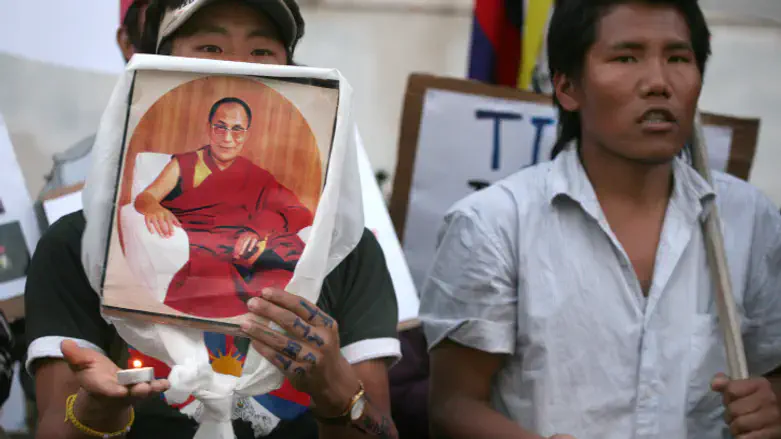
I have never worn bracelets with Dharma wheels, lotus flowers, and golden fish, but I adore Tibetans.
They do not promise rivers of other people’s blood.
They do not turn mourning into geopolitical spectacle.
They do not advance expansionist claims.
They do not want caliphates.
Their self-immolation as an extreme act of non-violence is their own body offered, not the other’s body destroyed.
They offer their own body as proof that tyranny still exists and that communist totalitarianism is not a closed chapter but a living machine that digests entire peoples.
So why does their tragedy, which has lasted eighty years, not generate the same emotional tides, the same viral campaigns, the same gatherings of intellectuals and movie stars that accompany other causes, such as the Palestinian Arab one?
Even Richard Gere no longer wears Tibetan scarves: has he understood that certain causes age badly in the indignation market that feeds Hollywood?
The video described below does not only show a man dying: it also shows a West that has lost the ability to recognize tragedy because it is too busy inventing one that is convenient, politically correct, monetizable, and third-worldist.
In front of the Glass Palace of the UN in New York, another Tibetan set himself on fire. The video is shocking; it must be watched and rewatched to understand what we have become.
Poor Logba, the 52-year-old Tibetan from Queens who set himself on fire on the street without anyone seeing him. He had declared before the immolation that Beijing’s policies are “destroying the Tibetan people."
Under the clear sky overlooking the United Nations buildings, Logba turns into a living torch. The Tibetan flag waves for an instant, the last shred of identity before the fire devours flesh, hair, and voice. The body curls up in a pyre that is not a spectacle, not a performance, not a stupid social media scream: it is the extreme, desperate, crystal-clear act of someone who knows the world has stopped listening and wants to remind it that “cultural genocide" is not a metaphor - it is monasteries razed to the ground, language erased, children torn from their mothers to be “re-educated."
This is not victimhood. It is the exact opposite. Here no one is demanding a “neutral pronoun" or demanding a “safe space."
Since 2009, 159 Tibetans, including women and minors, have set themselves on fire. That is 10 precious human lives every single year, nearly one per month, sacrificed in flames to protest for identity, religious freedom, and dignity.
But their tragedy is too clean, too spiritual, for an era that prefers the canons of oppressor and oppressed defined according to the horrible woke gospel.
Have you ever seen international human rights activists, liberal leftists, or self-proclaimed peace defenders raise their voices for Tibetans with even a fraction of the intensity and constancy they pour into the Palestinian Arab cause?
Their cause is not the apex of an ideological syncretism that merges old anti-Western grudges with new Islamic dogmas.
David Emton writes in Le Point: “The Palestinian question has devoured everything, summarizes everything, eclipses everything. Relations between the West and Islam are reduced to Palestine. Racism, colonialism, the wretched of the earth: Palestine, they tell you! The intolerable fate of Christians under Muslim domination, the Kurds and Tibet, Timor and Darfur, blacks thrown into the desert in Tunisia or sold as slaves in Libya, the ethnic cleansing of Christians in Kosovo? Secondary problems. Our geopolitical masochism is endless: we have abandoned our allies, our friends, our own kind everywhere. When will we conduct a diplomacy based on our interests and our affinities, when will we finally say that the so-called Palestinian Arab question is perfectly secondary to us?"
A Tibetan sets himself on fire in front of the UN, which has dedicated 173 resolutions against Israel and 80 to the rest of the world, and no one notices.
Tibetans have suffered a refined, administrative genocide, a real one, that aims not only at the body but also at memory.
Unlike the Palestinian Arabs and radical Islam, Tibetans do not kill, Tibetans do not rape, Tibetans do not take hostages, Tibetans do not commit terrorism around the world, Tibetans do not want to erase another state, Tibetans do not call the Chinese “sons of pigs and monkeys."
Tibetans do not create problems in the West: Syrians, Palestinian Arabs, Afghans, and others do - and many of them.
Yet how much the Tibetans have endured… Yet for them there is only a media blackout.
Tibetans, heirs to a millennia-old civilization that has resisted Mongol, Manchu, and now Han invasions, embody a paradoxical resistance.
They do not invoke global caliphates and do not cultivate a theological antisemitism that justifies the extermination of the other. Their struggle is existential: to preserve language, monasteries, the cycle of reincarnations that binds the sacred to the temporal. Yet precisely this purity makes them invisible.
Thus, no “Free Tibet" pins on the Cannes red carpet, no rapper tweeting against Xi Jinping with the same vehemence reserved for Netanyahu.
The Islamic Palestinian narrative has been skillfully interwoven with an anti-colonial, anti-Western tale that resonates with Europe’s historical guilt and contemporary woke ideology.
Tibet, on the other hand, sins with strategic innocence: its martyrs do not wave Jihad flags, do not invoke global Intifada, do not threaten to “erase" Israel or the West “from the river to the sea." Their resistance is against Chinese atheist and communist imperialism, not against Jews and Western liberalism.
In a West where activism is only an anti-Western ideological performance, the “wrong" enemy makes the cause indigestible.
In a West of nihilistic narratives built in ridiculous television salons, those who do not know how to sell themselves are destined for oblivion.