

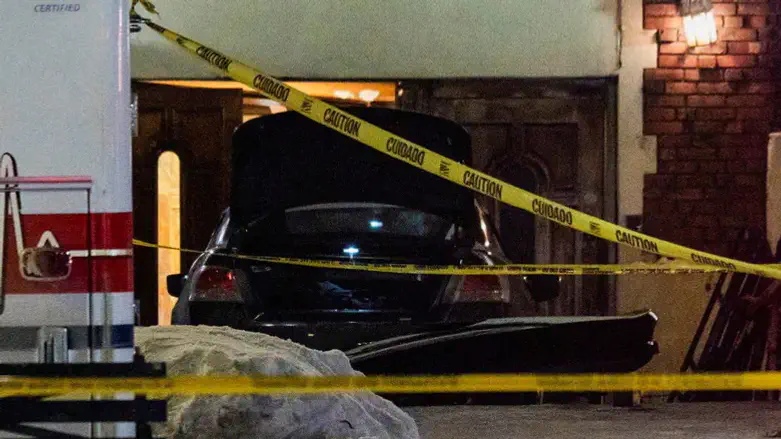
Local leadership in Brooklyn’s Crown Heights neighborhood expressed deep frustration on Thursday following the sentencing of a New Jersey man who repeatedly drove his vehicle into the international headquarters of Chabad-Lubavitch, arguing that the outcome minimizes the gravity of the assault, JNS reported.
Dan Sohail, 36, of Carteret, New Jersey, entered a guilty plea in May to a single federal charge of damaging religious property after directing his Honda Accord down an access ramp leading to the handicapped-accessible entrance at 770 Eastern Parkway on Jan. 28.
Prior to impact, Sohail removed protective security barriers. He then repeatedly drove into the synagogue's doors five times, backing up between each hit and forcing the entrance off its hinges. The incident resulted in no physical injuries.
On Wednesday, US District Judge Eric N. Vitaliano of the Eastern District of New York ordered a punishment of time served plus seven additional days, turning down a request from federal prosecutors for a 14-month prison sentence. With his impending release, Sohail will have spent slightly more than six months in federal custody.
Prior to driving into the structure, Sohail gestured to bystanders near the doors to clear the area. However, inside the building, roughly 2,000 worshippers and yeshivah students were assembled for Yud Shevat - a major observance on the Chabad calendar marking the anniversary of the passing of the sixth Lubavitcher Rebbe, Rabbi Yosef Yitzchak Schneersohn, and the succession of Rabbi Menachem Mendel Schneerson.
Yaacov Behrman, speaking as a liaison for Chabad headquarters, observed that had people been leaving through that doorway, the attack could have produced mass casualties. Behrman expressed confusion over why federal officials chose not to file hate-crime charges. He maintained that intentionally targeting a synagogue and crashing a car into it while thousands were gathered inside constitutes an act of hate by definition, regardless of the perpetrator's internal state of mind.
When asked why federal prosecutors refrained from bringing hate-crime charges, John Marzulli, a representative for the US Attorney’s Office for the Eastern District of New York, declined to outline the reasoning behind charging decisions, citing internal agency deliberations.
While federal sentencing guidelines suggested zero to six months, prosecutors sought a 14-month term, writing in a court memorandum that a longer sentence was necessary to reflect the offense's severity, uphold respect for the law, and deter future attacks against religious institutions amid rising anti-Jewish incidents.
At the sentencing proceeding, Judge Vitaliano firmly rejected that logic while recognizing that anti-Jewish hostility represents a serious stain on the city. He remarked that society is enduring a difficult period of anti-Jewish offenses driven by bias, which transforms property damage into a larger issue.
However, the judge stated that his authority was limited to the offense specified in the plea agreement, reiterating that the defendant was charged with property damage rather than a hate crime. Vitaliano expressed disappointment with the government's request, asserting that it asked the judiciary to issue a sentence based on widespread public misunderstanding.
Legal filings outlined significant mental health considerations regarding the defendant. Sohail's mother previously indicated to police that her son suffered from emotional instability. Prosecutors also noted he engaged in an altercation with a detainee in a holding cell and twice declined to attend scheduled court appearances.
State hate-crime charges originally filed against Sohail following his arrest were subsequently dismissed after the federal plea was reached.
Under the terms of his sentence, Sohail must pay more than $19,000 in restitution and complete court-mandated treatment for post-traumatic stress disorder and a personality disorder.