
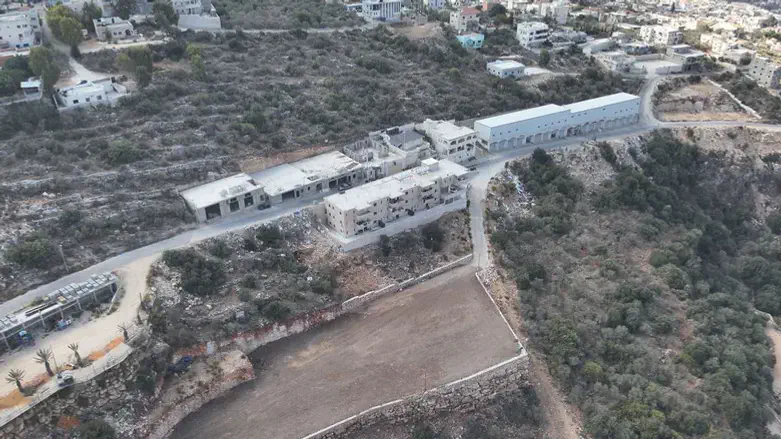
A legal battle is set to begin over what Regavim says is an illegal Palestinian Authority housing project built in Area C of northern Samaria, just a few hundred meters from the Israeli community of Katzir.
According to the organization, the neighborhood was built in the village of Bartaa, in an area under full Israeli control west of the security barrier and approximately 360 meters from homes in Katzir. The project includes a residential building with dozens of apartments, a mosque, commercial and industrial facilities, and another structure. Regavim claims the buildings were constructed without permits on state-owned land.
Bartaa has been divided since before the Six-Day War, with part of the village inside Israel and the remainder in Area C. Following the construction of the security barrier, the section west of the barrier but east of the Green Line has, according to Regavim, fallen into an enforcement gap. The organization argues that Israeli authorities within the Green Line lack jurisdiction in Judea and Samaria, while the Civil Administration has not enforced building regulations in the enclave, allowing unauthorized construction to continue.
Regavim said it has repeatedly appealed to enforcement authorities over the past eight months, but no action has been taken. During that time, it says, the buildings were completed and commercial activity began, including the operation of a poultry facility and a grocery store.
The organization plans to file an administrative petition with the Jerusalem District Court against the Defense Minister, the minister within the Defense Ministry responsible for civilian affairs, the commander of the IDF Central Command, Civil Administration officials, and the Israel Police. It is seeking an order requiring the demolition of the neighborhood, along with an interim injunction preventing residents from moving into the apartments. Regavim has also called for a criminal investigation into those responsible for the construction.
Roi Drucker, Regavim's director for Judea and Samaria, said the situation poses both legal and security concerns.
"For a resident of Katzir who bought his home for millions of shekels, it makes no difference which authority is responsible for enforcement," Drucker said. "The seizure of land within arm's reach of the community is not only a matter of unequal enforcement, but also an immediate security risk. We cannot allow enforcement black holes to exist in the heart of the State of Israel."
Regavim and the Shomron Regional Council have also filed a separate petition over what they describe as illegal construction near Tira and the community of Sela'it. The petition challenges the development of a residential compound and a horse farm in another Area C enclave west of the security barrier.
According to the petition, similar areas along the barrier have become vulnerable to unauthorized construction because of overlapping jurisdictional issues. Regavim argues that additional structures and agricultural development have continued despite previous complaints.
Samaria Regional Council head Yossi Dagan accused the authorities of failing to enforce the law. "We act with responsibility and genuine concern for the security of our residents," Dagan said. "An enclave along the separation line has become lawless territory. While enforcement authorities turn a blind eye and fail to respond to repeated requests, illegal construction continues unchecked in the heart of Area C, which is under full Israeli control."