

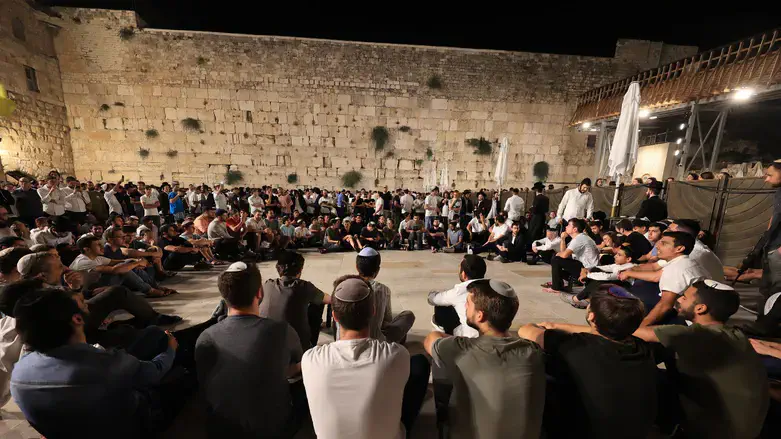
Tisha B'Av (lit. the Ninth of Av) is a day of fasting in memory of the destruction of the First and Second Temples, beginning on the evening before the ninth of Av, at the end of the Three Weeks period between it and the fast of the Seventeenth of Tammuz.
The laws of mourning on Tisha B'Av are more severe than the rest of the fasts and include five other customs of self-deprivation in addition to mourning the destruction and reciting the Book of Lamentations: no eating or drinking, no washing the body, no wearing of leather shoes, no applying of lotions, and no marital relations.
According to Jewish tradition, five tragic events befell the Jewish people on Tisha B'Av: It was decreed that our ancestors not enter the Holy Land; the destruction of the First and Second Temples; Beitar, the last stronghold of Bar Kochba's revolt, was destroyed; and the city of Jerusalem was plowed under.
Times for the fast of Tisha B'Av 2026 (use the Chabad guide for other places):
- Jerusalem: Begins 7:47 p.m. on Wednesday, July 22, and concludes at 8:12 p.m. on Thursday, July 23
- Tel Aviv: Begins at 7:45 p.m. |Ends 8:14 p.m.
- Haifa: Begins at 7:48 p.m. | Ends 8:14 p.m.
- Be'er Sheva: Begins at 7:46 p.m. | Ends 8:13 p.m.
- Eilat: Begins at 7:39 p.m. | Ends 8:11 p.m. [1]
- New York: Begins at: 8:21 p.m |Ends 8:52 p.m.
- Miami: Begins at: 8:12 p.m.|Ends 8:37 p.m.
- Los Angeles: Begins at: 8:02 p.m.|Ends 8:29 p.m.
- London: Begins at 9:03 PM BST |Ends 9:49 PM BST
The days of mourning for the destruction are meant for national and individual introspection. Jewish tradition states that anyone who observes them faithfully will merit witnessing the return of the rebuilt Temple.
A message from Rabbi Zalman Baruch Melamed, head of the Beit El Yeshiva:
Tisha B'Av, the day of the destruction of the First and Second Temples, is the day when we must concentrate and look at what we are missing. Let us not forget or ignore the pain of the people of Israel at this time.
Much of the people of Israel are in the Diaspora, our people are scattered and separated among the nations, across all lands. Most Jews living abroad are very far from any Jewish education, far from any connection to the Jewish people. The Jewish spark that is deep in the heart of every Jew is covered and invisible. Assimilation is growing and terrible - every Jew who leaves his people creates an empty space, and every Jew who marries a gentile is a painful loss. Our people are torn apart and the tears are very painful.
Although past persecutions have ceased, discrimination and antisemitic acts against Jews around the world have increased, and it is not possible to say that the danger of a resurgence of persecution has completely passed. We remember the terrible Holocaust perpetrated by the cultured peoples of Europe, by the German Nazis and their allies. The danger of antisemitic hatred, and its dire consequences, has not gone away.
No less and severe and difficult and painful is the spiritual condition of the nation. Although there is a resurgence of religious connection in Israel since the Gaza War, there is still reason to mourn, regret, cry, and hurt when coming to pray at this time. Believers know that spiritual decline is the cause of all the troubles that have come upon the people of Israel.
Let us pray for our soldiers welfare and for the recovery of those wounded and remember those who fell at the hands of our enemies. We must thank G-d for the miracles He has wrought for us during the current war and pray that we merit that they contiinue.
Laws of Tisha B'av:
Note: IDF soldiers have specific instructions relayed to them by the IDF Rabbinate (in Hebrew)
This year the fast of Tisha B'Av falls on Wednesday night. It is suggested to drink water every hour the day before the fast and have a proper, square afternoon meal including type B starches, such as pasta.
1. Before the fast begins, it is customary to eat a minimal meal of an egg and bread, each dipped in ashes, eaten alone and sitting on the floor.
2. It is advisable to brush your teeth with a brush and mouthwash to remove food debris.
3. Change to clothes of mourning, including removing leather shoes.
4. Do not sit on a normal-height chair until chatzot (the time when the sun has reached its apex)
4. Do not study Torah (except for the “sad" parts that deal with the destruction of the Temples, etc.)
5. Do not send gifts, or even greet one another (you may respond to greetings)
6. Do not engage in outings, trips or similar pleasurable activities
7. Do not wear fine, festive clothing
The following is from Chabad's Tisha B'Av site:
-Tisha B’Av evening services are held in synagogue, where the ark has been stripped of its decorative curtain and the lights dimmed. Evening prayers are followed by the chanting of Eichah (Lamentations).
-Morning prayers are held without tallit and tefillin, since both are considered adornments. Most of the morning is occupied by the reading of Kinot, elegies marking the various tragedies that befell our people. The tallit and tefillin are worn during the afternoon prayer. In the synagogue, the ark’s curtain is restored to its place before the afternoon prayers.
-Many communities have the custom to clean the house and wash the floors after midday, in anticipation of the Redemption, which we await.
-When night falls, before breaking the fast, one should perform netilat yadayim (hand-washing), this time covering the entire hand with water, but without reciting the blessing.
-It is also customary to perform Kiddush Levanah at this point, celebrating the rebirth of the moon, and our hoped-for national rebirth.
-The Temple was set ablaze on the afternoon of the 9th of Av, and it burned through the 10th. Therefore, the restrictions of the Nine Days (such as not eating meat, swimming or laundering clothing) extend until midday of the 10th of Av.
Tisha B'Av is a day when we not only avoid distractions, we actively seek to internalize the tragedies of the day. With God's help, we will see the end of these practices with the rebuilding of the third Holy Temple, speedily and in our days.