
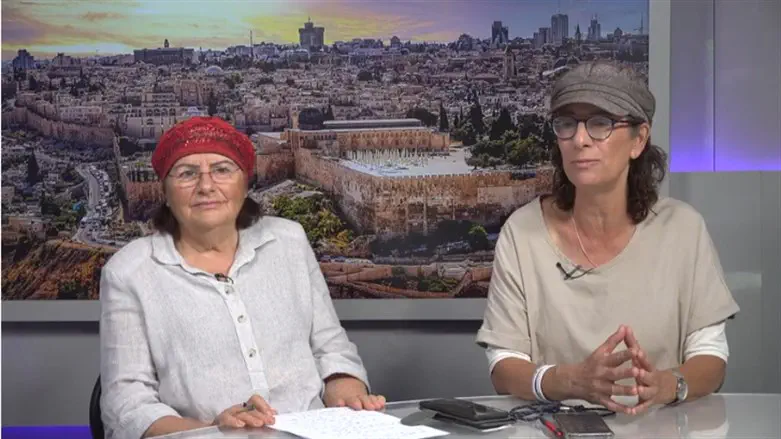
Yehudit Katsover and Nadia Matar are heads of The Sovereignty Movement
If Tisha B'Av were taking place in a courtroom today, who would we place in the dock?
The Romans? That is the easy answer.
Tisha B'Av is far more than a day of remembrance. It is a day of national soul-searching. If the destruction of the Temple represents the loss of Jewish sovereignty, then we must ask ourselves: Have we truly repaired that loss, or does it continue to exist among us-even in a generation that has merited the return to its homeland?
Destruction is not merely the destruction of stones. Destruction is the loss of sovereignty.
We have merited returning to the Land of Israel. We have built a strong state, gathered the exiles from across the world, established cities, communities, and farms, and made the desert bloom. But the Jewish dream was never merely to live in the Land of Israel. The Jewish dream was to be sovereign in the Land of Israel.
And here begins the tragedy of our generation.
We continue to speak about the danger that a Palestinian state might one day be established here, while refusing to recognize the reality before our eyes. In the heart of the Land of Israel, a Palestinian state already exists in practice, possessing all the characteristics of statehood. It has governing institutions, security forces, a judicial system, an educational system, foreign relations, and a flag. It operates on the international stage, educates its people to hatred of Israel, and works to deny the Jewish people’s right to their homeland.
If so, why do we continue to speak of a "Palestinian state" as a future threat?
There is no other country in the world that would accept the existence of a hostile state operating against it from within the heart of its own territory.
Yet we have become accustomed to this reality.
As if this were not enough, the Palestinian state continues to create facts on the ground: building in Area C, encircling Jewish communities, and promoting high-rise construction as part of its struggle for control of the territory and the creation of territorial continuity.
The most tragic part is that this reality was not imposed upon us.
We created it ourselves.
The Oslo Accords were not merely a security mistake. They granted legitimacy to the idea that another people has national rights in the heart of our homeland. Since then, the world no longer needs to invent this falsehood-it can point to decisions that Israel made.
But the Land of Israel is not meant to be divided.
It is the land promised to Abraham: “To your descendants I will give this land."
In Parashat Massei we are commanded: “You shall inherit the land and dwell in it." The Ramban (Nachmanides) explains that this commandment means “that we must not leave it in the hands of any other nation."
This is not merely a commandment to settle the land.
It is a commandment to establish Jewish political sovereignty.
The national camp, too, must engage in self-examination. At times, we believe that one more community, one more farm, or one more neighborhood will prevent the establishment of a Palestinian state. Settlement is a magnificent Zionist enterprise and an essential condition-but it is not a substitute for sovereignty. Without sovereignty, settlement remains vulnerable and reversible.
Therefore, the goal is not another road or another neighborhood.
The goal is one thing:
Full Israeli sovereignty over Judea, Samaria, the Jordan Valley, and Gaza, together with the complete dismantling of the Palestinian Authority (the "Palestinian state").
Sovereignty means an official declaration by the Government of Israel:
This is our land, and we are the sole sovereign authority over it.
Tisha B'Av is also a day of indictment.
Not against Nebuchadnezzar. Not against Titus. Not against the Romans.
They belong to history.
The indictment of Tisha B'Av is directed at us-and especially at the governments of Israel throughout the generations.
For decades, they chose to manage the conflict rather than resolve it, accepting the existence of a hostile state in the heart of the Land of Israel.
This is not a decree of fate. It is a policy.
And policies carry responsibility.
Enough hesitation.
Enough postponement.
The time has come to decide.
The generation of exile dreamed of returning to the Land of Israel.
The generation of 1948 established the State of Israel.
The generation of 1967 liberated the heartland of our country.
Our generation will be remembered by one question:
Did we have the courage to complete the task of sovereignty?
When we lost our sovereignty, the Holy Temple was destroyed.
When we restore our sovereignty, we will be able to rebuild it.
If we fail to do so, Tisha B'Av will continue to be not only a day of mourning for the destruction of the past, but also an indictment of our generation’s missed opportunity.
But if we succeed, perhaps we will merit to be the last generation to mourn the destruction-and the first generation to witness its complete repair: through full Israeli sovereignty over the Land of Israel, sovereignty over the Temple Mount, the rebuilding of the Holy Temple, and the revelation of the light of the People of Israel to the entire world.