

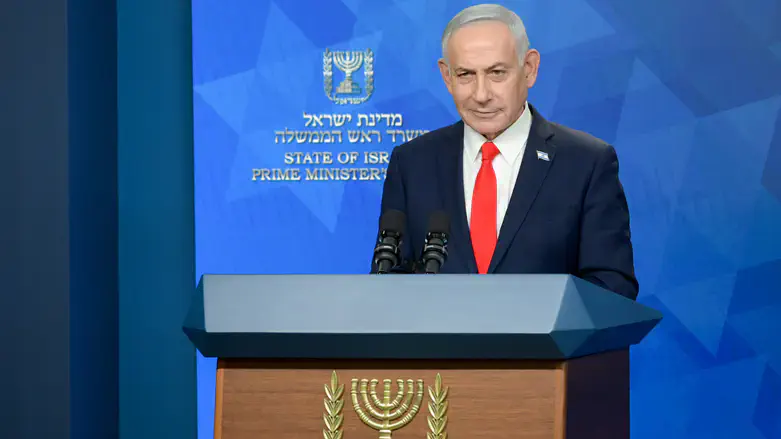
Prime Minister Benjamin Netanyahu joined host Sid Rosenberg on New York’s 77 WABC Radio on Monday for a wide-ranging interview, reflecting on the sudden passing of US Senator Lindsey Graham, Israel's military campaign against the Iranian axis, and relations with Washington.
Expressing grief over the loss of Senator Graham, Netanyahu described his close personal friendship with the South Carolina lawmaker and emphasized Graham’s dedication to the US-Israel alliance.
“I'm in tatters, actually. I'm shocked. Nobody expected that. Lindsey Graham was a great American patriot, a great friend of Israel, and a great personal friend of mine. And he had such vitality, such energy, that to hear that his life was cut short in one fell swoop is a great shock," Netanyahu said.
Netanyahu noted that he had spoken with Graham just days prior regarding regional security strategy.
“In fact, we were talking a few days before, as we do, we did all the time, about how to advance security, how to win the war against Iran, finish the remnant, and then move on to a broader peace, which he very much believed in and devoted his life to. So it's a great shock and a great loss, a great loss for America, a great loss for Israel, a great loss for our great alliance," Netanyahu said.
Highlighting Graham’s deep understanding of regional dynamics, Netanyahu praised the late senator’s legislative advocacy for missile defense funding.
“He understood that the security of Israel and America are intertwined. Because Israel is the one country in the Middle East that is holding the Middle East together, that is preventing the Islamist radicals from taking over the Arabian Peninsula, the Jordan next to us, Egypt on the other side. Israel's strength is America's strength. He understood that," Netanyahu recalled, adding that Graham was “courageous" and possessed a “wide sense of humor."
Turning to the ongoing conflict against Iran and its regional proxies, Netanyahu described Israel’s post-October 7 military campaigns as an unprecedented turnaround.
“Well, if you compare it to where we were on October 7th, Israel has had the greatest comeback in history after the massacre we sustained on that day, on October 7th," Netanyahu told Rosenberg. “You know, Hamas invaded us, butchered our people, raped and then murdered our women, burned our babies alive. And the next day Hezbollah joined them. So people thought that this is the end of Israel. This was Iran's plan to use its proxies for simultaneous invasions and to carpet bombers with ballistic missiles and rockets."
Netanyahu stated that joint Israeli and American actions have severely degraded the Iranian terror axis over the past three years.
“Iran has been itself hurt very badly by our joint operations, America and Israel. The regime has been decapitated in many ways. You know, we hit their navy, their air force, their economy, their money machines. Everything is gone. And yes, they are still trying to negotiate their way out of this, but they're much weaker than Iran. Their axis of evil, their proxies," Netanyahu explained.
Detailing the current operational standing of regional proxy forces, the Prime Minister added, “Hamas, you know, is a shadow of its former self. We're in Gaza, preventing them from being able to reach our communities nearby. We're in Lebanon with a security zone that prevents Hezbollah from invading us. We've knocked out about 9,000 of their terrorists, knocked out their leadership, Nasrallah, knocked out almost all of their 150,000 ballistic missiles and rockets that were aimed at Israel. There was no such concentration of precise precision weaponry on earth. Nowhere. It's gone. Nearly about 8% of it is left. So we knocked out Assad's regime by knocking out Hezbollah."
When asked about his personal and working relationship with US President Donald Trump, Netanyahu stated that cooperation remains strong.
“Well, it's never been better. I mean, one of the things that characterizes our friendship is that we talk openly with each other. You know, friends don't agree on everything, and sometimes they disagree. And we talk about it openly, you know, in full candor," he said.
Netanyahu expressed firm opposition to supplying advanced F-35 fighter jets to Turkey, citing hostile rhetoric from Turkish President Recep Tayyip Erdogan and his administration.
“I said to [Trump] that I think the fact that Erdogan and his administration are talking about the destruction of Israel, the conquest of Jerusalem, that's what one of his ministers said the other day," Netanyahu noted. “So I think that somebody that has that ideology, who harbors Hamas and glorifies these terrorists, I don't think should be served F-35s. I don't think he should deserve, he should get any weapons."
Netanyahu dismissed threats by New York City Mayor Zohran Mamdani regarding potential legal actions or travel restrictions during future visits to the United Nations in September.
“[Mamdani] is condemning Israel, the one democracy that stands shoulder to shoulder with American values, fights our soldiers, fights shoulder to shoulder with America's valiant soldiers," Netanyahu said. “He basically apologizes and accuses for Iran, the greatest terror regime on earth, that openly calls for the murder of President Trump and other senior officials, and so on. So he's with the terror actors. And I think the problem is, you know, that he doesn't recognize or he doesn't care that those who hate the Jews and Israel ultimately hate America."
Concluding the interview on domestic Israeli politics, Netanyahu reiterated his commitment to leading the nation through upcoming electoral cycles.
“I run in every election as if I'm going to lose. And, you know, it's up to me and my colleagues to make sure we don't," Netanyahu stated, adding, “I intend to be around."