
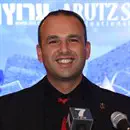
The Knesset Education, Culture and Sport Committee held a discussion this morning (Wednesday) on a bill to commemorate the October 7th masscre, marking 1,000 days since the attack.
During the discussion, Heritage Minister Amichai Eliyahu spoke about the importance of preserving the memory of the massacre and acts of heroism for future generations. At one point, when he addressed the controversy over commemoration, he had difficulty continuing his remarks and choked up with tears.
"It’s clear to me that none of the people present here want to erase the legacy, the massacre, and certainly not the stories of heroism that were there," the minister said. "Our people is known for its long-term memory. It is very hard for me to see this argument happening within us. It is hard for me to hear all the stories and what happened on October 7th."
Miniter Eliyahu said that the remembrance of the massacre events does not belong only to the bereaved families or to the communities that were harmed, but to the entire public in Israel. He said there were historical events and massacres from the past that did not receive sufficient preservation and called for drawing lessons also in the field of commemoration.
The minister said that immediately after the terror attack, the Ministry of Heritage turned to authorities and bodies operating in the area with a request to act to preserve the stories and sites for future generations. "We are in a natural tension between the desire to return to life and the need for us as a people to remember the stories, the obstacles and the mistakes," he said.
He later emphasized that commemoration at the original sites where the events took place is of special importance. "There is value in the heritage of a site that is in its proper place," he said, comparing it to the attempt to move the Western Wall to another location.
Continuing, he became emotional again and called for unity on the issue of commemoration. "We want this memory, so painful, not to be forgotten from our rebuilding and not because we will be divided," he said. "They tried to break us, and we broke them back militarily, but the point is also our spirit as a people."
The minister, Eliyahu, cited his late grandfather, Rabbi Mordechai Eliyahu: "When an olive tree is not connected to a tree, it is alone, sad for it, and it is bitter for it. But when an olive tree, or a sprout from its first day, is connected to its roots, it is not just a sprout from its first day. We are not only 70-year-olds or 3-year-olds."
He concluded his remarks with a call to reach understandings regarding how to preserve the memory of the massacre and heroism. "Let’s find a way to tell the story so they don’t forget. Reach understandings. We don’t want to be in this dispute because it’s their victory. We must find the way both to preserve and to live, both to preserve and to grow, because that is the only victory over our enemies."