

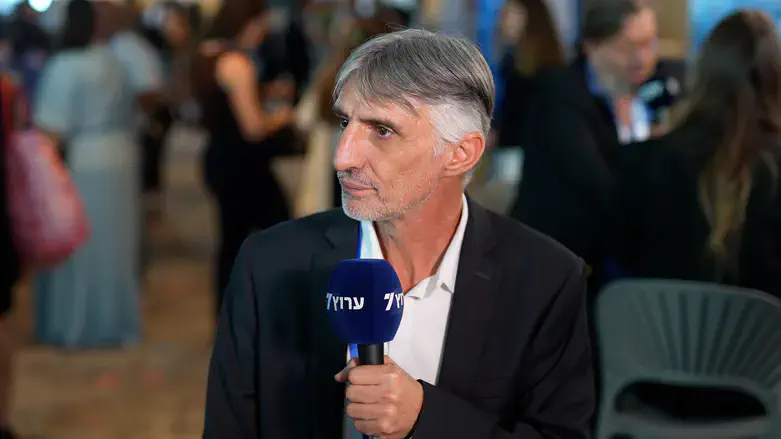
Beni Sabti, an Iran researcher at the Institute for National Security Studies (INSS), sharply criticized the U.S. administration and President Donald Trump during an interview with 103FM, arguing that Washington’s approach reflects weakness in dealing with Tehran.
“Trump’s roller coaster continues to go up and down," Sabti said. “They talk about releasing funds for the Iranians’ benefit, they restrict us in Lebanon, and at the same time say that if Iran does not behave, they will deal with it. It is very difficult to understand Trump."
Sabti accused the American leadership of sending mixed signals, saying: “All these games of give-and-take and delaying tactics create an ugly struggle that is difficult to resolve. There is a good cop and a bad cop; in Iran, suddenly there are more radicals and then fewer. The man is not sane. Trump is simply not sane."
The researcher also warned about the possibility of Iranian Supreme Leader Ayatollah Ali Khamenei’s son succeeding him, comparing the scenario to the biblical succession dispute involving King Solomon’s son Rehoboam. “Khamenei’s son is like Rehoboam: ‘My father disciplined you with whips, and I will discipline you with scorpions,’" he said.
During the interview, Sabti said that a regime change in Iran is unlikely in the near term and that Tehran’s leadership could actually strengthen once it receives additional funds. He cited remarks by Iran’s president that the country had managed in recent months to sell 36 million barrels of oil, with 20 million barrels transferred to the Islamic Revolutionary Guard Corps (IRGC) to help cover budget shortfalls.
“The money flows directly to the Revolutionary Guards," Sabti said. “The deal we are getting is the result of an American decision to buy oil; the Americans are financing the terrorism against us."
He added that most U.S. presidents have placed significant constraints on Israel, with the possible exception of President Richard Nixon, and said Israel faces a difficult strategic reality. “We don’t have raw materials; it is a very hard problem. We have brains, equipment, and high-tech, but sometimes it is not sold to the ordinary American on the street," he said.
Sabti also described the attitude of Iranian exiles in the United States, saying many have become skeptical of Trump and express frustration over what they see as a lack of American support. According to him, Iranian opposition activists use international events such as the World Cup as platforms for protests and display the former Iranian flag, while increasingly viewing Israel rather than the U.S. as a more reliable partner.
“Everyone understands that the confrontation will return," Sabti said. “Iran is deceitful; they want more. They were not satisfied with $6 billion."
Sabti referred to a report from three weeks earlier that surprised him, in which a Hamas spokesperson claimed Iran had contacted the group and sought to secure a ceasefire and the withdrawal of IDF forces from Gaza. He warned that this reflected the broader strategy of the Iranian regime, which he described as stretching from Lebanon, through its nuclear program, and into Gaza, based on the belief that Israel is weakening.
“There comes a moment when Israel needs to stand its ground and say ‘no,’" Sabti concluded. “Maybe then they will reconsider and speak with the Americans, because we are facing a very great challenge."