
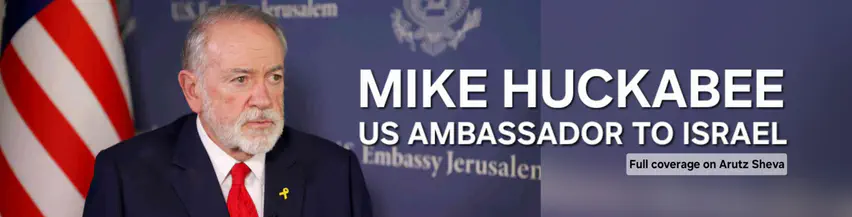

US Ambassador to Israel Mike Huckabee said Iran remains a central national security concern for Washington, stressing that President Donald Trump has been unequivocal in opposing any Iranian path to nuclear weapons, during a wide-ranging interview with the Institute for National Security Studies (INSS).
Asked whether the US would support further Israeli military action should Iran move to cross nuclear or ballistic missile thresholds, Huckabee emphasized that such decisions are made at the White House level. However, he pointed to the President’s consistent public statements. “He consistently has said Iran is never going to enrich uranium and they're not going to have a nuclear weapon,” Huckabee said, adding that the message has not changed following the recent conflict.
Huckabee said Iran’s continued efforts to rebuild its nuclear infrastructure pose a threat beyond Israel and the US, suggesting Tehran may only recently have begun to take US warnings seriously. “Iran, I don't know that they ever took him seriously until the night that the B-2 bombers went to Fordow,” he said. “I hope they got the message, but apparently they didn't get the full message because … they appear to be trying to reconstitute and find a new way to dig the hole deeper, secure it more.”
He stressed that the danger extends well beyond the immediate region. “This presents a real threat to all of Europe,” Huckabee said, adding that failure to recognize that threat would reflect a serious lack of understanding. He noted that Iran has openly threatened both Israel and the United States for decades, describing Israel as “the appetizer,” while its ultimate objective remains the United States.
The ambassador also addressed the global rise in antisemitism, citing recent attacks on Jewish communities and growing concerns in the US. He pointed to President Trump’s appointment of a special envoy to combat antisemitism as evidence of the administration’s priorities. “It shows to some degree how much President Trump is trying to make this a priority,” Huckabee said.
Referring to anti-Israel slogans heard on university campuses, Huckabee warned that many demonstrators fail to grasp their implications. He said chants such as “from the river to the sea” constitute a call for Israel’s destruction, including all of Judea and Samaria and the rest of the country.
On the erosion of bipartisan support for Israel in the US, Huckabee expressed concern over generational trends, particularly among younger Americans. He attributed much of the shift to social media, which he described as a primary source of misinformation. “We have not downloaded the proper data, the correct, the true data into the minds of younger people,” he said.
Turning to military cooperation, Huckabee reaffirmed the US commitment to maintaining Israel’s qualitative military edge. He said the policy remains enshrined in US law and expressed hope for early progress on renewing the next 10-year Memorandum of Understanding between the two countries. He also highlighted what he described as the mutual benefits of defense cooperation, including Israel’s operational use of advanced US systems.
Regarding Gaza, Huckabee said US and Israeli objectives remain aligned, particularly on dismantling Hamas and preventing it from retaining any governing role. He cited President Trump’s peace plan, stating that reconstruction is impossible while Hamas remains armed. “If you don't get rid of Hamas, then how are you going to rebuild?” he asked.
Huckabee said President Trump has repeatedly stated that Hamas “will have no future in Gaza” and must disarm and release all hostages. He warned that delays only allow the terror group to strengthen its position.
Addressing Israel’s northern front, Huckabee said he believes an agreement between Israel and Syria is possible, though he declined to predict timelines or terms. He said Syria’s leadership understands that stability depends on peaceful coexistence with Israel and secure borders that prevent future attacks.
On Lebanon, Huckabee acknowledged the limitations of the Lebanese Armed Forces in confronting Hezbollah, saying their capacity must gradually increase. He said Israel cannot afford to disengage prematurely while Hezbollah continues to receive Iranian support, but expressed hope for a gradual transfer of responsibility as Lebanese institutions strengthen.