

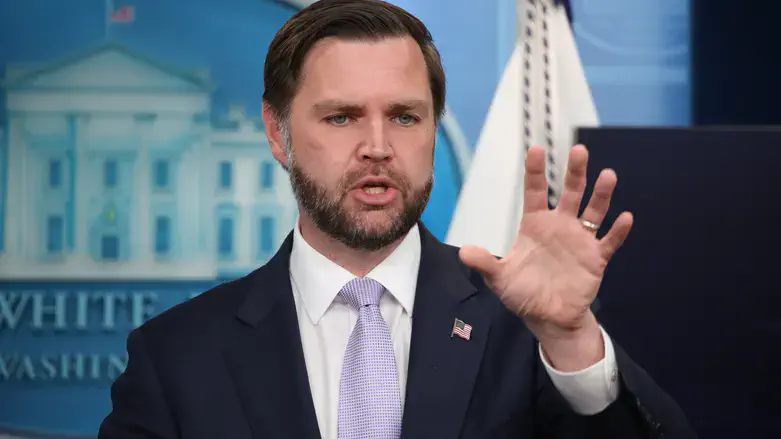
US Vice President JD Vance arrived in Switzerland on Saturday to spearhead high-stakes, direct diplomatic talks with an Iranian delegation, Axios reported.
The critical summit, slated to begin Sunday at the Bürgenstock alpine resort, marks the first face-to-face encounter between Washington and Tehran since their April session in Islamabad, signaling the official launch of an intense 60-day nuclear negotiation window.
The high-level rendezvous proceeds despite a volatile geopolitical backdrop, highlighted by Tehran's Saturday declaration that it was shuttering the Strait of Hormuz in response to alleged Israeli ceasefire breaches in Lebanon.
Acknowledging the fragility of the diplomatic atmosphere prior to his departure from Washington, Vance stated, “I think we're going to hopefully make progress on the nuclear issue, make progress on the Lebanon ceasefire issue. Those are the two big things that I think we're to be focused on."
The groundwork for the summit was laid earlier Saturday morning when White House envoys Steve Witkoff and Jared Kushner arrived on-site, followed later in the day by the Iranian continent led by Foreign Minister Abbas Araghchi and Parliament Speaker Mohammad-Bagher Ghalibaf.
A robust mediation team - comprising the prime ministers of Qatar and Pakistan, Pakistan's top general, and the head of the International Atomic Energy Agency (IAEA) - is present to facilitate the dialogue.
Vance indicated that the introductory round is geared toward "getting the actual structure and negotiation in place," noting he intends to stay for a day or two of the sessions, while technical working groups will remain in Switzerland to sustain prolonged expert-level talks.
Behind closed doors, regional sources with direct knowledge told Axios that Washington's immediate objective is securing a formal Iranian invitation for UN inspectors to return to its atomic facilities, which were previously struck by joint US and Israeli operations.
If Tehran permits the inspections - the first since June 2025 - the US is prepared to unfreeze a $6 billion Iranian account designated for humanitarian purchases in Qatar.
Witkoff told Congress members last week that Iran intends to grant the United Nations' nuclear watchdog access to its atomic facilities.
To date, Tehran has withheld information from the IAEA regarding the present location or condition of that material, while concurrently blocking inspectors from conducting assessments at the bombed facilities.
An agreement announced last September between Iran and the IAEA, intended to resume inspections and uranium accounting, has since been declared void by Tehran after Britain, France, and Germany triggered the return of UN sanctions previously lifted under the 2015 nuclear deal.
Though a temporary renewal of commitments to the Lebanon ceasefire was announced by Israel and Hezbollah on Saturday, the peace remains incredibly fragile following a rapid breakdown of a similar truce on Friday. Despite concerns that the border conflict could shatter the Swiss negotiations, Vance maintained a measured outlook on the de-escalation tracks overseen by Secretary of State Marco Rubio.
“Despite the headlines, things are actually getting better there, and things are slowing down a little bit. It's going to be something we're just going to have to continuously manage to ensure that Israel and Lebanon are both safe and secure," Vance concluded.