
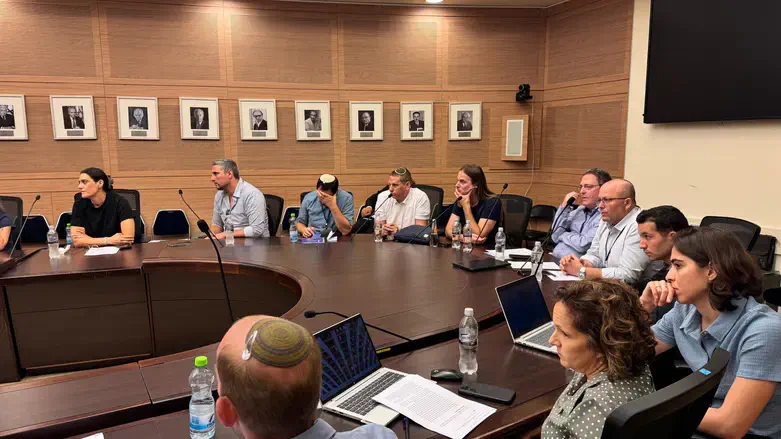
The Knesset Foreign Affairs and Defense Committee, chaired by MK Boaz Bismuth (Likud), has approved for its first reading a bill to freeze funds transferred by the Palestinian Authority linked to terrorism from the revenues transferred to it by the Israeli government.
The bill, introduced by MK Moshe Passal (Likud), stipulates that each year an amount equal to the funds paid by the Palestinian Authority to the Gaza Strip in the preceding year will be frozen, and that these frozen funds will be used to compensate victims of terrorism from the Gaza Strip.
The first part of the session was held in public, with the participation of bereaved families who lost their loved ones in the October 7 attacks and who sought to advance the legislation. The second part of the hearing was held behind closed doors, during which the positions of relevant government ministries and agencies were presented.
Ben Zoherman, whose father was murdered at the Sha'ar HaNegev junction on October 7, said, "I don't know where the terrorist who murdered my father is today. We know that some of the terrorists operating at that junction returned to Gaza that same day. I don’t know if justice will ever be served, and I don’t know who can be held accountable."
He added that his family members are excluded from certain existing assistance frameworks, describing a feeling that families are left without an adequate response. Galit Shopen, whose brother Ziv Shopen was murdered in Kibbutz Be'eri, said, "No amount of money will fill the void Ziv left behind, nor can it restore what we lost. But if there are funds originating from entities that for years encouraged, supported, or rewarded terror-related activities, I believe it is right and just that these funds be channeled to compensate the families of terror victims and aid those harmed by acts of terror."
Moshe Saville from the OneFamily organization said that the NGO supports thousands of families affected by terrorism and war, noting that the bill meets a tangible need for bereaved families.
"Nothing will bring back those we lost. No amount of money in the world can erase the pain or blur the loss. But it can grant the families a modicum of peace, a bit of stability, and some breathing room amid the harsh reality they live in," said Saville.
A representative from the Ministry of Justice presented legal difficulties during the hearing regarding the application of the law to victims of October 7, claiming that existing law allows the Palestinian Authority to be held liable for damages in tort lawsuits when it can be proven that it transferred payments to the perpetrator of an attack, and there is even precedent ruling that a single payment to a terrorist can establish the required legal nexus.
The representative further noted that there is a complex factual and legal question regarding the Palestinian Authority's involvement in the massacre and whether it had previously paid any of the terrorists who participated in it. She stated that based on currently available information, the answer is likely negative for many of those involved in the October 7 attacks, making the central challenge proving the necessary link between the funds and the terrorists who took part in the massacre.