
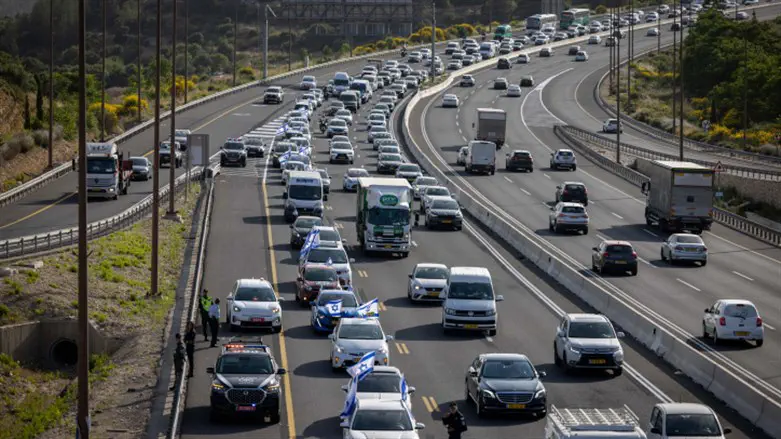
Transportation Minister Miri Regev has announced plans to increase the speed limit on certain roads in Israel from 90 km/h to 110 km/h.
The proposal has sparked debate over whether the move will improve traffic flow or lead to more dangerous accidents. To address the issue, jurist and traffic law expert Attorney Aryeh Oranj spoke about the implications of the decision.
Oranj welcomed the minister’s plan, saying that raising speed limits on appropriate roads is justified due to advances in vehicle safety technology and improvements made to Israel’s road infrastructure. He pointed to the Tel Aviv-Jerusalem highway as a prime example, noting that its major renovations in recent years created a safer road with better visibility and conditions for higher-speed travel.
According to Oranj, court cases involving speeding offenses show that the issue has become a significant source of state revenue rather than a genuine public safety measure.
He explained that prosecutors often argue drivers endangered the public by exceeding the speed limit, but said the circumstances of many cases do not support that claim. As an example, he cited enforcement on the Tel Aviv-Jerusalem highway, where police frequently place laser speed cameras near the Beit Shemesh interchange, issuing large fines and suspending licenses for drivers who exceed the limit - even though the road section is not near residential areas and does not pose a direct danger to others.
Oranj said these conclusions are supported by studies conducted by the Transportation Ministry.
Asked whether higher speeds could still endanger drivers on highways even outside residential areas, Oranj argued that modern vehicles and improved roads have changed the reality. He claimed that excessively low speed limits can cause drivers to become distracted by factors unrelated to driving, while higher speeds encourage greater concentration behind the wheel.
He also said that unnecessarily low speed limits contribute to traffic congestion, which increases frustration and impatience among drivers. According to Oranj, Transportation Ministry studies presented to the Knesset support this position and show that the proposal is not merely a political gesture.
At the same time, Oranj stressed that stricter punishment is appropriate in cases involving dangerous behavior such as driving while using a phone or failing to maintain proper control of the vehicle.
“On proper roads and with proper vehicles, there is no reason not to raise the speed limit," he said.
He also pointed to Begin Road in Jerusalem as another example, arguing that a road with three lanes in each direction should not be treated like a typical urban street. In his view, the speed limit there should be raised to 100 km/h and possibly even 110 km/h.
Oranj added that excessive enforcement on roads designed for higher speeds has become little more than a revenue mechanism for the state.
Regarding comparisons with speed limits in other countries, Oranj said such comparisons are complicated because every road has different characteristics. Instead, he argued, each road should be evaluated individually, and where conditions allow, such as on the Tel Aviv-Jerusalem highway, speed limits should be increased.