

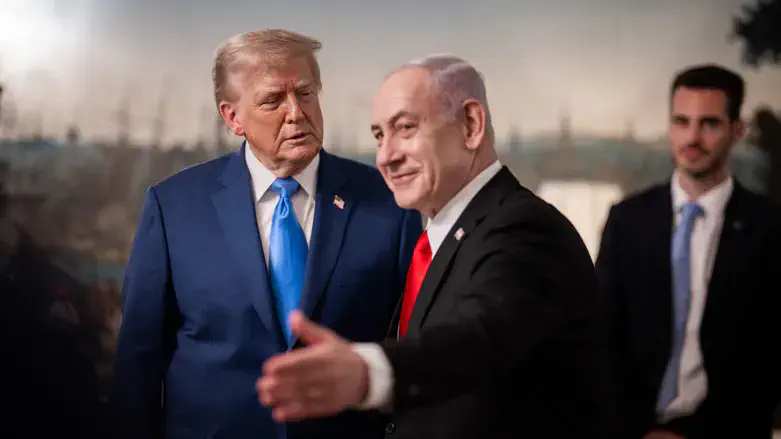
Behind the Israeli decision to halt strikes in Iran at the request of US President Donald Trump lies a dramatic 24 hours of coordination, conflicting messages, and heavy American pressure on Prime Minister Benjamin Netanyahu, according to a Ynet report published on Monday evening.
Sources familiar with the talks quoted in the report said that Israel had prepared for a far more significant strike in Iran, but Trump blocked it at the eleventh hour after realizing the situation could spiral into a broad regional escalation and jeopardize negotiations for an agreement with Tehran.
The sources claimed that contrary to the impression left by Trump’s public statements, the US president knew in advance about the Israeli strike in the Dahieh suburb of Beirut, to which Iran responded by firing missiles at Israel. According to these insiders, Trump had even authorized Netanyahu to strike Beirut if Israeli localities were hit, though he later projected a different narrative, claiming he had no advance knowledge of the attack. The same sources also contend that the claim that Trump was completely unaware Israel would strike during the night does not reflect the full picture.
According to the report, the IDF briefed US Central Command (CENTCOM) on all details of the strike, including the target list. The American understanding was that Israel would conduct a limited operation in the Dahieh to send a message of deterrence to Hezbollah and Lebanon, and then conclude the operation. Trump reportedly went to sleep knowing that Israel was expected to strike, but under the assumption that it was a measured move that would not drag the entire region into a major escalation.
However, in the early morning hours, when it became clear in Washington that Israel was also preparing a far more substantial response inside Iran, the picture changed. Trump realized that Israel might expand the campaign and strike strategic targets in Iran in retaliation for the Iranian missile fire and developments in Lebanon. A source familiar with the details said the White House feared Netanyahu was effectively trying to derail the possibility of reaching an agreement with Iran by forcing a new security reality.
At that stage, Trump called Netanyahu. The president made it clear to the prime minister that if Israel launched a wide-scale strike in Iran, it would stand alone. Netanyahu, conversely, argued that Israel must respond following the Iranian fire, warning that a failure to act would damage deterrence. While Trump understood the Israeli need to retaliate, he demanded that the response be limited, measured, and formatted so as not to trigger an open campaign against Tehran.
Israel had already prepared plans for a much more extensive operation than the one executed - one that was supposed to involve dozens of fighter jets hitting a series of targets across Iran. However, following the call with Trump, Netanyahu informed the defense establishment that the plans had to be suspended. The IDF stood down the strikes planned for the remainder of the day and night, halting the operation long before it ran its course from an Israeli perspective.
The resulting sentiment in Israel is one of profound disappointment, according to Ynet. Jerusalem believed the situation could have been leveraged to achieve significant gains against Iran - especially after the regime in Tehran attempted to establish a new equation whereby an Israeli strike in Lebanon would be met with direct fire toward Israel. For officials in Israel, this was a missed opportunity to make it clear to the Iranians that such an equation would carry a heavy, direct price.
However, Tehran acted quickly. Recognizing that Trump desired above all else to prevent regional deterioration and preserve the possibility of a nuclear deal, the Iranians announced in the morning hours that they were ready to halt military operations. This announcement provided Trump with the diplomatic window he needed to pressure Netanyahu into halting the strikes and ending the event before it spun out of control.
The Ynet report concluded that the events of the past 24 hours illustrate the strict boundaries of Israel’s freedom of action against Iran when Washington opposes escalation. Even if Jerusalem frames the event as close coordination between allies, in practice, it was Trump who drew the line.