


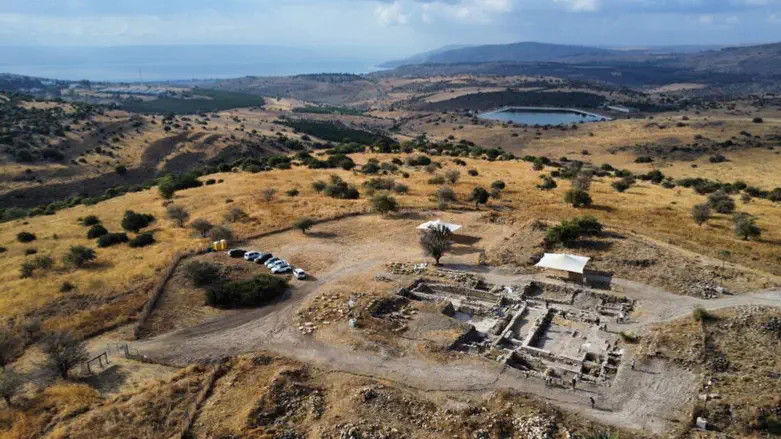
A new US-Israel heritage initiative has been launched to preserve the ancient synagogue at Huqoq, northern Israel, while making the site accessible to audiences in Israel and around the world through digital experiences, educational resources, and immersive interpretation.
The Judeo-Christian Heritage in the Galilee Project was announced last week at Huqoq in the presence of US Ambassador to Israel Mike Huckabee and representatives of leading Israeli and American institutions.
Although the synagogue has attracted international attention since its mosaic floors were first discovered in 2012, the archaeological site has never been open to visitors. The new initiative combines archaeological excavation and conservation, public interpretation, and digital engagement, laying the foundation for the synagogue's eventual opening while allowing the public to explore its history through digital platforms.
The excavations at Huqoq, directed by Professor Jodi Magness of the University of North Carolina at Chapel Hill, uncovered one of Israel's most important Late Antique synagogue sites. Its mosaic floors, noted for their artistic quality, preservation, and diverse iconography, have contributed to new scholarly understanding of Jewish life and visual culture in Roman-Byzantine Galilee. Alongside biblical narratives, the mosaics also include rare scenes that continue to inspire research.
While conservation and site development continue, the project will provide public access through a dedicated website, a three-dimensional reconstruction of the synagogue, educational materials, documentary films, and interpretive content.
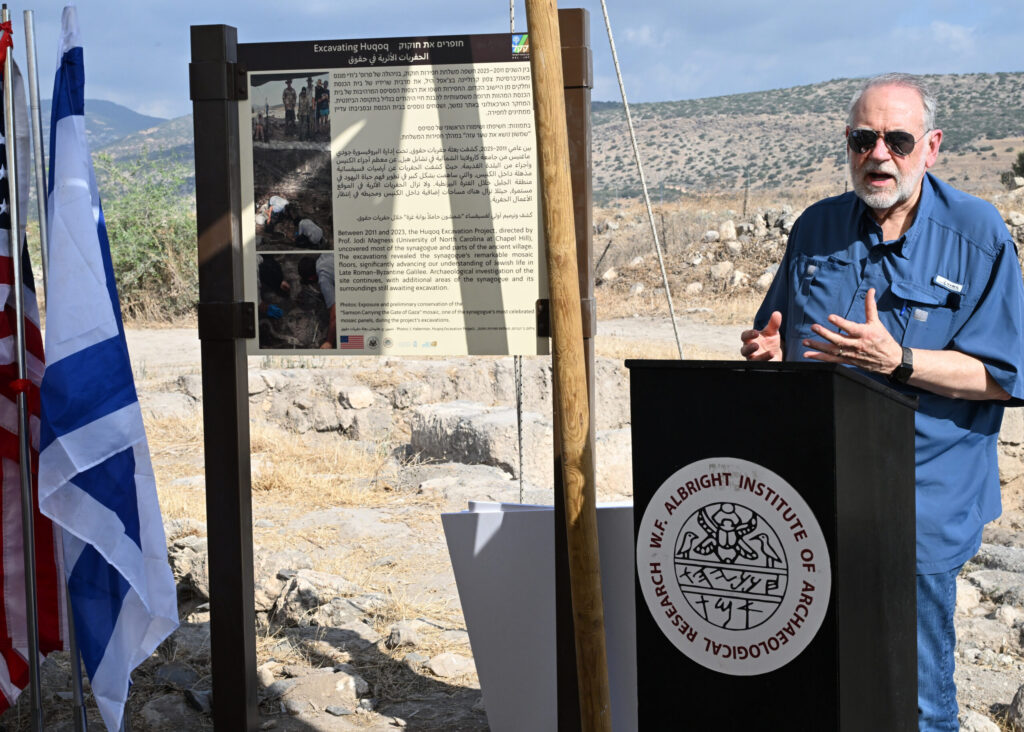
The project is being implemented by the W. F. Albright Institute of Archaeological Research, funded by the US Department of State through the Bureau of Educational and Cultural Affairs' Cultural Heritage Center and the US Embassy in Jerusalem as part of the Freedom 250 initiative, which commemorates the 250th anniversary of the United States through international partnerships focused on shared heritage, education, and cultural exchange.
"As Huqoq enters this important new phase, the United States is proud to partner with Israeli institutions to preserve one of the region's most significant archaeological treasures while making its remarkable story accessible to people around the world," Ambassador Huckabee said. "This initiative reflects our commitment to preserving shared cultural heritage through international cooperation and education."
Dr. James Fraser, Director of the W. F. Albright Institute of Archaeological Research, said, "For more than a century, the Albright Institute has connected scholarship and heritage preservation. This project ensures that extraordinary archaeological discoveries are not only preserved, but also shared with audiences around the world."
Professor Magness said, "The discoveries at Huqoq have transformed our understanding of Jewish life in Late-Byzantine Galilee. It is exciting to see the site entering a new phase that preserves these remarkable remains while making them accessible to broader audiences."
The initiative brings together the Israel Antiquities Authority, Keren Kayemeth LeIsrael-Jewish National Fund (KKL-JNF), the Huqoq Excavation Project at the University of North Carolina at Chapel Hill, the Yigal Allon Centre, and additional Israeli partners.
The Israel Antiquities Authority is leading conservation work to stabilize and protect the synagogue's remains in preparation for future public access.
"Conservation ensures that archaeological discoveries become lasting public heritage. Our responsibility is to protect these exceptional remains for future generations," said Israel Antiquities Authority Director Eli Escusido.
KKL-JNF, as the site's landowner and long-term steward, is advancing plans to develop Huqoq as one of the Galilee's leading heritage destinations.
"Preserving Israel's heritage and making it accessible to the public are an integral part of KKL-JNF's mission," said KKL-JNF Chairman Eyal Ostrinsky. "Alongside protecting landscapes and open spaces, we work to ensure that the cultural and historical treasures of the Land of Israel continue to tell the story of the Jewish people for generations to come. Our commitment to Huqoq reflects this mission, as we continue to preserve this extraordinary archaeological site while developing it as one of the Galilee's leading heritage destinations."
The project also supports a dedicated exhibition on Huqoq currently on display at the Yigal Allon Centre.
"For years, Huqoq has transformed our understanding of the ancient Galilee," said Dr. Shua Kisilevitz, Project Director on behalf of the Albright Institute. "Our challenge now is to transform this extraordinary discovery into a heritage site people everywhere can experience. Archaeology reveals the past. Heritage makes it part of our future."
According to the organizers, the Huqoq initiative is the first phase of the broader Judeo-Christian Heritage in the Galilee Project, a multi-year effort to preserve, interpret, and share important Jewish and Christian heritage sites across the Galilee. Future phases are expected to expand to additional sites, including Bethsaida.