

The IDF held situational assessments and operational activity throughout Sunday night and early Monday morning, following the latest developments on the Iranian front.
The military assesses that Iran is presenting its missile attack on Israel as defense of its proxies in the region, but stresses that Iran was the one that violated the ceasefire, which had lasted about two months, by firing directly at Israeli territory.
The IDF rejected foreign media's claims that Israel violated the ceasefire.
The IDF also stressed that the decision to take action in Iran was made after extensive staff work that included examining a range of scenarios and operational possibilities, with the scenario that unfolded being one of those reviewed in advance.
Since the beginning of April, the IDF has maintained high readiness in both its defensive and offensive arrays, based on the assessment that the campaign against Iran had not yet ended. The military says that the prolonged readiness enabled a rapid response when fire resumed, as well as activation of operational plans prepared in advance.
At the same time, close coordination is being maintained with the United States and US Central Command (CENTCOM). The IDF noted that Chief of Staff Lt. Gen. Eyal Zamir has spoken with the CENTCOM commander three times since Sunday, and that US military officials were updated on the developments. According to the IDF, the strikes carried out so far in Iran are Israeli only, while the United States is assisting in the defensive effort.
According to IDF data, between 22 and 24 missiles were launched at Israel from Iran overnight. In addition, the Houthis launched three more missiles, one of which fell en route and two of which were intercepted. The military is preparing for at least several days of fighting, as well as the possibility that the campaign will expand to additional arenas.
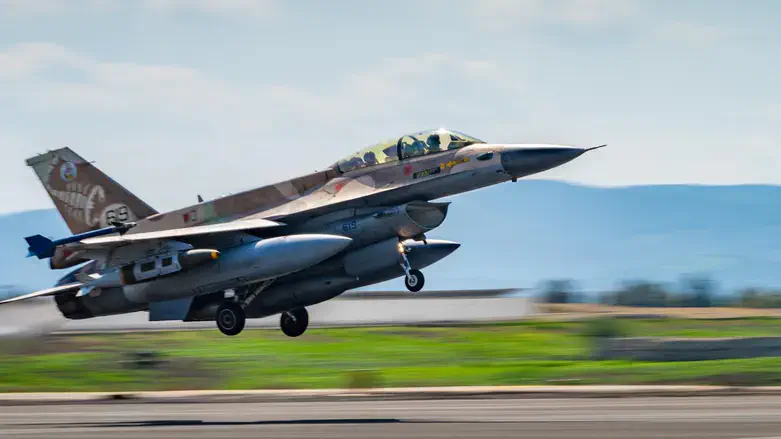
With the renewal of fire, two main waves of strikes were carried out in Iran. The first wave included two separate efforts in western and central Iran, while during the morning, three factories in a petrochemical complex used to manufacture and export chemical materials for the Iranian regime were struck.
In total, according to the IDF, nine air defense system targets and three factories in the petrochemical complex were struck. The military stresses that additional target banks and follow-up plans exist to deepen the damage to the Iranian regime’s capabilities.
The IDF clarified that this is not the launch of a new operation, but a direct continuation of Operation Roaring Lion. Over the past two months, battle procedure continued alongside high readiness, in preparation for the possibility of renewed fighting.
On the northern front, the IDF continues to operate in Lebanon and is holding ongoing situational assessments. The military noted that yesterday’s strike in Dahieh targeted a command apartment involved in the drone operations, and according to intelligence assessments, two Hezbollah terrorists were killed and nine others were wounded, including commanders at battalion level.
Military officials said that following the extensive damage caused to Hezbollah infrastructure in recent months, the terror group is operating from hideout apartments and alternative locations, and therefore the nature of the target bank has changed. Decisions on additional strikes are made according to operational opportunities, intelligence considerations, and diplomatic considerations.
The IDF stressed that the central goal of the campaign is to deeply harm the Iranian regime and its capabilities, while seeking to divide the various arenas. It also assessed that air superiority can be achieved quickly, stressing that Israel will continue to act to prevent Iran from creating a new reality in the Middle East.
The IDF further stated that it is preparing both for the possibility that Hezbollah will refrain from joining the fighting and for the possibility that it will open an additional front.
At the same time, civilian defense policy has been updated, with the military emphasizing that at this stage it is not possible to accurately assess the duration of the fighting, but the assessment is that the campaign will continue for at least several days, and possibly beyond.