

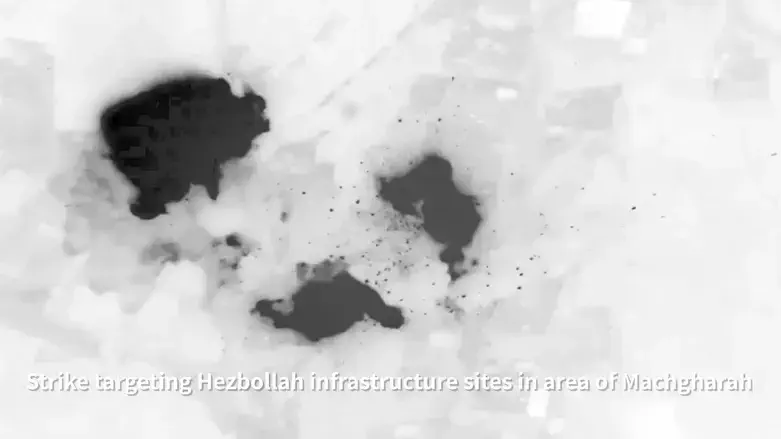
The world's diplomatic attention is fixed on Pakistan, on ceasefire memoranda, on whether Mojtaba Khamenei will emerge from hiding long enough to initial a document. In that distraction, Israel has done something strategically significant in Lebanon that has received almost no serious analysis (but was highlighted on Arutz Sheva). It has crossed the Litani River.
Israeli forces have advanced beyond the Litani, a line that for decades functioned as an unofficial boundary in southern Lebanon. Troops are now pushing northward toward the Zahrani River, roughly ten kilometers away. The IDF has declared the entire area between the two rivers an active combat zone, has destroyed several bridges spanning the Litani to sever Hezbollah's supply lines, and has called on all residents of southern Lebanon below the Zahrani to evacuate north.
This is not a raid. It is a territorial reorganization.
The Litani has been a symbolic and political threshold for half a century. UN Security Council Resolution 1701, which ended the 2006 war, was premised on Hezbollah withdrawing north of it - but it did not. Every subsequent diplomacy around southern Lebanon treated it as a floor below which Israeli power would not permanently project.
Israel has now made clear that floor no longer holds, and it has done so with almost no international outcry, because the world is watching Iran.
The timing is not coincidental. Israel is shaping the battlefield while nuclear talks proceed, understanding something that Western commentators consistently underestimate: the leverage in any negotiation is determined by the facts on the ground, not by the goodwill of the parties at the table.
Every kilometer of southern Lebanese territory that Israeli forces consolidate before a permanent deal, if one will be made, is a kilometer that will have to be explicitly negotiated back, if it is negotiated back at all.
The operational logic is coherent. Hezbollah initiated this conflict, reentering in March after launching rockets and drones in alleged retaliation for the killing of Iran's supreme leader, tearing up the 2024 ceasefire and giving Israel the justification it needed for a new campaign. Israel is not going to repeat the experience of allowing Hezbollah to reconstitute south of the Litani after every round.
The buffer is being built this time, not promised. The bridges are down. The supply routes are cut. The terrain between the two rivers is being cleared methodically, and Israeli officials have been explicit that the objective is to prevent Hezbollah from ever again using that corridor to threaten northern Israeli communities. And the line is moving towards a point that may make explosive drone launches out of range.
Operations are continuing despite a US-brokered ceasefire nominally in place since mid-April and despite a fourth round of direct talks scheduled for early June. That simultaneity is the point. Israel is presenting Washington with a fait accompli while American diplomats are focused elsewhere, betting that no one will demand a full Israeli withdrawal from newly secured territory as part of a ceasefire framework that is itself still unresolved.
The Lebanese government is calling what is happening a scorched-earth policy. The humanitarian effects are unavoidable, though Israel warns civilians. None of that changes the underlying military calculus, and Israel is not pretending otherwise. Hezbollah's capacity to threaten northern Israel from southern Lebanon depends entirely on its ability to control and transit that terrain. Denying it that terrain is not a side effect of Israeli operations. It is the objective.
What remains to be seen is whether the United States will allow the Lebanon track to be settled on Israeli terms before the Iran nuclear talks conclude, or whether Washington will pressure Jerusalem to freeze its gains in exchange for a broader regional package.
If the pattern from Gaza holds, the pressure will come. And if the pattern from Gaza holds, it will be resisted. Hamas has not disarmed despite the Trump plan. Israel has learned that every ceasefire accepted before the military objective is achieved becomes the starting point for the next round. The Zahrani River, not the Litani, may turn out to be the line that matters.
Amine Ayoub, a fellow at the Middle East Forum, is a policy analyst and writer based in Morocco. Follow him on X: @amineayoubx