

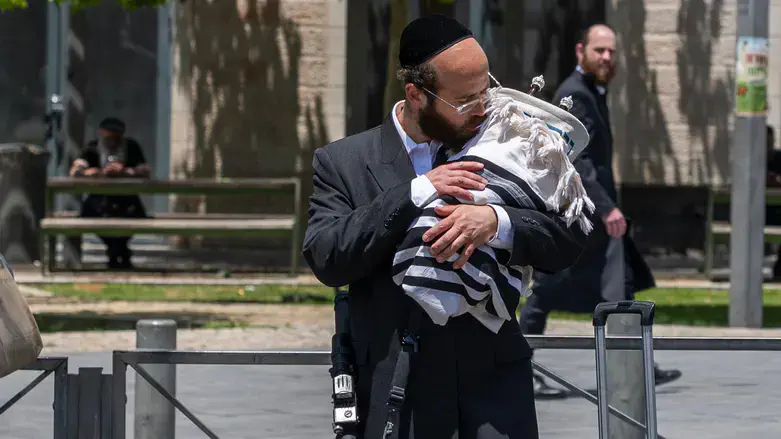
Captain (res.) Rabbi Yehuda Weitzman, 34, a Gur Hasid, a soldier and rabbi in the Hashmonaim Brigade, describes the path he took from the yeshiva study hall to full military service, against the backdrop of the photo taken this week that went viral on Israeli media.
Weitzman, father of three, grew up in Jerusalem and studied in yeshiva, and enlisted in 2018 for full military service. In an interview with Yedioth Ahronot he explained that he felt a need to be connected to the whole of Israel, and notes, "In the IDF there is a special unity - there are no class distinctions, no politics, it is a clean place that connects parts of the nation and allows one to be connected to the whole of Israel, to sanctify God's name and to touch hearts."
On the morning of the October 7th massacre Weitzman went to the Gaza region and was later assigned to handle casualties at Camp Shura. He describes experiencing emotionally intense days there, and that he saw what happens to a people that does not stand guard over itself.
Subsequently he served in various roles, including battalion rabbi in brigades that fought, among other places, in the Gaza Strip and in Lebanon, as well as in an additional staff position.
Despite his significant roles in the war, Weitzman felt like a supporter rather than a player. When the Haredi Hashmonaim Brigade was established, he chose to renounce his ranks and undergo combat basic training from the start. "I turned in my promtion and did combat basic training from the beginning. I am a captain and my training officer was a staff sergeant. But it was worth everything: now I am no longer a supporter - I am a soldier, a player on the field."
Alongside his combat service, Rabbi Weitzman organizes fundraising for various units and reports on widespread mobilization within the haredi public since October 7. "I brought donations to the IDF even from Satmar anti‑Zionist Hasidim in the United States, who donated operational equipment worth tens of thousands of shekels."
He saw Rabbi Avi Goldberg, who fell in Lebanon, as a role model, who combined the role of rabbi with that of a combat soldier. "I wanted to be like him: a rabbi who is not only responsible for kashrut, but who leads and is present on the ground. I am proud to follow in his path."