
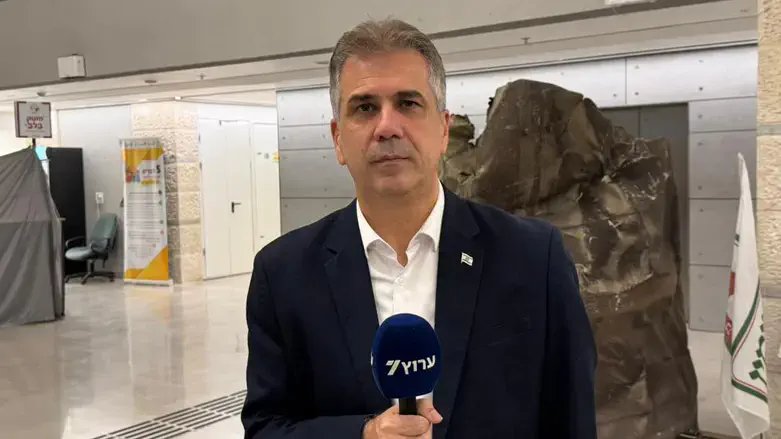
Energy and Infrastructure Minister and member of the security cabinet Eli Cohen visited the Binyamin Regional Council’s emergency operations center on Monday and spoke with Arutz Sheva-Israel National News about the security situation and the government’s plans to strengthen Jewish communities in Judea and Samaria.
Cohen said security forces in the area have been on heightened alert in recent years. “We have been operating under increased readiness and vigilance in Judea and Samaria over the past two years, and especially during the current period," he said. “The IDF, Border Police, and Israel Police forces are all on alert in order to ensure ongoing security here."
The minister also outlined the government’s policy for expanding and strengthening Jewish communities in the region. “It’s clear to everyone that we are strengthening Judea and Samaria, the homeland of our forefathers," Cohen said. “Recently I had the opportunity to approve dozens of additional communities in the cabinet. Together with Regional Council head Israel Gantz, I visited some of the newly approved communities. We are working to connect them to electricity and water infrastructure, on the way to more than one million Jews living here in Judea and Samaria."
Asked whether this is the right time to advance Israeli sovereignty in the area, Cohen said the government is already doing so in practice. “We are advancing sovereignty in action, not just in words. That’s what I’ve done in every role I’ve held."
He also addressed the issue of investments in regional infrastructure, noting that the government is promoting large-scale plans in the energy and water sectors. “Together with Minister Smotrich, we redirected funds to support an unprecedented investment of more than one billion shekels in water infrastructure," he said. “This includes connecting infrastructure to the new communities. Judea and Samaria is experiencing significant momentum. In addition, I plan to build four power stations in Judea and Samaria that will drive economic growth and provide high-quality employment opportunities for residents throughout the area."
Turning to the situation in northern Israel, Cohen said Israel would act decisively against Hezbollah. “Pressure from France or any other country that thinks it can lecture Israel about its security is irrelevant. The only thing that matters to me is the safety of Israel’s citizens."
He added that, in his view, Israel should cancel the maritime gas agreement with Lebanon. “The gas agreement with Lebanon, which was signed in sin by Bennett and Lapid, should be revoked," Cohen said. “At the same time, we must ensure the safety of northern residents and clear the area up to the Litani River, including through ground operations if necessary. Everyone understands that the Lebanese government and army do not have the capability to do this. We do not outsource our security - we will carry out the task ourselves."
Cohen said earlier predictions about Hezbollah’s firepower have not materialized. “There were forecasts of thousands of rockets being launched every day, thousands of casualties, and widespread destruction. That is far from reality. Instead, we see an organization that is being pursued, humiliated, and exposed by Israel."
He added that with the launch of operations against Iran, Israel has already taken steps to create a buffer zone along the northern border. “We established a buffer zone not only at key control points but along the entire border. This buffer zone will continue to expand, and from a security perspective, I believe it must extend to the Litani River."
Cohen also rejected criticism from opposition leader Yair Lapid over advancing the state budget during wartime. “We are moving forward with the budget because it is the right thing to do now, in order to ensure we have the full resources required for security," he said. “Everyone has set their ego aside because this is a historic campaign. Our focus is on what matters most - achieving victory."
Concluding his remarks, Cohen said it is difficult to set a timeline for the end of the conflict. “We are not operating with an hourglass. We will act for as long as necessary to achieve our objectives. This is a historic and unprecedented campaign that will shape the future of the State of Israel and the Jewish people for generations."
Watch the Hebrew video: