

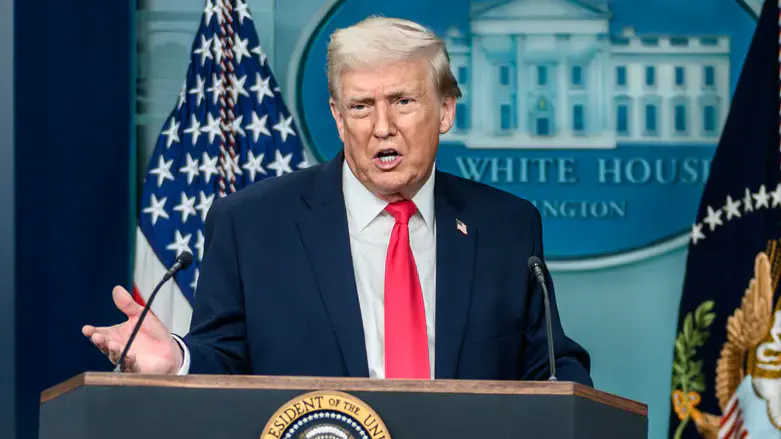
US President Donald Trump revealed on Monday that the US was planning on striking Iran on Tuesday, but postponed the attack because what he referred to as "serious negotiations" were being held.
The President clamed on Truth Social that he was asked by leaders in the region, namely the Emir of Qatar, Tamim bin Hamad Al Thani, the Crown Prince of Saudi Arabia, Mohammed bin Salman Al Saud, and the President of the United Arab Emirates, Mohamed bin Zayed Al Nahyan, to "hold off on our planned military attack of the Islamic Republic of Iran, which was scheduled for tomorrow, in that serious negotiations are now taking place, and that, in their opinion, as great leaders and allies, a deal will be made, which will be very acceptable to the United States of America, as well as all countries in the Middle East, and beyond."
According to Trump, "This Deal will include, importantly, no nuclear weapons for Iran!"
He concluded: "Based on my respect for the above mentioned Leaders, I have instructed Secretary of War, Pete Hegseth, The Chairman of The Joint Chiefs of Staff, General Daniel Caine, and The United States Military, that we will not be doing the scheduled attack of Iran tomorrow, but have further instructed them to be prepared to go forward with a full, large scale assault of Iran, on a moment’s notice, in the event that an acceptable deal is not reached."
US President Donald Trump stated in an interview with the New York Post on Monday that Iran knows “what’s going to be happening soon" as the fragile ceasefire between the US and the Islamic Republic continues to fray.
Trump further stated that he is “not open" to further concessions to Iran.
The statements come after Iran submitted a new proposal for a deal via Pakistani mediators, which contained only limited changes from previous versions.
The proposal reportedly includes broader language regarding Iran’s commitment not to pursue nuclear weapons, but does not include detailed commitments concerning uranium enrichment or Iran’s stockpile of highly enriched uranium.
Pakistani sources said the updated Iranian proposal included a commitment not to produce nuclear weapons, but did not address the issue of enriched uranium or developments surrounding the Strait of Hormuz.
A senior Iranian official told Reuters that Washington had shown flexibility in discussions with Tehran, including regarding restrictions on Iran’s nuclear program. According to the official, the United States has agreed at this stage to unfreeze 25 percent of Iran’s frozen funds under a defined timetable.
The Iranian official said Tehran is demanding the release of all frozen assets, as well as a permanent end to the war, the lifting of sanctions, and the reopening of the Strait of Hormuz.
However, a report by Axios cites a US official who said that the new proposal does not represent a meaningful improvement and remains insufficient to secure an agreement.
The report also said the US rejected claims in Iranian state media that Washington had agreed to sanctions relief during the talks. According to the official cited by Axios, the US position remains that sanctions relief would require reciprocal steps by Tehran.
“We are really not making a lot of progress. We are at a very serious place today," the senior US official said, according to the report