
Michel Gurfinkiel is a French conservative journalist and public intellectual. He served as editor-in-chief of Valeurs Actuelles and blogs here.
On January 3, 2020, Maj. Gen. Qassem Soleimani, the commander of Iran’s elite Quds Force, was killed along with several other Iranian officers on a highway near Baghdad. The strike was carried out by an MQ-9 Reaper, an American hunter-killer drone weighing nearly 4,900 pounds and capable of carrying about 6,000 pounds of fuel and weaponry: in this case, laser-guided Hellfire missiles. The operation was directed and monitored from the White House, roughly 6,200 miles away. According to reports, an American officer counted down for President Donald Trump: “One minute, sir." “Thirty seconds." “Eight seconds." Then, finally: “They’re gone, sir."
In service since 2007, the Reaper is just one of dozens of military drones now in operation. They come in all sizes - from a 6-inch wingspan to 85 feet - and all ranges, up to about 930 miles. Their missions are remarkably varied. They are often built from carbon fiber, a material both light and strong, but aluminum, titanium, and even fiberglass or Kevlar are also used. Prices today range from $500 to $220 million.
If aviation was the most important revolution in the art of war since the advent of firearms, drones are a revolution within aviation itself. No piece of military equipment has evolved faster over the past three decades. None has carved out so central a place, so quickly, in the arsenals of states and terrorist groups alike.
The war in Ukraine, which began in 2022, has been called “the war of drones." Much the same can be said of the conflict that has pitted the United States and Israel against Iran since 2025. The Israeli analyst Seth Frantzman, in a 2021 book titled Drone Wars, already warned of an “apocalyptic scenario": the inevitable - and already well underway - fusion of drone technology with artificial intelligence.
Drones, for all that they evoke the future, are more than a century old. In 1916, a British engineer named Archibald Low designed the Aerial Target, an unmanned flying device controlled remotely by radio waves. On July 2, 1917, the Frenchman Max Boucher flew a pilotless aircraft about 165 feet (50 meters) above the ground over a distance of roughly 1,600 feet (500 meters). On September 14, 1918, he repeated the feat over 60 miles (100 km).
There was something exciting, if unsettling, about unmanned devices. But what use could they be, exactly? In the 1920s and 1930s, many experts believed the chief use of unmanned aircraft would be to train piloted ones - which was, incidentally, what Low himself had in mind. Others wanted to assign them to a completely different task: aerial reconnaissance. Whichever route was chosen, production was already significant.
The young Norma Jeane Mortenson, who would go on to a well-known career as Marilyn Monroe, took her first job in 1944 at Radioplane, one of the first American manufacturers of training drones (15,000 units were delivered to the U.S. Army Air Forces between 1941 and 1945).
The word “drone" itself first appeared in Britain in the 1930s - a wry nod to the buzzing of the engines. It eventually prevailed everywhere, edging out the technical English-language acronyms adopted by NATO after 1945: UAV (unmanned aerial vehicle), UAS (unmanned aerial system), UCAV (unmanned combat aerial vehicle). In French, drone was naturalized in its original form by 1954.
Indeed, the Cold War sharpened interest in these aircraft, whatever the task. In 1946, Hellcat fighters retrofitted as drones made it possible to observe nuclear tests at close range without endangering human personnel. Western militaries then developed state-of-the-art target drones for training purposes, such as the American jet-powered Firebee and the French CT.20. Finally, in 1952, during the Korean War, a third dimension was added: Americans assigned drones to combat missions for the first time, notably to destroy enemy bridges. But remote control was still unreliable: in 1956, one such drone crashed at Palmdale, north of Los Angeles. Fortunately, there were no casualties.
In 1960, the priority shifted to aerial reconnaissance. Several dozen American servicemen had been killed flying surveillance missions over the Eastern Bloc - a grim run that culminated in the shoot-down of a U-2 and the capture of its pilot, Gary Powers. The Pentagon then turned to the Lightning Bug, an upgraded Firebee equipped with cameras and a miniature radar, used both for large-scale strategic intelligence and for small-scale operational decisions in the heat of battle. It would prove a major American asset throughout the Vietnam War.
Then came an eclipse in the 1970s. The Soviets and the Chinese failed to copy American UAVs to any satisfactory standard. Meanwhile, Washington turned to other reconnaissance technologies that seemed far more advanced: spy satellites, which covered nearly the whole of adversary territory and beamed back high-resolution imagery (down to a few inches) in real time; and AWACS aircraft, a kind of flying war room coordinating ground operations.
Israel brought drones back. The small Middle Eastern country (with only some 3.5 million inhabitants at the time, against 10 million today) had faced unrelenting hostility from its Arab neighbors since its founding. After a brilliant victory in 1967, it was hit in 1973 by a surprise attack from Egypt and Syria, freshly armed by the USSR with one of its best weapons systems - the SAM missile. Israel won again, but it understood that to secure its future, it would have to maintain at least a two-generation technological edge.
The most pressing need was to acquire a complete, wide-angle picture of the enemy’s deployment. Rather than buy American Lightning Bugs, Israel set out to build its own series of lighter drones, equipped with more sophisticated observation gear. As Edward Luttwak and Eitan Shamir observed in The Art of Military Innovation, the country pulled this off in just two or three years, rather than the ten or so usually required, thanks to extremely tight cooperation among the military, the scientific community, and industry - along with a “horizontal," non-hierarchical culture that allowed every participant to raise objections or offer new suggestions along the way.
What proved even more decisive was the second phase, championed by Air Force Colonel Aviem Sella: integrating drones into Israel’s “battle management" systems. Pioneered by the Royal Air Force in 1940 against the Luftwaffe, this approach consists of continuously centralizing operational intelligence and feeding it to every combat unit. Sella’s insight was to both computerize the process and rely heavily on drones - accelerating it dramatically. Commanders could now see in real time, on their screens, exactly what a drone’s optics were capturing, and transmit orders just as instantly.
On June 9, 1982, the Israelis put their innovations into practice, crushing a Syrian army in the Bekaa Valley in just four hours - a force the Soviets had only recently re-equipped. What came to be called the “Revolution in Military Affairs" had begun.
Yet while the drone’s tactical utility had been demonstrated, few recognized its full strategic potential or its capacity to evolve into a major combat platform. It would take nearly twenty years for that new conception to take hold. Here again, the Israelis led the way, responding to the emerging threat posed by “sub-state actors": Palestinian Arab armed groups (Fatah, Hamas, and others) and Lebanese ones (Amal, Hezbollah).
The Americans followed from 1995 onward, reinventing the killer drone - first the Predator, then the Reaper - deployed in the Balkans and then across the Middle East. By the early 21st century, the two countries dominated global drone production: Israel held as much as 60 percent of world exports in 2017, with 165 different models on offer.
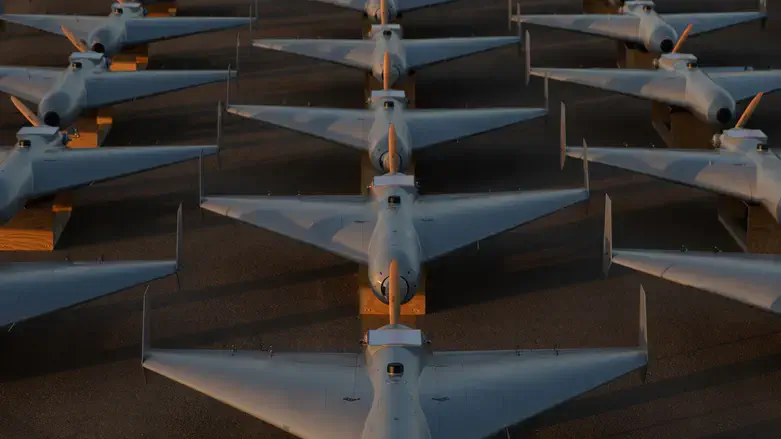
But no monopoly or duopoly in military technology lasts forever. Turkey, close to Israel until the 2010s, bought numerous Israeli drones and adapted them to its own needs. Now an adversary, it produces its own, notably the Bayraktar TB2, sold to thirty countries. Iran, Israel’s principal enemy, has gone further still, patiently developing a full range of drones at relatively low cost, including disposable “suicide drones" - which allowed it, on September 14, 2019, to test a swarm attack against the Saudi Aramco oil facilities at Abqaiq and Khurais, designed to overwhelm missile defenses.
The war in Ukraine has driven new forms of proliferation and, in doing so, accelerated the drone’s transformation into a strategic weapon. The Ukrainians acquired Turkish Bayraktars, copied them, and improved on them. Within three years, Kyiv had become one of the world’s leading drone producers. The Russians, caught flat-footed, bought Iranian Shaheds and then learned to manufacture them at home. Both sides now use their ever-improving drones for decisive missions of destruction, on the front lines and deep inside enemy territory alike.
In the current war, Israel is innovating once again, countering Iranian “swarms" with “smart swarms" of its own: rather than relying on sheer mass, these formations behave like genuine organisms guided by AI, capable of carrying out multiple, complex tasks simultaneously. A striking adaptation of insect behavior. Never have “drones" so fully lived up to their name.
(Israel is employing various responses to the explosive drones with which Hezbollah has begun using, attacks which caused several fatalities and injuries among IDF soldiers in Lebanon, ed.)
The ultimate question raised by drones is whether they herald an even wider military revolution - the global advent of unmanned, robotic systems, not only in the air but on land and at sea. 2026 may prove a pivotal year in this regard, with Ukraine's full-scale deployment of robotic ground combatants and China's unveiling of integrated fighting units that combine smart drones with dog-like combat robots.