
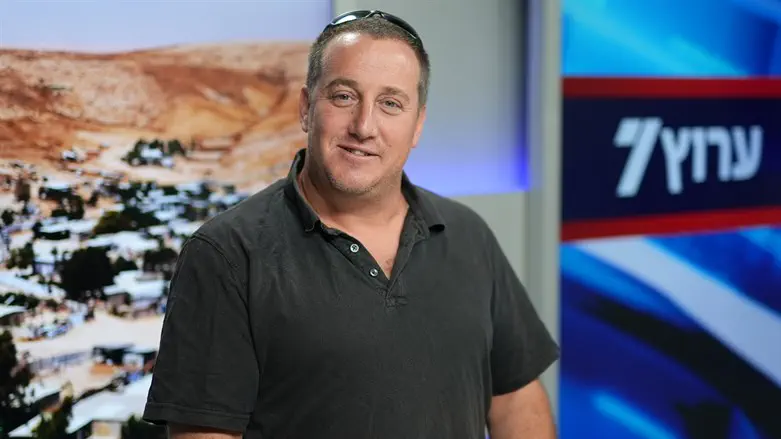
Among the movements, organizations, and individuals sanctioned by the European Union is Regavim. Arutz Sheva spoke with the organization’s CEO, Meir Deutsch, about the significance of the sanctions and his expectations from the Israeli government in light of the European move.
Asked about the meaning of the sanctions, Deutsch said that at this stage, nothing is really clear.
“We don’t really know. What we are learning comes from the Israeli and international media. They did not contact us before or after, even though the European Union knows Regavim’s lawyers as those who filed dozens of petitions against the European Union’s illegal activity in Judea and Samaria - construction of illegal buildings and schools, paving illegal roads, laying water infrastructure, operating anarchists in provocations, and more. So they know our lawyers, but they chose not to contact us."
Regarding comparisons to sanctions imposed by the Joe Biden administration on right-wing organizations, Deutsch noted that there is a significant difference, since the American sanctions obligate Israel’s banking system, whereas the European sanctions do not.
Deutsch stressed that the sanctions are not really intended to target Regavim or any specific individual, but rather to pressure the State of Israel into recognizing a Palestinian state. He said he hopes the Israeli government also understands that this is the European Union’s true objective behind the decision.
On a personal level, he estimated that he himself may no longer be able to travel to European capitals without facing some sort of detention order, although he emphasized that the implications are still not fully clear at this stage. He suggested it may be worthwhile to test the practical significance of the sanctions.
Deutsch also argued that the sanctions could ultimately backfire against the European Union itself, since the EU is using a draconian tool originally intended for combating terrorist organizations against a research institute that operates through public advocacy and legal channels. Such use, he said, could be interpreted internationally as an attempt to silence voices, which could damage perceptions of the European Union itself.
Asked whether he believes the State of Israel responded appropriately to the European move, Deutsch admitted he does not know whether the Foreign Ministry actually worked to block or reduce the measures. He expressed hope that efforts were made beyond the social media posts published by Foreign Minister Gideon Sa'ar.
“The question is what tools exist in the State of Israel’s toolbox, but I believe there are things that can be done. The European Union sends representatives here, and it would also be possible to deny them entry as long as they prevent Israelis from entering EU countries. I assume that tool exists."
Deutsch also referred to what he described as the European Union’s “subversive activity" aimed at creating facts on the ground to establish a Palestinian state in practice. At first, he said, the claim was that the activity was intended for humanitarian needs, but his organization exposed what he described as an organized effort to establish a Palestinian state through construction, agriculture, infrastructure, road paving, and additional measures, including activity in the media and public diplomacy arena.
“The purpose of all these efforts is one thing - the establishment of a Palestinian state," he said.
Deutsch welcomed what he described as Israel’s actions over the past two years to halt these efforts, saying the government had effectively “turned the hourglass over" and begun carrying out steps on the ground intended to prevent the establishment of such a state.
At the same time, he stressed that “everything is reversible," and that another government could decide to dismantle communities and promote the opposite policies.