

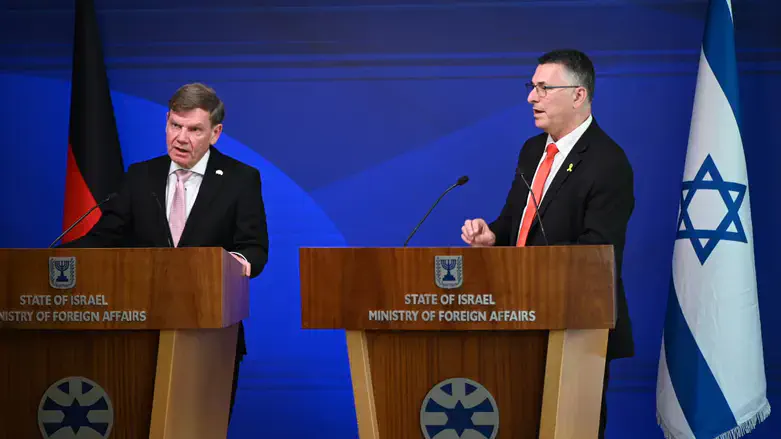
German Foreign Minister Johann Wadephul held a joint press conference in Berlin with his Israeli counterpart Gideon Sa’ar, emphasizing the deep strategic, historical, and security ties between Germany and Israel, while also addressing regional conflicts and shared security concerns.
Wadephul warmly welcomed Sa’ar to Germany, describing the relationship between the two countries as “strong and unique," built on friendship, cooperation, and shared values across fields including culture, academia, science, and security.
“We will never take this for granted," Wadephul said. “This connection exists in many areas - culture, academia, the scientific world, and security."
The German Foreign Minister stressed that Germany’s commitment to Israel’s security is central to the bilateral relationship. “We are standing up for the existence and security of Israel; it is part of the essence of our relationship," he stated, noting that Israel, founded as a safe haven for victims of the Shoah, now also contributes to Germany’s security.
He highlighted defense cooperation between the countries, including Germany’s procurement of Israeli defense systems. “The fact that an Israeli system protects German airspace fills me with humility," he said, referring to joint air defense cooperation.
Much of the discussion focused on regional security threats, particularly Iran. Wadephul reiterated that Iran must not be allowed to obtain nuclear weapons and called for an end to its ballistic missile program.
“We are ready to assume responsibility with others once the war has ended," he said, adding that Europe is prepared to contribute to post-conflict stabilization efforts, including mine clearance and maritime security operations.
He also condemned recent attacks on the United Arab Emirates, stressing the need to prevent renewed armed conflict in the region while ensuring that Iran does not threaten Israel, neighboring states, or Europe.
“We must avoid a return to armed conflict, while ensuring Iran does not pose a threat," Wadephul said. “Every day it becomes more urgent for Iran to accept a diplomatic deal."
On Lebanon, Wadephul acknowledged the impact of ongoing tensions on northern Israel and noted that Israel is engaged in sensitive discussions regarding security along its northern border. He said Lebanon must take responsibility for its territory and prevent armed groups from operating freely.
He expressed cautious optimism about recent Israel-Lebanon talks, describing them as the first in decades, and suggested that progress, while difficult, is possible.
Wadephul also addressed the situation in Gaza, saying conditions there have not improved. He said Germany remains engaged as an international partner and supports efforts to advance a proposed 20-point framework aimed at stabilizing the situation, including the disarmament of Hamas.
Regarding Judea and Samaria, he said recent events underscore the need for improved stability and governance for the Palestinian population. He also expressed concern over ongoing settlement construction in parts of the area and said Germany expects Israel’s judicial and political systems to address relevant issues in accordance with legal standards.
The ministers also discussed Holocaust remembrance and educational cooperation. Wadephul noted ongoing plans involving Yad Vashem to establish a memorial or educational initiative in Germany, calling it a meaningful but significant undertaking that reflects the depth of bilateral relations.
“This is not something we can take for granted," he said, adding that both sides are working to ensure the initiative succeeds.
Foreign Minister Gideon Sa’ar thanked his German counterpart for the invitation and emphasized the strength of Israel-Germany relations.
“It is good to be back in Berlin," Sa’ar said, noting that frequent meetings reflect deep cooperation “in security, the economy, and the fight against terrorism."
He pointed to Israeli defense systems deployed in Germany, including the Arrow air defense system and other technologies, as examples of Israel’s contribution to German security.
Sa’ar also warned about the “dangerous nature" of the Iranian regime and supported international efforts to prevent Iran from obtaining nuclear weapons.
Addressing Hezbollah and Lebanon, Sa’ar said the group had dragged Israel into conflict and stressed that Israel seeks to remove threats along its northern border. He said Israel withdrew fully from Gaza in 2005 and continues to face security challenges from Hamas.
He also criticized what he described as international double standards toward Israel and warned of rising antisemitism globally, including in Europe, Australia, and Canada.
“The new antisemitism denies Israel’s right to defend itself," Sa’ar said. “We are seeing this dangerous phenomenon again in attacks on Jewish communities and synagogues."
He concluded by thanking Germany for its friendship and inviting continued cooperation. “You are invited to Jerusalem," Sa’ar said.