
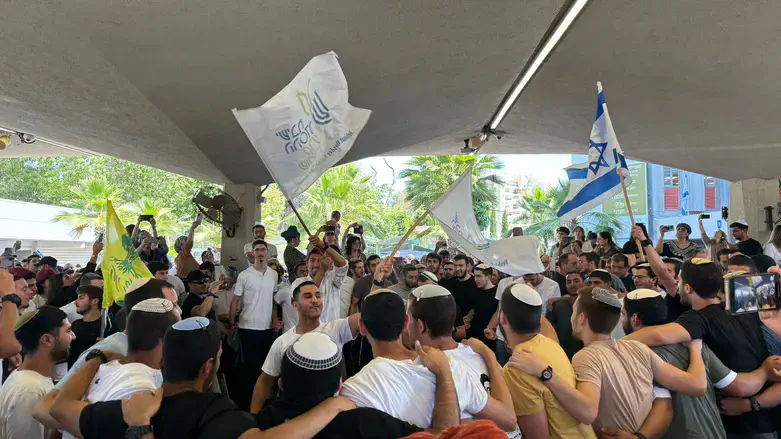
Hesder yeshiva students designated for non-combat roles in the IDF have appealed to the rabbis of the Hesder Yeshiva Union, requesting intervention and assistance in dealing with the military authorities.
In a detailed letter sent to the rabbis, the students outlined difficulties related to maintaining a Torah-observant lifestyle, as well as a sense of lack of purpose in their military service. The writers emphasized that their appeal is made “out of deep respect and a sense of responsibility both to the world of Torah and to our service in the Israel Defense Forces."
The students noted that while combat tracks maintain a clear group framework, rear-echelon roles are carried out in environments not suited to a fully observant religious lifestyle.
“Unlike the combat tracks, in ‘jobnik’ (non-combat) roles the service often takes place in an environment that is not adapted to a fully Torah-observant lifestyle," the letter states. According to them, this situation creates significant halachic and spiritual challenges for students seeking to remain faithful to their religious path.
Another key issue raised was the dispersal of soldiers across different bases and the lack of group enlistment characteristic of field units. The students explained that serving individually makes it harder to preserve the spiritual framework built during their years in yeshiva. They argued that serving alongside peers who share similar values is critical for maintaining religious identity and connection to Torah life.
Beyond the spiritual challenges, the students also pointed to a sense of underutilization in the roles to which they are assigned, due to the shortened length of service. “There is at times a feeling of lack of significance in the roles assigned to soldiers in this track," they wrote. They added that many positions do not require substantial professional training and are sometimes not suited to their personal abilities.
As a possible solution, the students proposed establishing tailored frameworks that include short professional courses, enabling preparation for more meaningful roles.
They noted that models already exist within the IDF that combine professional training with a Torah-observant lifestyle, which could be applied in their case as well. The students emphasized that Hesder soldiers do not require academic bridging programs, a factor that could ease their integration.
In conclusion, the students asked the rabbis to raise these issues with the relevant IDF authorities in order to enable more meaningful contribution to the system. “We request the intervention and assistance of the esteemed rabbis in bringing these issues before the relevant authorities in the IDF."
They stressed the need to explore options that would allow “better preservation of their Torah lifestyle alongside meaningful contribution to the military system."
“We believe that with the guidance and assistance of the esteemed rabbis, it will be possible to advance steps that benefit both the soldiers and the system as a whole." The letter concluded with a request for the rabbis’ attention and support on what they defined as an important issue.