

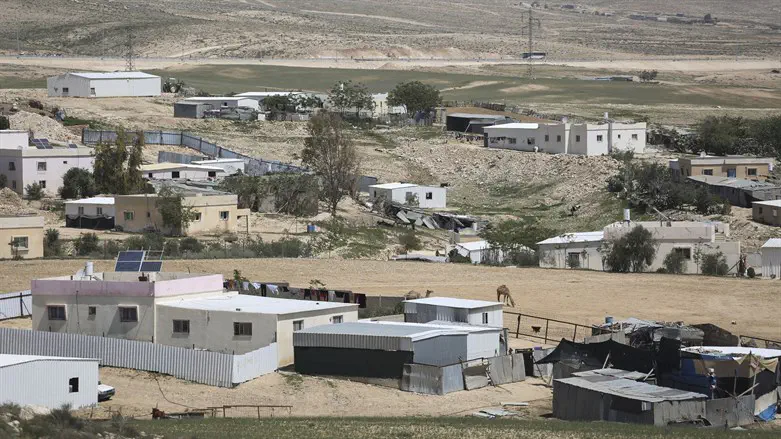
Israel Land Authority has unveiled sweeping changes to the framework for resolving Bedouin land ownership claims in the Negev.
Following the Negev reform led by Minister Amichai Chikli, the Israel Land Authority (ILA) published a detailed plan to amend the legal framework for regulation of Bedouin settlement in the Negev, with a particular focus on so-called "ownership claims."
The plan will be launched as a pilot in five localities - Kseife, Mar’it, Sa’wa, Abu Talul, and Lakiya - and incorporates a series of planning principles reflecting a comprehensive, professional reassessment of past policy failures.
Among other measures, the plan clarifies eligibility criteria for compensation and establishes firm timelines: claimants must sign an agreement within ten months of the plan’s publication, fully evacuate the claimed land, relocate to an allocated plot, (provided, gratis, by the government) and demonstrate effective use of the land for its designated purposes.
Compliance with these deadlines will entitle participants to grants worth tens of thousands of shekels, while failure to meet the requirements or lack of cooperation may result in the loss of eligibility for compensation and benefits.
The plan also addresses complex issues such as polygamy and cases in which not all heirs to an ownership claim agree to adopt the government’s terms of settlement. It includes substantial incentives for members of the armed forces and establishes a dedicated exceptions committee authorized to review individual cases and grant extensions where warranted. At the same time, access to the courts remains fully open: Any Bedouin claimant who declines to enter into a settlement may pursue legal ownership claims through judicial proceedings.
The initiative focuses on lands within the "blue line" municipal boundaries of recognized Bedouin towns, aiming to address the current reality of vast undeveloped tracts within municipal areas which, when freed of "ownership claims," will enable the construction of thousands of housing units for the Bedouin population.
It should be noted that approximately 3,200 ownership claims were filed in the early 1970s, covering hundreds of thousands of dunams in the Negev. To date, none of these claims has been upheld in court; in all instances, the land has been registered to the State. In practice, however, these claims have become a central obstacle to the State’s ability to develop the Negev and regulate illegal constructtion and the sprawl fo squatters camps. Ownership claims have also fueled ongoing disputes and have provided fertile ground for narratives of Bedouin dispossession, despite the fact that the State has, over the years, provided substantial compensation in both land and monetary terms - even when the ownership claims themselves have been unfounded. Despite the State’s best efforts, the existing framework has proven ineffective.
Minister Amichai Chikli remarked, "In many Bedouin communities in the Negev, the majority of municipal land remains tied up in ownership claims and therefore lies vacant and undeveloped. To address this, the Israel Land Council today approved the ‘Blue Line Reform’ for resolving ownership claims within municipal boundaries."
"The framework offers generous compromise arrangements for claimants within the blue line, with enhanced benefits for early participants and a gradual reduction in eligibility over time. In parallel, where agreements cannot be reached, the state will act to revise municipal boundaries and re-zone in accordance with planning needs. This reform addresses the core structural challenge in the Negev. Resolving ownership claims is essential for development, infrastructure, and the creation of a regulated, planned, and sustainable living environment."
The Regavim Movement welcomed the decision, adding, "The ILA’s resolution adopts professional principles we have long identified as strategically vital, and reflects a much-needed paradigm shift. It addresses critical issues that have created chaos and inequity in the compensation system-such as encouraging the practice of polygamy and the transfer of compensation rights across generations-and, most importantly, establishes a clear timetable for the regulation process, with built-in incentives for prompt cooperation."
"We commend the Israel Land Council for approving the decision, and Minister Chikli and the Bedouin Settlement Authority for advancing it in a professional manner. We look forward to its implementation both in the pilot communities and across the Negev as a whole."