

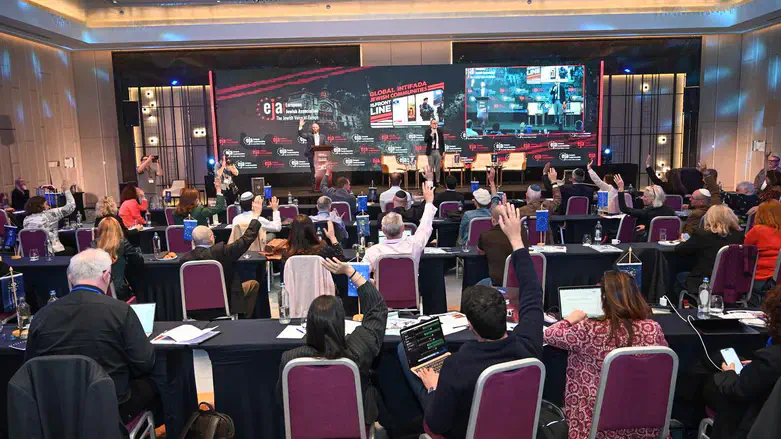
More than 100 Jewish leaders from across Europe on Thursday voted to give the European Jewish Association (EJA) a mandate to negotiate a special protected minority status for European Jewry on their behalf with national governments and the EU.
The mandate was granted following a plenary session vote at the EJA’s Annual Conference in Brussels, and after two days of high-level discussions, working groups, and plenary debate.
The vote reflects real concern that Jewish life in Europe is in a period of profound existential insecurity.
The conference, held under the theme, "Global Intifada: Jewish Communities on the Frontlines," brought together senior policymakers, diplomats, and community representatives.
The EJA’s mandate, as granted by Jewish Leaders, will establish an actionable framework of what constitutes a permanent Special Protected Minority Status, from legal provisions, safeguarding freedom of religion, and establishing practical mechanisms for security and protection.
This status will be ringfenced: Jewish life and practice will no longer be dependent on the goodwill of whichever government is in power at any given period.
Special Protected Minority Status for European Jewry is built on three central pillars supported by international legal experts, and based on the constitutional architecture that already exists in Europe:
Recognition of Jews as a National Minority
Jews should be formally recognized as a National Minority, either explicitly listed or protected under general law as an ethnic or racial group as well as a religious one. This recognizes that Jews are more than just a minority within a country, but that they have longstanding ties and their own distinct culture and identity that needs to continue to be preserved.
Jews have lived in Europe for more than 2000 years. Many countries have had Jews living in their lands for centuries. Many countries where Jews were persecuted, expelled or fled have recognized their longstanding ties to the communities by offering Jewish descendants opportunities to secure citizenship, and by preserving Jewish cultural sites and institutions. Jews are more than a religious group. They are an ethnic or racial one. This allows for Jews to have their right to freedom of religion protected and also to preserve their distinct identity and culture.
Protection of Rights Essential to Jewish Life
Jews' ability to participate in public life will be protected, including by meaningfully tackling antisemitism in criminal and civil law. This includes having specific criminal and civil laws on antisemitism, including definitions, penalties for incitement, dissemination of antisemitic symbols, and on the establishment of antisemitic organizations.
In addition, there will also be protection of religious practices that are essential to Jewish identity, including circumcision, kosher slaughter, marriage, and burial rites. While these are sometimes protected under religious freedom, there is a need to ptotect them as expressions of cultural and national identity, particularly in light of ever increasing legal challenges across Europe.
Education and cultural continuity will be recognized as central pillars of Jewish identity, enabling the transmission of history, tradition, and culture. This includes not only formal education, but also the preservation of and access to Jewish cultural heritage sites.
Practical Mechanisms for Protection and Promotion
States should establish structured dialogue with Jewish communities and formally recognize representative bodies. Collaboration between public authorities and Jewish communities across policing, education, and public services, is essential to build trust and ensure effective protection. Funding must be flexible and responsive, particularly in areas such as security, education, and cultural preservation.
States are also encouraged to implement recommendations from bodies such as the European Commission against Racism and Intolerance (ECRI), ensuring that protections are not only declared but enforced.
EJA Chairman Rabbi Menachem Margolin said: "For too long we have been raising the alarm, engaging governments, and working with European institutions to confront antisemitism. But the simple truth on the ground is that in spite of a plethora of statements, definitions and strategies, the situation affecting Jews keeps deteriorating further."
"Today, Jewish leaders from across Europe gave us a clear mandate and sent a loud message across the continent: The existing government tools are not enough. When it becomes normal that Jews are attacked in the streets, that students are forced to hide their identity, and that Jewish communities are forced to live behind security barriers, it demands an urgent new set of rules, an urgent new standard. Granting Jews with a special protected minority status will do two things: One, it ensures that Jewish life in Europe is not only defended, but can continue openly and with confidence. Two, its settles the issue once and for all, protecting Jewish communities from political whims , and ensuring that their rights are ringfenced within a protected framework."
Over two days of intensive discussions in Brussels, the conference brought into sharp focus the depth of the crisis facing Jewish communities across Europe and the urgent need for coordinated action. European Parliament President Roberta Metsola warned that "synagogues attacked, schools targeted and Jewish families afraid to walk the streets" are not isolated incidents but "an assault on everything Europe stands for," stressing that antisemitism is "a poison that must be rooted out."
US Ambassador to Belgium Bill White echoed the sense of urgency, recalling the message he heard repeatedly from the Jewish community: "We don’t feel safe anymore," and reaffirmed that the United States stands "unequivocally" with Jewish communities and their right to live openly and practice their traditions.
US Special Envoy Rabbi Yehuda Kaploun emphasized the need for clear policy and coordination, warning that despite growing resources, antisemitism continues to rise in the absence of a unified and effective strategy.
The broader geopolitical dimension was also a central theme. Israel’s Ambassador to the EU and NATO, Avi Nir-Feldklein, underscored that, "Europe is a key partner for Israel, and we should not allow the current situation to stand between us," calling for closer cooperation and a renewed focus on shared interests. Against this backdrop, participants repeatedly stressed that the current trajectory is unsustainable.