
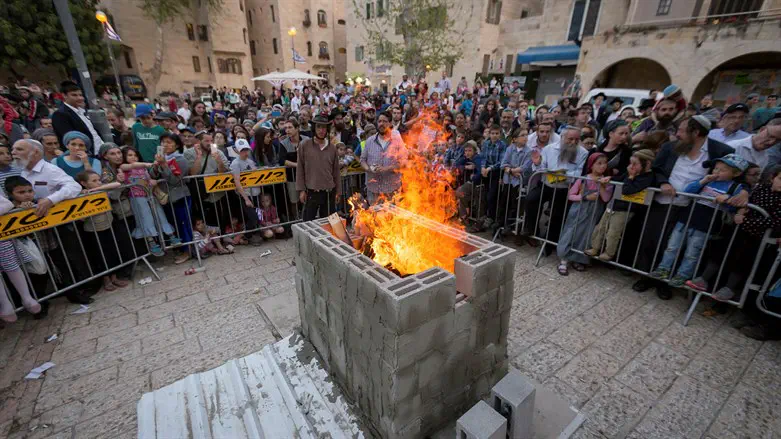
Among the many detailed instructions in Vayikra and Tzav, one command stands out for its simplicity and insistence: “A perpetual fire shall be kept burning on the altar; it shall not go out."
At the level of peshat, the literal level, this is a technical requirement governing the service of the Beit HaMikdash. Yet it also points toward a broader assumption: spiritual life is not episodic, but continuous.
Whatever the altar represents, its fire must be sustained. Classical sources already move in this direction. “Ner Hashem nishmat adam"-the human soul is described as a divine flame.
If so, the altar and its fire offer not only a model of ritual practice, but also a framework for thinking about the inner life. From this perspective, the offerings, korbanot, can be read as a structured language of transformation-one that distinguishes not only between different offerings, but between different modes of inner work.
Some ideas in life are like an olah, the offering that is entirely consumed by the fire. They require total commitment. You do not negotiate with them-you build your life around them. These are the principles that are not weighed against alternatives, but accepted in their entirety.
Other things are like a mincha, the modest offering of meal, small, refined, almost quiet- habits, disciplines, subtle acts of growth. They do not transform a person overnight, but over time they shape character with remarkable precision.
Then there are experiences like shelamim, the peace offering: they are meant to be shared- friendship, conversation, learning with others. Some forms of growth do not occur in isolation. They emerge only within relationships that allow something to be both given and received.
And sometimes, one requires a chatat, atonement offering: not inspiration, but correction. Not a sweeping vision, but a precise adjustment- a habit, a word, a pattern that must be realigned.
The Torah does not assume that error is corrected through general sentiment. It requires specificity. But there are moments that go beyond misalignment. There are situations that call for an asham, guilt offering: not only correction, but accountability. A breach has occurred-of trust, of responsibility, of integrity. Here, it is not enough to “improve." Something must be restored. What was damaged must be acknowledged and, where possible, repaired.
Insight alone does not heal this level of rupture. And there are moments of unexpected good, which call for something entirely different. These are the moments of todah, the thanksgiving offering: when one has been carried through danger, or granted success, or simply received more than one could have expected.
The Torah’s response is striking: gratitude must not remain private or abstract. It must be expressed, shared, even amplified-before it fades. Taken together, these categories suggest that the Torah is concerned not only with what is offered, but with how it is offered.
Different forms of nourishment-intellectual, moral, experiential-require different modes of engagement. This stands in quiet contrast to a modern assumption: that rationality consists in applying the same method across all domains of life.
The structure of the korbanot suggests otherwise. A well-ordered life depends not on uniformity, but on discernment-the ability to recognize when something calls for total surrender, when for refinement, when for sharing, when for correction, when for repair, and when for gratitude.
The command of the esh tamid adds a further layer. Even the most refined distinctions remain ineffective without continuity. Intensity cannot replace constancy.
A fire that is not sustained does not remain latent-it disappears. If one accepts this analogy, the question that emerges is not merely what one believes, but what one consistently places upon the inner altar.
The Beit HaMikdash was a site where the physical was transformed into the spiritual through a disciplined process.
In its absence, that process has not disappeared-it has become less visible, and perhaps more demanding. It now takes place within the individual.
And this leaves us with a set of simple but exacting questions:
What, in our lives, is being treated as an olah?
What is being refined like a mincha? What is being shared as shelamim? What is being corrected with the precision of a chatat?
What requires the responsibility of an asham?
And what deserves to be expressed as a todah before the moment passes?
The fire, in that sense, still burns-or fails to burn-according to what we choose to place upon it.
Rafael Castro is an independent political analyst and a graduate of Yale and Hebrew University. An Italian Noahide by choice, Rafael can be reached at rafaelcastro78@gmail.com