
Douglas Altabef writes:
In 2009 my wife and I, together with our youngest, made Aliyah to the Upper Galilee (Galil in Hebrew), moving into a small, historic and picturesque village. Soon after we moved in, we made plans to expand our little house, and were required to add a "mamad" (safe room) into our architectural plans.
At the time we chalked this up to belt and suspenders safety concerns; today, we are most thankful to have it.
When commentators extol the resilience of the Israeli public during this current war, as well as the one in June ’25, and of course the war that unfolded post October 7, 2023, they are not exaggerating.
The stoicism, the insistence on living as normally as possible in a somewhat surreal environment is very real and tangible.
This is certainly true in the Galilee where most recently there has been a plethora of missile and drone attacks. The missiles come primarily from Iran and the drones from Lebanon. Why this is happening now, I will return to momentarily.
Suffice it to say, the situation today in the North - the Western, Central and Upper Galilee - is diametrically different from what it was post October 7th. At that time there was a massive evacuation of residents from border area communities.
Our little village was not evacuated. Quite the opposite. We hosted hundreds of evacuees from further north in guest houses and hotels. It was a profoundly disorienting time for tens of thousands of Israelis but, given the lack of preparation and the vulnerability to a potential land invasion by Hezbollah (which thankfully never materialized), there was justification for the evacuation.
What a difference two plus years have made!
In this war, there has been no consideration of any evacuation of northern border communities, nor should there be. Thanks to the heroic efforts of the IDF, southern Lebanon has been evacuated. Even after the ceasefire reached months ago with Hezbollah, the IDF has continued to root out munition storage areas in southern Lebanon systematically, besides attacking Hezbollah-controlled parts of Beirut such as the Dahiye suburb, on an ongoing basis.
None of this means that Hezbollah, while greatly diminished, is out of business. Sadly, they are still sitting on thousands of missiles and reportedly can call on close to 100,000 terrorist operatives.
Having absorbed for months, including the first few days of the current conflagration, the blows inflicted by the IDF with no reprisal nor retaliation, Hezbollah began launching rockets into northern Israel several days into the war. Perhaps that was part of its agreement with Iran.
At the time, this was seen to be a major strategic mistake, one that would provide the legitimacy and the rationale for immense Israeli retaliation. That assessment will hopefully be borne out. However, the question remains what the strategy of Hezbollah is now.
Hezbollah leaders did say at one point that while they were predisposed to sit out a conflict between Israel and Iran, they would get involved if Israel sought to overthrow the regime, including by killing Supreme Leader Khameini.
That, of course, happened, and Hezbollah might have therefore felt impelled to join the fray. Their decision might have also been impelled by an assessment that the Islamist Iranian regime, even post-Khamenei, could and would survive whatever attacks the US and Israel inflicted upon them. In that case, not actively supporting Iran could endanger continuing Iranian patronage, a lifeline worth billions. Right now, their arms supply routes - sea, air and land - are all but shut off.
What is particularly intriguing is why Iran in the past few days is directing a seemingly disproportionate share of their missile fire to the north. Of course, to the Iranians, all Israelis are fair game, so maybe they don’t care where they are attacking.
Somehow, however, I do not think this is the real calculation. Such a focus might, in their view, dilute the Israeli effort towards them in Iran.
This is not exactly coming to the rescue of Hezbollah, since the temptation would be for the IDF to redouble their efforts in order to protect endangered northern communities, and to punish Hezbollah for their decision to get involved.
Iran’s northern focus would only be clearly sensible if it thought such attacks would pave the way for a belated land invasion by Hezbollah, or could take pressure off Hezbollah by forcing Israel to remove border community residents.
Neither of these possibilities, however, seems at all likely. Hezbollah has been pushed further north, and if anything, an Israeli security cushion area, potentially extending as far north as the Litani River, is increasingly likely.
Furthermore, there has been no speculation nor any reports that another evacuation is being considered. To the contrary, northern communities are working their hardest to simulate normalcy. Minutes after a siren and a rush to shelters, people start drifting back outside, and yes, returning to cafes.
This is not to say that things in the north are normal. They are not. Last night we had three sirens in the middle of the night. That doesn’t do wonders for one’s placidity.
But to the great credit of the Israeli people, all throughout the country, we have seen resilience, resolve and a determination to accomplish the mission of removing genocidal threats from our borders and in our region.
People in the north are playing their part and standing strong and determined. Am Yisrael chai!
Douglas Altabef is the Chairman of the Board of Im Tirtzu and a Director of the Israel Independence Fund. Besides being a stoic resident of the north, he is a frequent op-ed writer for Arutz Sheva.
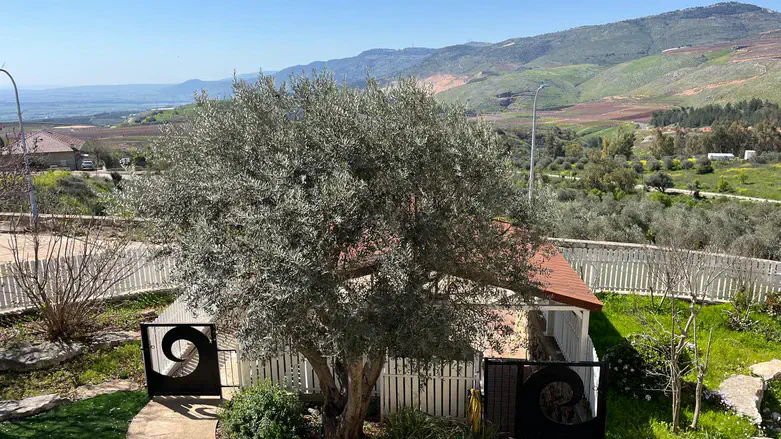
Note on photos from Metula, Northern Galilee, sent to Arutz Sheva this morning by Dr. Richard Small: Dr. Richard D. Small makes his home in Metula, overlooking Lebanon and plans to stay there. He has a PhD from Rutgers U. in Aerospace Engineering, taught at the Technion and UCLA before joining a California Think Tank as Director for Thermal Sciences. He was founder and President of Eastwind Research Corporation and as an expert on nuclear winter, was featured on 60 Minutes, as well as other media. His first novel, Elisheva's Diary, was published in the USA and reviewed on Arutz Sheva. The lead photo and those below were taken from his garden today, in between his bouts in the mamad.