

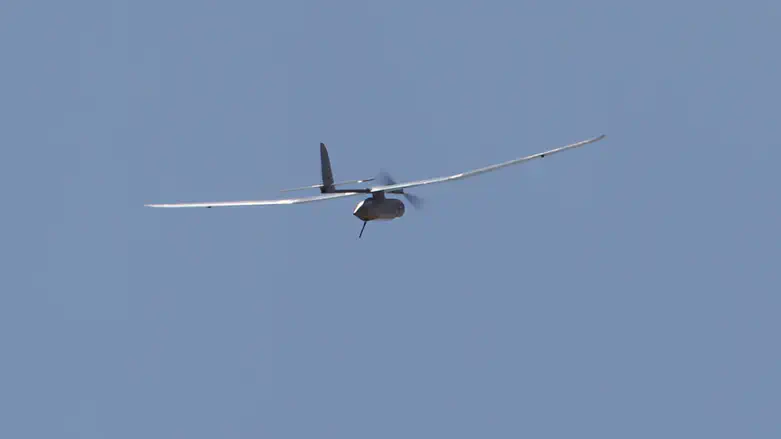
Against the backdrop of ongoing UAV and missile attacks during the war, aerospace engineer Israel Ofek, head of the Mechatronics and UAVs department at Ariel University, explains how Iran succeeded in building a large network of unmanned aerial vehicles.
According to Ofek, Iran spent years developing its drone capabilities largely by imitating Western technologies. “The Iranians prepared for a long time and developed systems by copying Western or Korean systems," he said. As an example, he noted that the Shahed 136 resembles the Israeli IAI Harpy, and that Iran also replicated other American drone technologies.
Ofek said some of the technical knowledge came from captured drones and intelligence gathering. “Some were seized drones, and some knowledge was obtained through intelligence and other sources," he explained. “Using this information, they built a network of drones, cruise missiles and ballistic missiles for the day they would be needed."
Despite the scale of the program, Ofek stressed that many of the systems are not particularly complex from an engineering standpoint. “They copied the aerodynamic design, and for flight control they used relatively simple Chinese systems," he said.
The primary advantage of Iran’s drones, he added, is their low cost. The Shahed 136 costs roughly $20,000 per unit, far cheaper than many advanced interception systems such as Iron Dome interceptors or missiles used by David's Sling. “Many of the parts are standard components originally designed for manned aircraft, and debris from intercepted drones often shows Chinese-made parts," he noted.
Asked about Iran’s engineering capabilities, Ofek said they should not be underestimated. While some drone systems are relatively simple, more advanced missile programs require higher-level engineering. He said Iran received substantial assistance from countries such as North Korea and Russia in these areas.
At the same time, Ofek said Israel continues to develop advanced defensive and offensive technologies. Programs are being led by Directorate of Defense Research and Development, under the leadership of Danny Gold, focusing on new strike capabilities, air defense systems, cyber technologies and electronic warfare.
Looking ahead, Ofek believes military aviation will undergo a major transformation. Future air combat systems are expected to include unmanned fighter aircraft that operate alongside piloted jets, sharing intelligence and functioning as coordinated swarms capable of autonomous attacks.
He also highlighted developments in laser-based air defense, including the Iron Beam system. According to Ofek, the laser system can intercept drones at extremely low cost of around two dollars per shot, although it requires significant power infrastructure on the ground. Weather conditions can also affect the laser beam’s accuracy, though engineers are working on solutions, including potentially mounting the system on aircraft.
In discussing future regional threats, Ofek said attention could eventually shift beyond Iran to Turkey, which in recent years has developed a rapidly advancing aerospace and UAV industry. He noted that some of its technological development grew out of earlier cooperation with Western aviation and defense industries.
Ofek added that demand for Israeli defense technologies is currently extremely high. Defense companies are receiving large numbers of orders and international requests, which he said was one of the motivations behind launching Ariel University’s UAV engineering program.
“The demand is very large," he said. “This field will only continue to grow."